The majority of those interested in the main streets of Ramallah pointed the finger at Israel over Arafat's death.
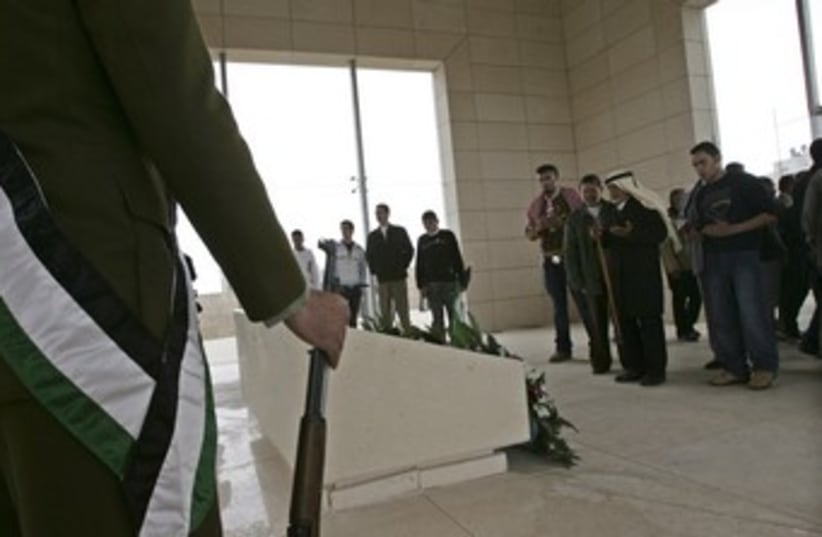
By NIDA TUMAYasser Arafat's tomb at the Muqata in Ramallah 370 (R)(photo credit: Mohamad Torokman / Reuters)
RAMALLAH – Palestinians expressed a wide spectrum of opinions about Al Jazeera’s latest investigative report suggesting late Palestinian leader Yasser Arafat may have been killed by the radioactive element polonium- 210.There has been no accepted explanation for his death in a French military hospital eight years ago, although Palestinians have not excluded a conspiracy.They believe that poison killed Arafat but lack the required evidence.Most of those The Jerusalem Post interviewed in the main streets of Ramallah on Thursday pointed their finger at Israel, basing their accusations on the fact that Israel considered Arafat a main obstacle to peace in the Middle East.Palestinians interviewed also thought then-prime minister Ariel Sharon gave the order to kill Arafat after the collapse of the Camp David negotiations in the summer of 2000, which he blamed on the Palestinian leader.“It’s [exhuming Arafat’s body] accepted, politically, religiously and socially, and I think it’s our right to know who did it,” said public employee Samia Theeb, 35.The engineer believes leading Palestinian figures who were close to Arafat while he was besieged in his Ramallah compound poisoned him. “I think Israel killed him through them,” she said.Um Tha’er Ramadan, 38, said the truth had to be revealed and people needed to know who killed their leader. “He sacrificed on behalf of us, and so we shouldn’t abandon him now.You can say that we owe it to him,” she said.Ramadan said that if it were her father or brother, she would have asked to exhume his body.“He is a public figure and so we all have the right to the truth,” she said.Riad, in his 30s, suspects that the French authorities are hiding something, asking: “Why did they [French hospital officials] discard Arafat’s urine and blood samples early?” “Is Al Jazeera a detective drama channel to do all these investigations? It would be better if they leave us alone,” said 23-year-old Hasan Daraghmeh.His view was widely shared among Palestinians who support the Palestinian Authority and think that Al Jazeera is against it.The news channel has become a source of contention among Palestinians. Many people became suspicious of its agenda after the channel released confidential papers in January 2011 from meetings and communications between Palestinian, Israeli and US leaders and negotiators.The PA said the papers were distorted; many people said the PA was compromising Palestinian rights.Daraghmeh, an X-ray technician who is affiliated with Fatah, said the timing of the report was suspicious. “We saw the recent protests, and the [PA] security campaign [against Hamas] in Jenin; the current situation can’t handle much more pressure,” he added.Daraghmeh had no doubt that Israel killed Arafat, saying that “he was bad for them, and he refused to let go of the right of return.”Hadeel, a 40-year-old public employee, said it was too late to exhume the body. “It might be decomposed by now, why do we need to know this now?” she asked, adding that she did not think many people cared about this subject.Hassan Ras, from Jerusalem, said Palestinian people needed to know the truth, but that they now worried about other things.“We have the occupation and the salaries to focus on. We care about such information and follow it, but I think that our daily concerns are more important,” Ras said, as he held a teddy bear and stood by his wife and two young daughters in Ramallah.He said such an investigation should have taken place when Arafat died in 2004.Not many of those interviewed by the Post expressed concerns about public anger or uprising if the investigation goes further.“There will be no more drama, enough, we’re fed up,” Umm Ahmed, a vendor in the city’s vegetable market, said.Observers believe that the PA will see the case through until an international investigation unveils the mystery behind Arafat’s death.The public’s nonchalant reaction to this case might be because of the state of economic hardship in the West Bank, or because the investigation has been eight years in the making, they said. However, reopening this file might push further away any peace talks between Israel and the Palestinians, which have been stalled since October 2010.
if(catID != 151){
var cont = `Take Israel home with the new Jerusalem Post Store