'Recent ME events a harsh reminder of our reality'
Netanyahu: In this region the only thing ensuring Israel's survival, security and prosperity is our strength.
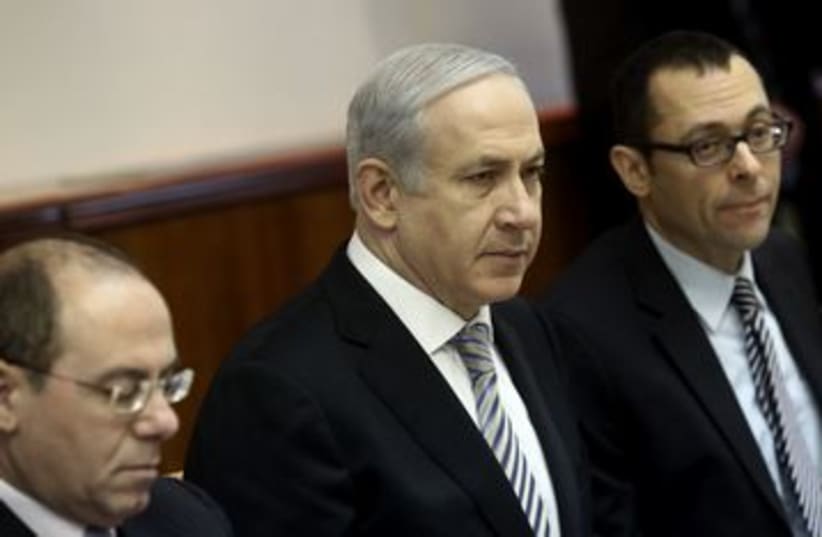
By HERB KEINONPrime Minister Binyamin Netanyahu in cabinet meeting 390(photo credit: Kobi Gideon/Flash90/Pool)
The recent bloodbath in Syria is a harsh reminder of the ruthless region Israel finds itself in, Prime Minister Binyamin Netanyahu said at the opening of Sunday’s cabinet meeting.“In the last few days we have received a reminder of the kind of neighborhood we live in,” Netanyahu said. “We heard the comments by Iran’s ruler about destroying Israel, we saw the Syrian army massacre its own people, and we saw other similar bloody incidents in our region,” an apparent reference to last week’s death of 75 people at an Egyptian soccer match.He said various regional leaders had no moral compunctions about killing their own people, or their neighbors.“In this region the only thing ensuring [Israel’s] survival, security and prosperity is our strength,” Netanyahu said. “We are obligated to continue to develop Israel’s military, economic and social strength. That is also the only guarantor of peace, and Israel’s only defense if that peace unravels.”At the Likud ministers meeting before the cabinet meeting, Netanyahu said Israel had no intention of intervening in any manner in the events taking place inside Syria, even though it was not “apathetic to the massacre” taking place there. Netanyahu put the number of people killed in the nearly year-long uprising there at close to 10,000, nearly double the number generally reported in the media.Before the cabinet meeting, a number of ministers commented on the events in Syria – and the failure of the UN Security Council to pass a resolution Saturday condemning the violence – even though as a government Israel was formally not issuing any statements on the developments.Finance Minister Yuval Steinitz termed Russia and China’s veto Saturday of the Security Council condemnation a “disappointment.”Characterizing what was happening in Syria as a massacre being perpetrated by a “brutal tyrant” with the help of Iran and Hezbollah, Steinitz said the very least the international community could do at this time was to impose “the harshest sanctions” on Syria and call on Assad to step down and “free his people from this murderous tyranny.”Vice Premier and Regional Development Minister Silvan Shalom, a former foreign minister, said it was unfortunate that China and Russia vetoed a resolution that, in any event, he said was “softer than necessary.”“Everyone should express deep shock at what is going on in Syria,” he said. “The massacre there is cruel and incomprehensible. There is no doubt that it needs to be stopped, and that the international community is at a critical decision- making hour: whether it has the ability to stop this type of murder.”Click for full JPost coverageVice Premier and Strategic Affairs Minister Moshe Ya’alon, in an Army Radio interview, rejected the idea Israel somehow supported the continuation of Assad’s regime, saying his fall could cause a “serious break” in the Tehran-Damascus-Beirut- Hamas “axis of evil.” There have been those arguing that Israel supported Assad largely because of the dictum that “the devil you know is better than the one you don’t,” and Israel had no idea about who or what would replace Assad.But Ya’alon said there was a big difference between Syria and Egypt, where the fall of Hosni Mubarak led to the significant rise of Islamist groups such as the Muslim Brotherhood and Salafists. Saying that the Muslim Brotherhood was much weaker in Syria than in Egypt, Ya’alon added that he thought a moderate Sunni government of middle-class intellectuals and generals could eventually take control of the country.Ya’alon refused to comment on whether or not the government was in contact with members of the Syrian opposition, saying that announcing such contacts would hurt the opposition by painting it as “backed by Zionists.”
if(catID != 151){
var cont = `Take Israel home with the new Jerusalem Post Store