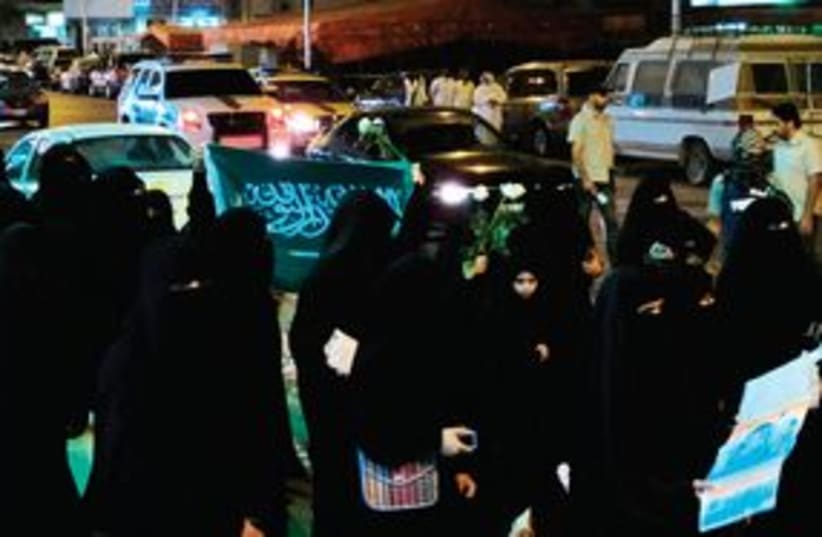
By DAVID ROSENBERG / THE MEDIA LINEProtest in Saudi Arabia 311 (R)(photo credit: Reuters)
Rioting in Saudi Arabia’s strategic Eastern Province that left 14 injured this week should serve as a warning that the monetary benefits the kingdom has showered on its citizens may be insufficient to ensure political quiet from its restive Shi'ite minority, analysts said.The riots erupted late on Monday in Al-Wamiyah city in the eastern governorate of Qatif, the Saudi Interior Ministry said in a statement issued hours after the incident ended. It blamed an unnamed “foreign country,” a code word for Iran, for the unrest and vowed to take a tough line on protesters.RELATED:Thar’s oil in them thar Israeli rocks Tussling over a textbook in Saudi Arabia In videos of what are said to be scenes of the rioting broadcast on Al Jazeera television, sounds of gunfire and shouts of “God is Great” can be heard amid pictures of burning tires and wounds from beatings. Human Rights First Society head Ibrahim Al-Mughaiteeb was quoted as saying it was the first time that protesters used firearms rather than stones and Molotov cocktails.Saudi Arabia’s population is as much as15% Shi'ite, concentrated in the eastern part of the country that is home to the country’s vast petroleum reserves. Living in a predominately Sunni society that is guided by the strict practices of Wahabi Islam, they face religious discrimination as well as inferior access to jobs and economic benefits.“The king has tried on several fronts to address these grievances, to redirect them away from a purely sectarian dimension,” Christian Koch, director of research at the Gulf Studies Center, told The Media Line. “But there is some resistance in more conservative sectors of the kingdom, which prevents quick progress from being made.”Unrest in Saudi Arabia would reverberate across the globe. The kingdom holds the world’s largest oil reserves, accounting for 11.6% of the global output and often steps in to fill shortfalls when other supplies elsewhere are disrupted, such as in Libya this year. The kingdom is a key US ally as a bulwark against Iran.Saudi Shi'ites face discrimination in the educational system, where religious instruction comprises a major part of the curriculum. Human Rights Watch said in a 2009 report that Shi'ite religious teachings are banned from the classroom and Sunni teachers relate to their Shi'ite students as unbelievers. Sunni judges sometimes disqualify Shi'ite witnesses on the basis of their religion and exclusively follow tenets of Sunni religious law.Saudi Arabia counts no Shi'ite government ministers, senior diplomats, or high-ranking military officers. Shi'ite students generally cannot gain admission to military academies, Human Rights Watch said.Tensions between the ruling Sunni minority and the majority Shi'ites in neighboring Bahrain exploded into violence last February. The unrest unnerved the Saudis enough that they took the unusual step of sending in security personnel to help Bahrain’s Sunni king, Hamad-Bin-Isa-Al-Khalifa, to quell it.In Saudi Arabia, Shi'ite unrest has never come close to endangering regime, but their restlessness remains a perpetual thorn in the side of the kingdom. Shi'ite pilgrims clashed with religious police in the holy city of Medina in February 2009. Last spring, the Saudi intervention in Bahrain spurred repeated protests among Shiites in support of their co-religionists.The Saudi government has responded to the threat of unrest with carrots and sticks.Last February and March, as protesters were bringing down regimes in Egypt and Tunisia, King Ablullah bin Abdul-Aziz Al Saud announced he would spend some $130 billion on social benefits, new jobs and housing - a figure equivalent to nearly a third of the country’s annual gross domestic product.But it also has cracked down hard on Shi'ite protesters. “The ministry will strike with iron fist at anyone who tries to do such acts or who has been misled to do such acts,” the ministry warned.In spite of the threat, a prominent Shi'ite cleric, Sheikh Nimr Nimr, urged his followers "not respond to bullets with bullets," according to the text of the sermon published online."The authorities depend on bullets ... and killing and imprisonment. We must depend on the roar of the word, on the words of justice," he said in a sermon to worshipers at a mosque in the village of Al-Awamia late on Tuesday.Salman Shaikh, director of the Brookings Doha Center in Qatar, told The Media Line that Saudi Arabia’s Shi'ites would deserve financial assistance because the region they live is economically disadvantaged. “But I’m not sure that alone would be sufficient,” he said. “I think the Shi'ite grievances now extend into the political realm – greater political representation. That’s a tougher nut to crack.”Shi'ite grievances take on outsized, fearful dimension for Saudi rulers because of suspicions that neighboring Iran – a Shi'ite theocracy and an arch-rival of the kingdom for regional influence – has a hand in fomenting unrest and would like to exploit it. Tehran was accused by Bahrain’s ruler of instigating the anti-government protests, and Riyadh made the same accusations about this week’s unrest on its own territory.The rioters acted “at the behest of a foreign country which tried to undermine the security of the homeland in a blatant act of interference,” the Interior Ministry said in its official statement on the incident. “Some naive members of the public participated in these acts thinking that no action would be taken against those incited by a foreign state that’s trying to extend its influence outside its narrow borders,” it said.
Bahrain and Saudi Arabia’s other allies, grouped under the Gulf Cooperation Council, share Riyadh’s worries. "Any threat to the Kingdom of Saudi Arabia is a threat to Kuwait," said Shaikh Hamad Al Jaber, Kuwait's ambassador in Riyadh told the Kuwait News Agency on Thursday.Shaikh said it was impossible to known the extent of Iranian interference, if any, but noted that blaming foreign meddling for domestic unrest has been common practice by Middle East leaders since the outbreak of the Arab Spring.Koch said that Saudi concerns probably had some basis. Acrimony between the two Gulf powers has grown during the course of the Arab Spring as Iran has tried to seize on unrest in Egypt and other Sunni Arab countries to extend it influence under the banner of Islamic revolution.“Given Saudi and Iranian tensions I wouldn’t be surprised if Iran wouldn’t take advantage by offering verbal support or even taking a role in instigating them. Their interventionist policies throughout the region are known,” Koch said.Click for full Jpost coverage of turmoil in the Middle East
if(catID != 151){
var cont = `Take Israel home with the new Jerusalem Post Store