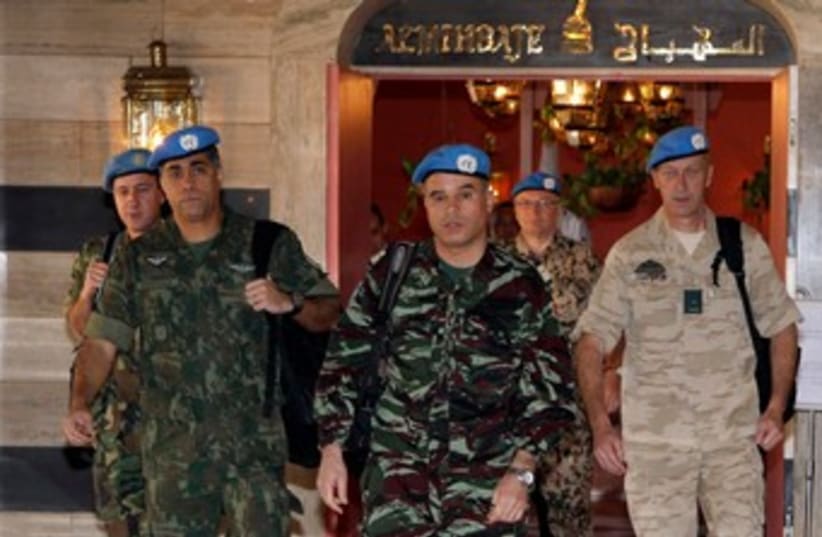
UN monitors reach the farming settlement of Mazraat al-Qubeir, finding it deserted but bearing signs of deadly violence.
By REUTERSUN monitors arrive in Damascus 370(photo credit: REUTERS/Khaled al- Hariri )
BEIRUT - The smell of burnt flesh hung in the air and body parts lay scattered around the deserted Syrian hamlet of Mazraat al-Qubeir on Friday, UN monitors said after visiting the site where 78 people were reported massacred two days ago.The alleged killing spree on Wednesday underlined how little outside powers, divided and pursuing their own interests in the Middle East, have been able to do to stop increasing carnage in the 15-month-old uprising against Syrian President Bashar Assad.A day after Syrian armed forces and villagers had turned them back, the unarmed UN monitors reached the farming settlement of Mazraat al-Qubeir, finding it deserted but bearing signs of deadly violence.One house was damaged by rocket fire and bullets, UN spokeswoman Sausan Ghosheh said. Another was burnt, with bodies still inside. "You could smell dead bodies and you could also see body parts in and around the village," Ghosheh told reporters after returning to Damascus.BBC reporter Paul Danahar, who accompanied the monitors, said it was clear "terrible crime" had taken place.In one house he saw "pieces of brains lying on the floor. There was a tablecloth covered in blood and flesh and someone had tried to mop the blood up by pushing it into the corner, but seems they had given up because there was so much of it around."Danahar's Twitter report added: "What we didn't find were any bodies of people. What we did find were tracks on the tarmac (that) the UN said looked like armored personnel carriers or tanks."Click for full JPost coverageGhosheh said Mazraat al-Qubeir, which has a population of around 150 people, was empty on Friday, but people from neighboring villages arrived to give their accounts."The information was a little bit conflicting. We need to go back, cross-reference what we have heard, and check the names they say were killed, check the names they say are missing".Is Annan peace plan dead?Many Syrian civilians are fleeing their homes to escape widening fighting between security forces and rebels, the Red Cross said, while the outside world seems unable to craft an alternative to envoy Kofi Annan's failing peace plan."Some say that the plan may be dead," Annan said before meeting US Secretary of State Hillary Clinton in Washington."Is the problem the plan or the problem is implementation?" he asked. "If it's implementation, how do we get action on that? And if it is the plan, what other options do we have?"Activists say at least 78 people were shot, stabbed or burned alive in Mazraat al-Qubeir, a Sunni Muslim hamlet, by forces loyal to Assad, whose minority Alawite sect, an offshoot of Shi'ite Islam, has dominated Syria for decades.Syrian authorities have condemned the killings in Mazraat al-Qubeir and another massacre of civilians in Houla two weeks ago, blaming them on "terrorists".The conflict is becoming increasingly sectarian. Shabbiha militiamen from the Alawite community appear to be off the leash, targeting Sunni civilians almost regardless of their part in the uprising.Opposition activists said those killed in Mazraat al-Qubeir had not previously been caught up in the conflict.Deadly violence continues across countrySome 300 UN observers are in Syria to monitor a truce between Assad's forces and rebels that Annan declared on April 12 but was never implemented.Now reduced to observing the violence, they have already verified the massacre in Houla, a town where 108 men, women and children were slain on May 25. The UN peacekeeping chief said Syrian troops and pro-Assad militia were probably responsible.As more and more civilians flee their homes to escape fighting, sick or wounded people are finding it hard to reach medical services or buy food, said a spokesman for the International Committee of the Red Cross (ICRC) in Geneva.Protests and strife erupted across Syria on Friday.Fierce gunfights between security forces and gunmen broke out in central Damascus, formerly a bastion of Assad's control, forcing people in the Mezze neighborhood to hide in their homes."The gunfire is so loud I think some bullets could have hit the house. I'm afraid to go out to see what is happening," one resident said. Activists said rebels attacked security barracks and shabbiha gunmen had been called in to help confront them.Earlier, a car bomb aimed at a bus carrying security men exploded in a Damascus suburb, killing at least two, the Syrian Observatory for Human Rights watchdog said.Another car bomb hit a police branch in the northwestern city of Idlib, killing at least five people, it said.Syrian forces shelled and then tried to storm the rebel-held district of Khalidiya in the central city of Homs, the heart of the revolt against Assad, the British-based Observatory said.Activists said 10 rockets a minute crashed into Khalidiya in one of the fierce bombardments to hit Homs. Videos posted on the Internet showed plumes of grey smoke rising from buildings.Activist footage of protests said to be in the northern city of Aleppo showed crowds fleeing from tear gas and gunfire.In Deraa, the southern birthplace of the uprising, Syrian forces pounded rebel hideouts in the rugged Luja area, after many soldiers had defected, activists and residents said."The Syrian people are bleeding," Ban said at the United Nations on Thursday, warning of an "imminent" civil war.US steps up pressure on Russia to oust AssadThere is little sign of the firm action he called for from a world divided between Assad's opponents and countries such as China, Russia and Iran that are deeply suspicious of Western and Arab states determined to unseat the Syrian leader.China again urged both sides to comply with Annan's peace plan, which Assad and his foes had accepted, although the rebels said this week they were no longer bound by the truce.Russia and China have twice vetoed Western-backed Security Council resolutions critical of Syria, whose security forces have killed at least 10,000 people, by a UN count, while losing more than 2,600 of their own, according to Damascus.Stepping up US pressure on Russia to support a Syrian transition that would include Assad's exit from power, State Department official Fred Hof met Russian Deputy Foreign Ministers Gennady Gatilov and Mikhail Bogdanov in Moscow.Bogdanov said Annan's plan, which does not directly call for Assad's departure, could be adjusted to improve implementation but its core elements must remain.He has said Moscow would be open to a negotiated Yemen-style power transition in Syria, referring to a deal under which Yemeni leader Ali Abdullah Saleh stepped down in February after a year of unrest.Moscow and Beijing have decried the killings of civilians, but resist any plan for coerced political transition, let alone military intervention - not that the West is ready for this.Clinton has said her country is willing to work on a broad conference on Syria's political future, as long as Assad goes.She has criticized the idea, favored by Annan and Moscow, of a contact group that would bring together major powers as well as regional ones, including Iran, a strategic ally of Assad with much at stake in Syria and neighboring Lebanon.
if(catID != 151){
var cont = `Take Israel home with the new Jerusalem Post Store