Iranian official: Teheran will hit Dimona if attacked.
By JPOST.COM STAFFSyria Lebanon(photo credit: Associated Press)
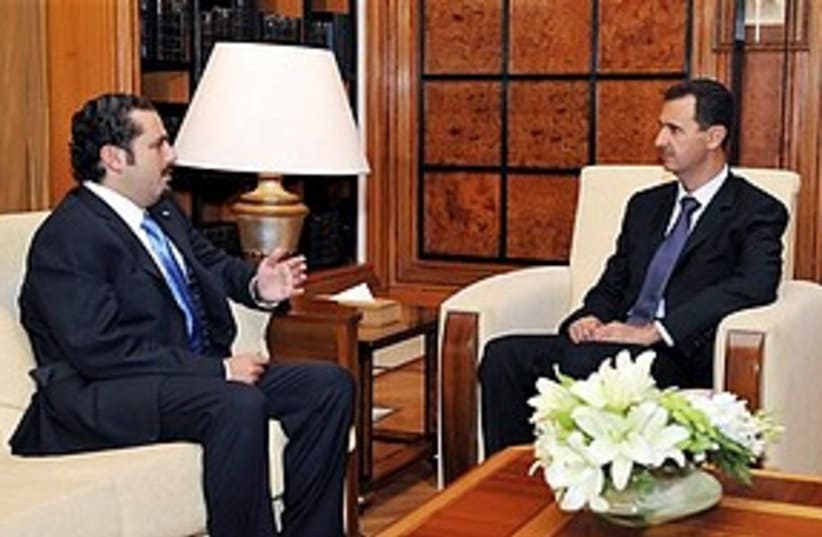
The Syrian army signed a defense alliance with Hizbullah, a Kuwaiti paper reported on Monday.According to the report in Al- Rai, in case of war, the two will split a “bank” of targets in Israel, and Syrian radars will supply Hizbullah operatives with intelligence on the location of Israeli aircraft, to assist Hizbullah in aiming anti-aircraft weapons.RELATED:'Israel ready to destroy LAF in 4 hours'Sunni-Shi’ite clashes in BeirutThe alliance radically changes the balance of power in the North, because it means in any future confrontation the IDF will be faced with attacks from both the northern and northeastern borders.The IDF was surprised by Hizbullah’s level of organization during the Second Lebanon War in 2006. Syrian assistance in intelligence gathering would give the Shi’ite organization a technological advantage that would bring it even closer to the level of an organized military.During the 2006 war, Israel warned Syria not to intervene, and it avoided clashing with the IDF. According to the new pact, each of the parties will rush to assist the other in case of confrontation with Israel.In Damascus, Syrian President Bashar Assad urged Lebanon’s leader to support Hizbullah and maintain calm in the country.Assad met with Lebanese Prime Minister Saad Hariri in the Syrian capital for a predawn suhour meal, the last meal before the daytime fast resumes during Ramadan, the Syrian state-run news agency reported.Hariri has visited Damascus repeatedly this year, in a sign of Syria’s renewed influence over Lebanon. Hariri’s visits indicate that he needs Syrian support as his Western-backed coalition struggles at home.Syria backs Hizbullah, which has a large role in Lebanon’s fragile national unity government.Last week, street battles in Beirut between the Shi’ite Hizbullah and a small Sunni group resulted in the deaths of three people.Hariri was expected on Monday to head the first meeting of a new committee formed to discuss ways of ridding the Lebanese capital of weapons.Meanwhile, an Iranian official told the London-based Arabic-language newspaper Asharq al-Awsat that Teheran would target Israel’s Dimona reactor if the Islamic Republic was hit by an Israeli or US air strike.“Teheran is aware that Israel and the United States want to target Iran, but we are also aware that while they actually have the option to launch war, they do not have the option to end it. This is America’s and Israel’s point of weakness.We know that there is no solution to this point of weakness, thanks to the importance of the Gulf region, America’s problems in Iraq and Afghanistan, and the small area of the Zionist entity,” the unnamed official was quoted by the paper as saying.The official added that the Iranian regime did not see any strong reason to reach an accommodation with Israel because of the view of Israel’s declining strategic value among Western countries, including the US.“We believe that the United States is looking for a strong partner in the region as an alternative to its dependence on Israel in the future. We in Iran believe that the United States and the Western nations now view Israel more as a burden and that Israel is incapable of contributing to achieving peace in the Middle East,” the official told Asharq al-Awsat.The official went on to say that the Islamic Republic would seek to expand its presence in Syria and Lebanon as Israel’s influence in the region declined and Iran acquired nuclear capability.Last week, Deputy Foreign Minister Danny Ayalon told the Iranian people by radio that a regional war initiated by Teheran was a distinct possibility, adding that “Israel is committed to defending its citizens and if attacked will act accordingly.”The comments, released by the Foreign Ministry in Hebrew last Tuesday, came during a Farsi-language broadcast on Israel Radio in which Ayalon addressed the people of Iran, took calls and answered questions. The Farsi broadcast originally aired last Monday.“A fear exists that Iran – as it becomes more pressured by sanctions – will goad those under its patronage in Hizbullah and Hamas to initiate military action against Israel. There’s also a possibility that Iran will make a military move against the Arab Gulf states and harm the flow of oil to the world, in which case the entire situation will degrade into widespread confrontations.Remember that the sanctions are aimed against Iran’s efforts to arm itself with nuclear weapons, and if they don’t elicit results, the United States and other nations might consider other options,” Ayalon said.AP contributed to this report.
if(catID != 151){
var cont = `Take Israel home with the new Jerusalem Post Store