UN Watch calls on human rights council to cancel review on report drawn up at 2010 session, before the breakout of the Libyan civil war.
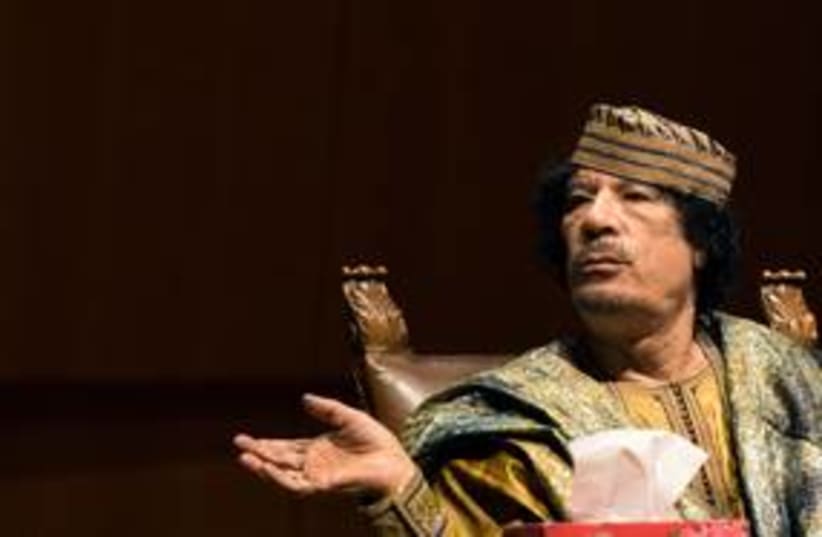
By ELIEZER SHERMANFormer Libyan leader Muammar Gaddafi 311 (R)(photo credit: REUTERS/Alessandro Bianchi)
The UN is preparing to adopt a report praising the human rights record of the former government of deposed Libyan ruler Muammar Gaddafi, in a move a UN monitoring NGO said would bring embarrassment to the international rights organization.The report – which is scheduled for review in March’s session of the Human Rights Council – is the outcome of a 2010 session, held before the eruption of mass protests and an armed rebellion that pushed Gaddafi from his throne in October 2011, after 42 years in power.NGO UN Watch called on the UN to cancel the review, with executive director Hillel Neuer saying the report only serves to “falsely praise Gaddafi’s oppressive regime, insult his victims, and harm the reputation of the UN.”“The report completely contradicts the council’s own commission of inquiry, which found evidence of Gaddafi war crimes,” Neuer said. “The review should be entirely redone, and the council should set an example of accountability by acknowledging that its original review was deeply flawed.”The report will be examined by the Universal Periodic Review (UPR), a branch of the Human Rights Council which monitors the human rights records of all UN member states.The report was originally slated for adoption last year but has been postponed repeatedly, according to UN Watch.Libya welcomed the report at the time, stating: “The Libyan Arab Jamahiriya [Libya’s official name] believed that the promotion and protection of human rights was one of the most important factors for the progress and development of the people.” In the report, the Gaddafi regime also touted “its pioneering experience in the field of wealth distribution and labor rights.”Included in the UPR report are member states’ rights recommendations for the Gaddafi regime, including methods to deal with refugees and abolishment of the death penalty.Among the member states praising Libya’s human rights record are other Mideast countries facing criticism over abuses that emerged during Arab Spring protests, which spread throughout the region at the close of 2010 – including Syria, Bahrain, Tunisia and Egypt.
if(catID != 151){
var cont = `Take Israel home with the new Jerusalem Post Store