Ambassador Robert Ford says extremists in Syrian opposition an obstacle to political solution; points to Iraqi al-Qaida affiliate.
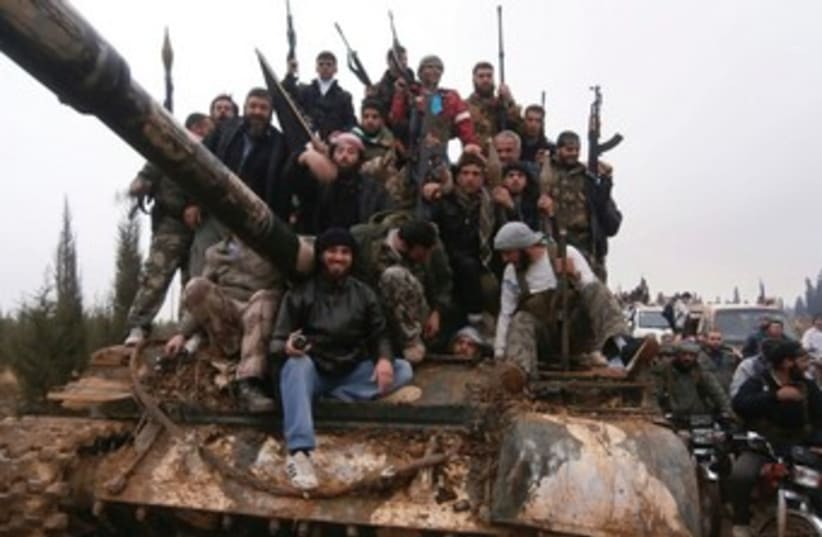
By HILARY LEILA KRIEGER, JPOST CORRESPONDENTFREE SYRIAN Army fighters pose on a tank 370 (R)(photo credit: Reuters)
WASHINGTON – The top US envoy to Syria warned on Thursday that extremists were gaining influence in the Syrian opposition and that this influence would only increase the longer fighting dragged on in the Levant country.US Ambassador to Syria Robert Ford, speaking to the Foundation for Defense of Democracies, described extremist groups that had “little by little been gaining influence among the armed opposition.” He pointed particularly to an al-Qaida affiliate in Iraq that is now operating in Syria.Extremist elements, which are still a minority among the opposition, pose “an obstacle to finding the political solution that Syria needs,” he said.However, he stressed, America sees a political solution as the only way to resolve the violence in Syria – one in which President Bashar Assad plays no role.To that end, the United States has been working with a newly formed umbrella group, which represents Syrians in the opposition both inside and outside of the country, to forge a political transition in the war-torn nation.Ford assessed that keeping this group unified was essential to diminishing the chance for outside actors to exploit difference, work one side against another and otherwise exercise influence in a new Syria.“If we can keep these Syrian leaders united, I think there will be less chance for Iran, Russia, and other pernicious actors – Hezbollah, for example – to intervene in their typically negative way,” he said.Click for full JPost coverageHe also reiterated the US warning about any use of chemical weapons, amid signs that Assad was making preparations to do so.“We want to be very clear to the Syrian government: As its situation deteriorates, they must not think about deploying these things. They must not deploy them,” he emphasized, saying such an action would cross red lines for America and the broader international community.“The use of those weapons is for us a qualitatively different situation, and frankly countries in the region also view it that way, so it will change our calculations in a fundamentally different way,” he warned.That Assad might be contemplating using chemical weapons is, according to many analysts, a sign of a last-ditch effort on his part to stave off an increasingly certain defeat.Ford added his assessment that Assad’s days in power were numbered.“The armed opposition groups... have made substantial gains on the ground over the past weeks,” he said, pointing to their control of eastern parts of the country, the Kurdish areas, and most of the border along Turkey and Iraq.“It’s very clear that the regime’s forces are being ground down and that they are losing,” he said. “The writing is on the wall.”But Ford noted that Assad’s forces continued to maintain some cohesion.“They still have some fight left in them, even though they are losing,” he said. “I’m sorry to say that I expect there will be substantial fighting in the days ahead.”
if(catID != 151){
var cont = `Take Israel home with the new Jerusalem Post Store