Saudis offer Bahrain rulers support against opposition
As uneasy calm prevails in tiny Gulf nation, Sunni-led Saudi Arabia tries to keep Bahrain from falling into Iran's orbit.
By ASSOCIATED PRESSBahrain Protester 311(photo credit: Associated Press)
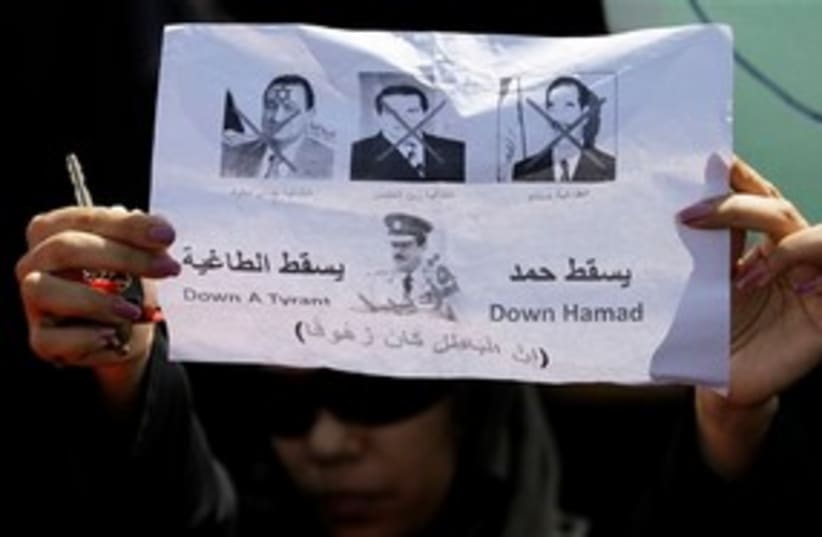
MANAMA, Bahrain - Saudi Arabia on Sunday said it stands ready "with all its capabilities" to shore up Bahrain's ruling royal family if a standoff with the Shi'ite-led opposition is not resolved soon, underscoring the kingdom's deep concern about its neighbor's ongoing political crisis.Sunni-led Saudi Arabia props up Bahrain's al-Khalifa family with cash and has long sought to prevent the tiny Persian Gulf state - with its majority Shi'ite population - from falling into Iran's orbit. With dwindling oil resources, Bahrain relies heavily on Saudi Arabia for money and security.RELATED:Iran briefly detains daughter of ex-president RafsanjaniOpinion:Knock, knock: History callingIt was unclear whether the Saudi comments indicated that the country was contemplating possible action in Bahrain or were merely meant to express growing anxiety among Saudi leaders. But some regional experts have long warned that a concerted Shi'ite challenge to the monarchy in Bahrain might prompt intervention from Saudi Arabia, which has its own restive Shi'ite minority population. The two countries are connected by a causeway.The Saudi comments came as an uneasy calm prevailed in Bahrain's capital Sunday. Protesters pitched tents and held a peaceful demonstration at a central square as opposition leaders continued to rebuff the crown prince's invitation to engage in dialogue.The statements from Saudi Arabia, which had been largely silent on the crisis in Bahrain since protests erupted a week ago, were issued in quick succession. The official Saudi press agency reported that the kingdom was following developments in Bahrain "with concern" and that it hopes to see a "restoration of calm and stability" under Bahrain's "wise leadership.""The Kingdom of Saudi Arabia stands with all its capabilities behind the state and the brotherly people of Bahrain," the statement added.Shortly afterward, it was announced that Saudi Arabia's powerful minister of interior, Prince Nayef, had called Bahrain's King Hamad bin Isa al-Khalifa to convey the same message.Kuwait's emir, Sheik Sabah Ahmed al-Sabah, also called the Bahraini king on Sunday and stressed that "the security of Bahrain is the security of the region," reflecting the growing anxiety among gulf monarchies that Bahrain's troubles could have a spillover effect. In Kuwait, protesters have already taken to the streets demanding more rights.Saudi Arabia's expression of concern came as Adm. Mike Mullen, chairman of the US Joint Chiefs of Staff, arrived in Riyadh for two days of consultations with the Saudi leadership, the first stop on a regional tour. The purpose of his mission is to "reassure, discuss and understand what is going on," Mullen told reporters. Bahrain, in addition to its proximity to Saudi Arabia, hosts the US Navy's 5th Fleet, which has served as a hub for operations in Afghanistan and Iraq.In the Bahraini capital, the Pearl Square roundabout, which had been the site of vicious crackdowns against protesters, again had the feeling of a festival. Families set out picnics, vendors sold tea and pastries and a tight knot of traffic stopped up what is usually one of Manama's most congested areas.The only noticeable government presence was a string of police officers keeping watch over the area from a nearby highway.The king "should work for us, not for himself," said Wafi al-Maged, a construction worker. "He's a very, very lucky king to have such peaceful people. Our demands are for jobs, health care, good education - that's it."At the Salmaniya Medical Complex, where doctors and staff said they had been prevented from sending out ambulances after Bahrain's military fired on protesters on Friday, pillars near the main entrance bore posters of one of the most seriously wounded, zoo worker Abdul al-Redha.Inside, Redha, a bullet lodged in his head, clung to life, but doctors said that he no longer showed signs of brain function. Family members gathered around his hospital bed, where he was covered in a red-and-white Bahraini flag.On Sunday, Crown Prince Salman bin Hamad al-Khalifa tried to coax Shi'ite opposition leaders to meet with him to discuss their demands for democratic reforms.When asked about Salman's invitation, Jassim Hussain of the Shi'ite political party al-Wefaq said, "we have not really done anything." Hussain, whose party withdrew from the 40-member lower house of parliament last week, added: "We think the environment must be right for any meaningful dialogue."(c) 2011, The Washington Post
if(catID != 151){
var cont = `Take Israel home with the new Jerusalem Post Store