Spokesman says dialogue with Jewish state ‘not up for discussion.’
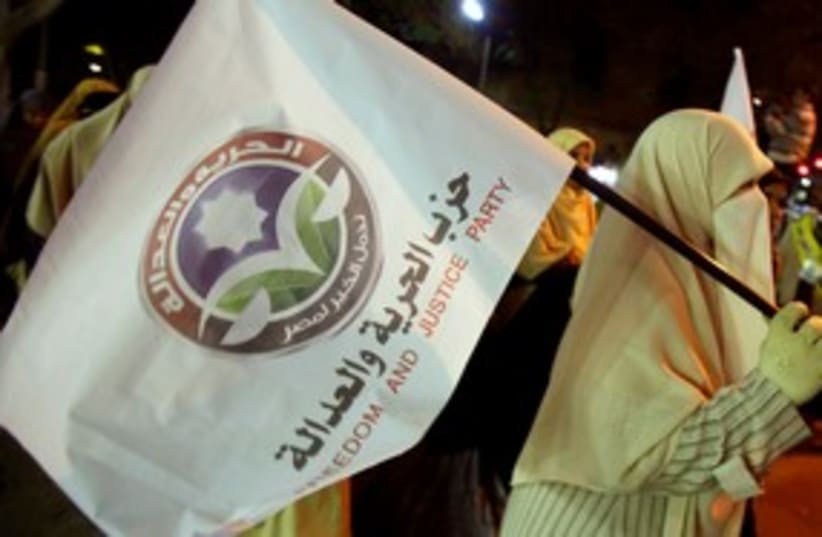
By OREN KESSLEREgypt muslim brotherhood flag 311(photo credit: REUTERS/Mohamed Abd El-Ghany )
Egypt’s Muslim Brotherhood categorically rejects dialogue with Israel, the group’s spokesman told an Arabic newspaper in an interview published Wednesday.Mahmoud Ghazlan told London’s Asharq Alawsat daily that the Islamist group’s position is “clear and not up for discussion.” Ghazlan denied his organization had been contacted by Israel’s embassy in Cairo, and said it would “reject any request from the Israeli embassy to meet with leaders of the Brotherhood.”Foreign Ministry spokesman Yigal Palmor told Army Radio on Tuesday that Israel “has not closed the door” to the new government in Cairo and “would be happy to conduct dialogue with anyone prepared to talk with us.” Palmor said he believes Egypt would continue to honor the 1979 peace treaty with Israel, which he said serves the interests of both countries.Ghazlan flatly rejected the prospect of talks with the Jewish state.“Our group is not prepared to conduct dialogue with Israel – that is our decision.Our position is consistent and clear, and is not up for discussion,” he said.“It is illogical to open dialogue, any dialogue, given the current Israeli policies against the Arab peoples,” he said. “We will reject any request from the Israeli embassy to meet with leaders of the group.”Earlier this month the deputy leader of the Brotherhood’s Freedom and Justice Party (FJP) said it would not recognize Israel “under any circumstances.”“This is not an option, whatever the circumstances – we do not recognize Israel at all. It’s an occupying criminal enemy,” Rashad Bayoumi told London’s Al-Hayat daily, adding, “I will not allow myself to sit down with criminals.”“The Brotherhood respects international conventions, but we will take legal action against the peace treaty with the Zionist entity,” Bayoumi said without elaborating.FJP officials have suggested putting the peace agreement to a popular referendum, which analysts say would allow the largely unpopular treaty to be overturned without the Brotherhood having to pay the diplomatic price for its annulment.Another possibility, reported by The New York Times this week, is that the Brotherhood and Egypt’s ruling military council intend to divvy up the spoils of post-revolutionary governance. That arrangement would have the Islamist group taking most important domestic posts, while foreign policy – including relations with Israel – would remain in the army’s hands.The Brotherhood has been the biggest winner in Egypt’s just-completed parliamentary elections, taking 47 percent of seats while even harder-line Salafi parties came in second at 24 percent.A Gallup Poll released Tuesday showed many Egyptians were undecided over which party to vote for until the weeks and months running up to elections.Support for the Brotherhood spiked from 15 percent in July 2011 to 50% in December, while figures for Salafi parties rose from 5% to 31%in the same period.In September of that year, 31% of respondents said they were undecided about the Brotherhood, and 36% about the Salafis. Once voting began two months later, those figures had dropped to 9% and 11% respectively.Nonetheless, the issues Egyptian voters cited as most important were overwhelmingly non-religious – jobs, cost of living and personal security.“Large numbers of previously undecided Egyptians decided to vote for Islamist political parties, even though the most important problems that Egyptians cited did not involve the implementation of Islamic law or other political demands of the Muslim Brotherhood or Salafi groups,” the polling group said in revealing its findings.“That pragmatism indicates that the country’s next elections could be equally surprising – if Egyptians believe that other political forces can address their problems more effectively, it is likely many of them will not refrain from switching their votes from one party to another.”
Related TagsDialogue
if(catID != 151){
var cont = `Take Israel home with the new Jerusalem Post Store