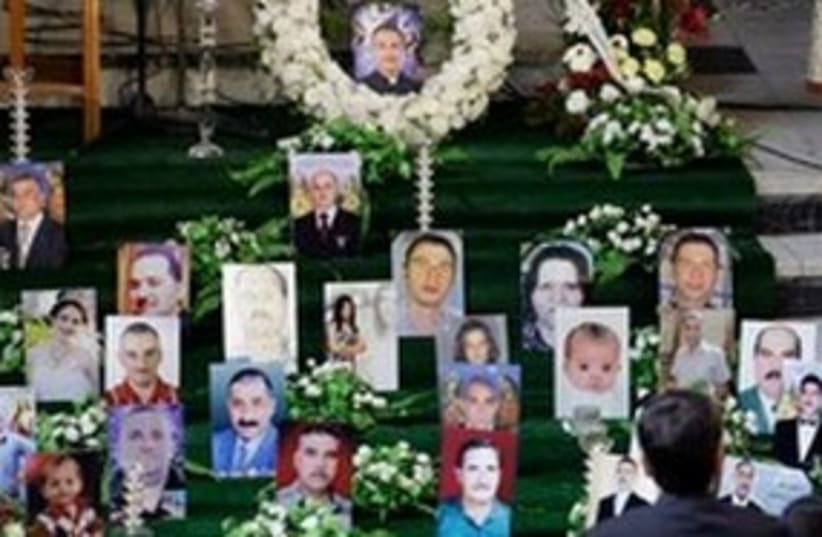
Iraqi Christians will not have a "merry little Christmas" as many flee the country out of fear for their safety and lives.
By ASSOCIATED PRESSIraq Christmas 311(photo credit: ASSOCIATED PRESS)
They saw their brethren murdered during Mass and then were bombed in their homes as they mourned. Al-Qaida vowed to hunt them down. Now the Christian community of Iraq, almost as old as the religion itself, is sensing a clear message: It is time to leave.Since the Oct. 31 bloodbath in their Baghdad church, Iraqi Christians have been fleeing Sunni Muslim extremists who view them as nonbelievers and agents of the West. At a time when Christians in various parts of the Muslim world are feeling pressured, Iraqi Christians are approaching their grimmest Christmas since the U.S.-led invasion of 2003 and wondering if they have any future in their native land.RELATED:Bethlehem tourism swells as violence and terror ebbsIDF eases security restrictions ahead of ChristmasThey have suffered repeated violence and harassment since 2003, when the inter-religious peace rigidly enforced by Saddam Hussein fell apart. But the attack on Our Lady of Salvation in which 68 people died appears to have been a tipping point that has driven many to flee northward to the Kurdish enclave while seeking asylum in the U.S. and elsewhere.What seemed different this time was the way the gunmen brazenly barged onto sacred ground, the subsequent targeting of homes by bombers who clearly knew every Christian address, and the Internet posting in which al-Qaida-linked militants took responsibility for the church attack and vowed a campaign of violence against Christians wherever they are.Ban Daub, 51, narrowly survived the onslaught. She and her nephew were at prayer when they heard explosions. They escaped before five attackers stormed in, but many of their friends did not. A neighbor died clutching his son and daughter in his arms.Days later a string of bombs went off outside Christian homes across Baghdad. Daub and her family packed a few belongings and headed to a Christian district called Ainkawa in this Kurdish city of Irbil."We are afraid for our sons and our children. There is no life in Baghdad for the Christians," she says.Since 2003 no Iraqi religious or ethnic group has escaped violence. Tens of thousands died in bombings and street battles between minority Sunnis and the Shiites who supplanted them in power after Saddam Hussein, the longtime dictator, was toppled.But like many of Iraq's minorities, Christians do not have political clout or militias.Even before the church attack, thousands of Christians were fleeing abroad. They are more than a third of the 53,700 Iraqis resettled in the United States since 2007, according to State Department statistics.How many Christians remain in this nation of 29 million is not reliably known. A State Department report says Christian leaders estimate 400,000 to 600,000 remain, down from a prewar level as high as 1.4 million by some estimates.In the Middle East and in Muslim countries beyond, Christians are finding themselves subject to violence and harassment. The Vatican is so worried that it hosted a two-week meeting of Mideast bishops this fall, dedicated to supporting Christian minorities.In Egypt, at least two people died and more than 150 were arrested last month in clashes between Christians and authorities over the building of a new church. In an ominous sign that militancy is transcending borders, the militants who carried out the Baghdad church siege said they were acting on behalf of two Egyptian women who they claimed were being persecuted by their priests for converting to Islam.In Pakistan, a Christian woman is under sentence of death for allegedly insulting the Prophet Muhammad.In Saudi Arabia, textbooks sometimes contain language intolerant of Christianity as well as other religions besides Sunni Islam, according to the State Department report on religious freedom.In Malaysia, a court decision last year allowing a Catholic newspaper to refer to God as Allah, the Arabic word for God, sparked a spate of arson and vandalism against Christian churches.Following the Baghdad church mayhem, some European countries offered asylum to Iraqi Christians. But Younadam Kanna, a Christian member of Iraq's Parliament, worries that such Western intercession will be seen as discrimination by Iraqi Muslims who wonder why outside countries are so quick to offer assistance to Christians but are often silent when Muslims are attacked in Iraq. This could drive a wedge between Iraq's Christians and Muslims."We are a small community here, and we are trying to resist and stay in our homes," Kanna said.More than 600 Christian families fled to the Kurdish area after the church siege, said the Kurdish interior minister, Karim Sinjari. More may have come without registering with authorities.The Kurds are Muslims who have suffered oppression and discrimination but now have an autonomous, Western-supported homeland in northern Iraq. Iraq's president, Jalal Talabani, who is a Kurd, has gone so far as to suggest something similar for Iraq's Christians. Meanwhile the Kurdish government has set up a committee to help the fleeing Christians. Proposals include letting them transfer their government jobs to the Kurdish provinces and allowing students to study in Kurdish colleges and universities."They've been part of Iraq for years. They are part of the community. They are part of the history. They are part of the culture of this country," said Sinjari, who heads the committee. He believes Christians who come to Kurdistan are more likely one day to return to their homes than those who leave Iraq.Ainkawa, the Christian enclave 320 kilometers (200 miles) north of Baghdad, has churches, Christmas trees for sale, and a population that has swelled from 7,500 to 22,000 since 2003, according to Ainkawa Mayor Fahmy Matti.Christians have been in Iraq since earliest Christian times, and although there are several denominations, their enemies do not discriminate.The Our Lady of Salvation church is Syrian Catholic, and Miriam Suleiman is Syrian Orthodox, but days after the attack her house was the target of a bomb.She and her family are renting an apartment in Irbil for $500 a month, her son is on unpaid leave from his government job, and her daughter had to drop out of medical school in Baghdad. Still, they have no desire to go back."Maybe there will be peace and stability, but suddenly the situation will deteriorate," said Suleiman, 61. "We want to go abroad. That is it."Matti, the Ainkawa mayor, said that about 70 percent of the Christians who moved there after the church attack came from Baghdad, and others from Mosul, Iraq's second largest city, 80 kilometers (50 miles) east of here.Mosul is one of the last bastions of Sunni extremists, who sow terror through assassination, targeting Iraqis of all faiths but Christians in particular.About 10 Christian families from Mosul recently found refuge at St. Matthew's, a monastery founded in A.D. 374 by a persecuted Christian and now home to a few monks. The families live in the stone rooms, their laundry drying in the courtyard and their kitchen utensils piled on the shelves.A 23-year-old woman, requesting anonymity for fear of reprisals, said that in Mosul she would try to blend in by keeping her head covered, Muslim-style. She said people would say "Oh, so you are supported by the West because you are Christian. ... They say it is not your country. You should leave."That is not so easy.To emigrate, Iraqis need a passport, and must apply for it in their city of residence — in the monastery refugees' case Mosul, the place from which they fled. A monk at the sanctuary, who for his safety identified himself only as Joseph, said Christians trying to get out often cannot afford hundreds of dollars in bribes to obtain a passport.Ban Daub and her family fled to neighboring Syria in 2006. In 2008, having been denied asylum and told Baghdad was getting safer, they returned to the capital. A few months later a bomb blast rained glass shards into their bedrooms.Daub's nephew, Izz Annan Azziz, said that after he left Baghdad for Irbil, a Muslim friend would call daily, assuring him it was safe to come back.Then another Christian was killed, and the friend called to say that maybe it was best he leave Iraq for good.
if(catID != 151){
var cont = `Take Israel home with the new Jerusalem Post Store