Asst.-Ch. Sau touts success in crime-ridden Lod after critical comptroller’s report.
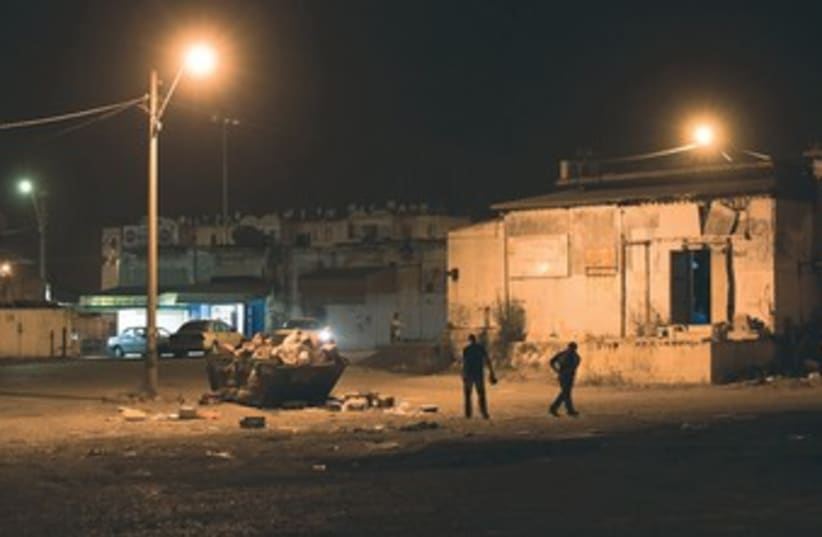
By BEN HARTMANMEN WALK near Lod’s Central Bus Station 370(photo credit: reuters)
The Central District Police commander on Wednesday issued an impassioned defense of his officers’ crime fighting efforts on Wednesday, a week after a state comptroller report targeted Lod as a city rife with law enforcement and municipal failures.Central District Police head Asst.-Ch. Benzi Sau called crime reporters to his office in Ramle on Wednesday and slammed the report for, in his words, ignoring the positive strides police have taken in reducing the number of murders and property crimes in Lod, one of the most crime-ridden cities in the country.Sau said the city of around 75,000 has gone from having 10 murders a year around a decade ago, to only five in 2011 and three in 2012. He also said that 2012 was the first year in recent memory where there was not a single woman from Lod murdered in a “family honor” dispute.The commander presented reporters with figures showing a decrease in the number of auto thefts, burglaries and aggravated robberies.The report issued by State Comptroller Joseph Shapira last week highlighted Lod’s crime problem, saying that police have fallen short in protecting citizens and that crime has thwarted efforts to attract new residents or to implement municipality programs.The report adds that police have achieved less success in Lod than in other cities, and that some kinds of crime have increased in recent years.Sau on Wednesday touted the district’s Women in Danger program, devoted to protecting those in danger of violence at the hands of family members. The program, which is run by the Ramle, Lod, Rosh Ha’ayin and Taiba police stations, tries to identify at-risk women, find them social workers to help them and identify community and religious leaders who can intervene to protect the woman. Sau said the program is currently helping six women in Taiba, five in Rosh Ha’ayin, 10 in Lod, and 13 in Ramle, but is by no means 100 percent successful.The Central District head said that while around 50% of murders in the Jewish sector are solved, only 25-30% are in the Arab sector.Sau chalked the problem up to the sector’s suspicion of the police and fear about cooperating with the authorities or being identified as someone who testified to police, because of the lethal violence often meted out on witnesses and their families. He related a conversation he had with the mayor of Tira in the Triangle, Abed al-Hai Mamoun, who told him: “The problem with finding a witness to testify in the Arab sector isn’t that you’ll then need to put him in protective custody.The problem is you’ll have to find protection for his entire family.”Sau also said his district lacks Arabic-speaking dispatch officers, and a major goal is ensuring that people calling to report a crime will have someone to speak to on the other side of the line.The commander said his district, which includes highcrime cities such as Netanya, Lod, Ramle and the towns of the Triangle, is home to most of the recognized organized crime gangs in Israel, with police resources always in short supply. Like many Israeli police commanders, he touted former New York mayor Rudy Giuliani’s implementation of the “Broken Windows” policy, the belief that keeping cities in a wellordered condition prevents vandalism and escalation into more serious crime, and tied it to efforts to implement the City without Violence programs in cities across Israel.For the commander, a likely future candidate for the head of the Israel Police, crime in his district, and in Lod in particular, should not be seen as a local plague of those living in troubled cities.“I see crime in Lod as a national problem, not a regional or district problem,” Sau said.
Related TagsLodTheft
if(catID != 151){
var cont = `Take Israel home with the new Jerusalem Post Store