Frustration grips Kafr Kasim family when police arrest Mahmoud Sarsur over murder of his 10-year-old son.
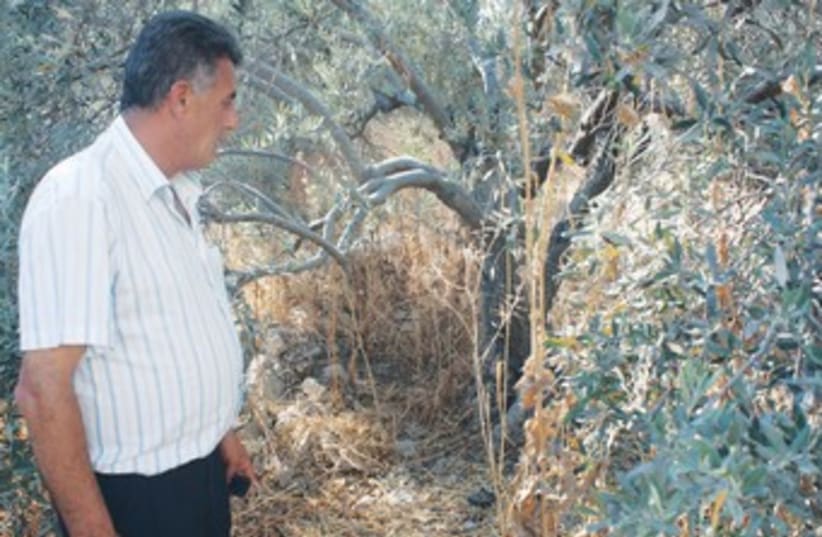
By BEN HARTMANMUHAMMAD SARSUR looks at spot where boy’s body was found 370(photo credit: Ben Hartman)
Anger and heartache gripped the Sarsur family of Kafr Kasim on Monday, the day after police arrested Mahmoud Sarsur in connection with the brutal murder of his 10-year-old son Anas last week.“The family has suffered two murders; first Anas was murdered and now a second time when police arrested Mahmoud,” Mahmoud Sarsur’s brother Muhammad said at the family home in Kafr Kasim Monday.Muhammad and several other mourners at the Sarsur house said they have no faith in the police investigation, and are certain that police arrested Mahmoud only after the real killer’s trail ran cold.“Just days before the murder Mahmoud was at a wedding with Anas and his boys, and you could see him hugging and kissing them, he loved him so much, he would’ve laid down his life for him,” Muhammad said.He added that after previous murder investigations in the city were closed by police with no arrests made, locals have little trust left in them.The three-story Sarsur family home lies down a dirt path near the entrance of the village.By Monday afternoon the family had already broken down the mourners tent that had been set up after Sarsur’s body was found Friday morning, but around two dozen of Anas’s relatives and loved ones sat and drank coffee on the plastic chairs that remained in the family’s courtyard and a vacant lot next door.Extended family members vowed to maintain a vigil outside the house until Mahmoud is freed, but Muhammad admitted they have not yet planned what they will do if he remains in jail after Thursday.Within steps of the family home is the small olive grove where Anas’s body was found Friday. Mohammed pointed at a depression in the ground under an olive tree where he said Anas was left dying Thursday night. Splotches of blood remained on a cinderblock under the tree and the grass was stamped down where Anas tried to crawl for help before he bled to death, Muhammad said.“This is something we’ve never had in the village before, it makes no sense. How someone could have this much hate, this much anger towards a child – there’s no explanation for it,” Muhammad said.The Sarsur family is one of the five major families in the city of around 20,000 outside Rosh Ha’ayin in central Israel. Police said Sunday that there had never been any domestic violence complaints against Mahmoud, nor had his family been visited by social services before the murder.On Monday the Ramle Magistrate’s Court extended Mahmoud Sarsur’s remand until Thursday. A spokesman for the Central District Police, whose branch of the YAMAR special investigative unit is handling the case, said Monday that in the course of investigating the case, they had received information which caused them to suspect that Mahmoud played a role in his son’s death, leading them to push for a remand extension. The spokesman added that police are still examining other scenarios and possible suspects.When Anas went missing Thursday evening, his father called police and officers and local residents began combing the village for any sign of him. Only hours later did they find his body, covered with signs of violence, only meters from his home.A short drive uphill from the Sarsur home towards the village center lies Kafr Kasim’s community center. Ola Amer, manager of the center, said local educators and social workers attended an emergency meeting on Saturday where they discussed ways to answer questions students may have following the crime.“With all the rumors circling around the village, it helps for the kids to have a trusted figure like a teacher, who can talk to them and tell them that everything’s okay,” Amer said, adding that the murder has also had an effect on parents – many of whom have kept their children at home in recent days, afraid there could be a killer loose in the city.Amer said the children who come to the after-school programs are basically split into two groups in relation to the crime. Relatives or classmates of Anas, many of whom are deeply traumatized by the crime, comprise one group, and children who did not know Anas and “just want to be given a game or a computer and they’ll be fine,” make up the other.Amer then pointed at a schedule book for an after-school chess club that was supposed to start today, which Anas had signed up for.“We canceled the class; none of the students wanted to show up,” Amer said.
if(catID != 151){
var cont = `Take Israel home with the new Jerusalem Post Store