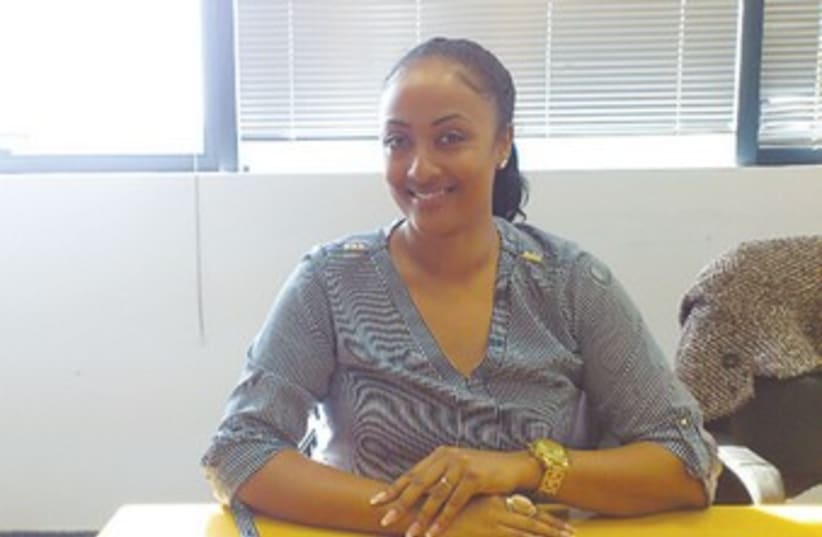
Bureau chief Rahel Tabay has overcome the obstacles faced by many immigrants in order to achieve success.
By YONAH JEREMY BOBRahel Tabay 370(photo credit: Yonah Jeremy Bob)
When Rahel Tabay was born in the desert of Sudan in 1981 on her family’s journey on foot from Ethiopia to Israel, it was unclear if she would survive, let alone that she would become bureau chief to State Comptroller Yosef Shapira.Tabay said that both she and her mother were “in danger during birth” because of the problematic conditions and the “lack of any standard medical care.”Even after she survived the birth, her parents were “unsure that she could survive the journey through the desert which could take anywhere from weeks to months.”“It’s not like we had GPS,” said Tabay, who added that many Ethiopians annually mark a day to remember around 4,000 Ethiopian Jews who died in the walk across the desert.Tabay grew up in Beersheba and had to struggle through adapting to Israeli language and culture despite the fact that neither of her parents had reached a level of Hebrew fluency.“There were organizational volunteers” and people “associated with school,” who Tabay was very thankful to and who gave her and others extra help in order to get through school and adapt.Calling herself religiously “traditional,” Tabay came from a completely orthodox family and could have opted out of army service in favor of doing national service.However, Tabay wanted a chance to “broaden her perspective” and “see something different from what she was used to.” Tabay also decided from the start that if she did the army, she wanted to “do something significant,” and volunteered and was selected for an officer track in the IDF logistics division where she would serve an extra year and obtain the rank of lieutenant.She said that the officers course was “not easy,” but that it was also an “experience which changed who I was.” Although her parents were initially surprised by her decision, they were eventually “very supportive and proud.” Prior to joining the State Comptroller’s Office as bureau chief and liaison on foreign cooperation, Tabay worked to raise money for her studies, got a degree in communications at the Interdisciplinary Center Herzliya and traveled on several trips to the US.On one of her trips, she toured synagogues and non-Jewish venues trying to correct people’s perceptions of Israel in the face of what she called media distortions and tried to highlight some of the less-known impressive aspects of Israeli society.It was particularly fun for Tabay, she said, to explain to non-Jewish Americans about multicultural Israeli society, since many of them thought that Israel was all immigrants from Europe and had not met a “black Jew” from Ethiopia ever before.Tabay started her position with Shapira, in which she, among other things, manages his schedule only three months ago.Her other “hat” is to share information with foreign nations so that Israel can improve its oversight of government operations and to help other nations learn from Israel’s accomplishments in that area.For example, Tabay noted that the comptroller’s powers in Israel “are much wider” and the “areas of government which he critiques are much broader” than in many other nations.Tabay also emphasized that the comptroller had significant “independence, a freer hand and independent control over his budget” in a way that corresponding officials in many other nations do not.She added that exchanging information and hosting visits, such as a recent visit by the ombudsman of Panama, were a huge opportunity to positively affect other nations’ views of Israel by direct contact.Asked why she took the position, Tabay said that not only did she want to do public service, but she liked that part of the comptroller’s work would let her improve services to ethnic minorities, such as the Ethiopian community.Tabay said she appreciated that Shapira was seriously concerned about issues of equality in Israeli society and that, provided candidates met the necessary qualifications, he viewed hiring ethnically diverse candidates as an additional positive.She remarked that Shapira was both “very serious about his work,” but “also fun to work with.”Asked if she was nervous interviewing with such a high public official, Tabay said that before she entered the room to interview “she took a deep breath.” But once she entered she said that she just “explained who I am, made sure I was myself” and showed that she “could be assertive,” an important quality in a bureau chief and foreign liaison.Tabay hopes that her experience and achievements will inspire other Ethiopians to see that a barrier has been crossed and that important positions in society are now open to them that were not in the past.
if(catID != 151){
var cont = `Take Israel home with the new Jerusalem Post Store