Peres meets with families of organ donors, says it is moving to see altruism free from discrimination.
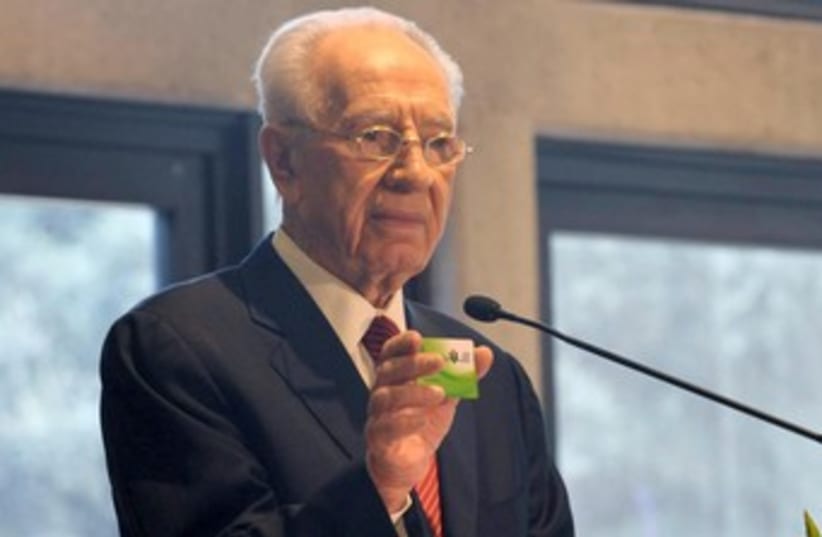
By GREER FAY CASHMANPresident Peres holding ADI card 370(photo credit: Mark Neyman/GPO)
Organ donors’ families, along with recipients and their families, gathered at the official residence of President Shimon Peres on Wednesday, under the auspices of ADI, the National Transplant Center.The Health Ministry established the center in 1994 as an official and independent body to manage Israel’s organ donation and transplant system.The event was also meant to show that there is no discrimination in donating organs.In a video shown at the event, a recipient says after a transplant, “I never thought I would live to see the day when I could raise my arms again. I was so weak, I couldn’t do a thing.”The mother of a young boy, making an obvious effort at self-control, says to doctors: “Take whatever you can from him, so more of him will remain alive on earth.”A Jewish family that received the gift of life from an Arab family has visited with that family several times. There is a bond between them that transcends any differences they might have.Although they have met before, there was a heart-warming meeting on stage between members of the Borin family, who contributed the organs of their five-and-a-half year old daughter that helped to save the life of teenager Maya Harel, who underwent a liver transplant.Now fully recovered, and a volunteer in the IDF, Harel, 18, and wearing her army uniform, told of how at age 13, she suffered from severe stomach cramps that her family doctor diagnosed as a virus.She was taken to hospital and placed in emergency care where she underwent every possible test before it was determined that she had a severely diseased liver. None of the treatment that she received in the course of a year did her much good, and the only solution that she could anticipate was a transplant.The trouble was that Israelis do not have a very good record for donating organs. Part of this stems from an old Jewish belief that a person who died should be buried with his or her body intact.But in Jewish law, as in Christian and Muslim law, the saving of life is given priority above all else. It has taken a long time to convince the haredi community to donate organs, although they have no problem in accepting them.Now that leading rabbis have come out in favor of organ donations and transplants, ADI is hopeful that more people will get the message and sign up for an ADI card, which obviates the need to ask immediate relatives to agree to donate organs if a card holder dies.Harel was in Switzerland with her parents and siblings when the news that a liver was available finally came. Her mother burst into tears of relief and it was left to Harel to pack the suitcase that they would take with them on the flight back to Israel. The 10-hour operation was successful, but she was kept sedated and in intensive care for two days.Later she went back to school and led a perfectly normal life, and considered it a privilege when she was accepted into the IDF.Looking out at a sea of donor families on Wednesday, she said: “In the depths of your own personal anguish, you seized the opportunity to save the lives of others.”Samach Ouda, one of 11 siblings, lost one sister many years ago and a second sister in a traffic accident three years ago.“I empathize with you in your own tragedies,” she told other grieving families. Her sister did not die on the road.Physicians made every effort to save her when she was brought to the hospital, but she was pronounced brain dead after spending three days in the trauma unit. When the family was asked to donate her organs, the only hesitation was over whether they were permitted to do so from a religious standpoint.Ouda’s father and brothers went to consult the local mufti, who told them that there is nothing in Islamic law to preclude them from doing so. There is nothing more important than saving life, he said.Prof. Rafi Bayer, chairman of the steering committee at the National Transplant Center, said that over the past year, 155 lives had been saved in Israel as a result of transplants and many more people were able to function better and breathe better after receiving transplants of kidneys, lungs and other organs.Peres revealed that he signed an ADI card two years ago.Although 70 is the maximum cut-off age for receiving organs, there are instances when the cut-off age is younger depending on the nature of the transplant.There may not need to be a cut-off age for donating organs if the organs are healthy. The president will celebrate his 90th birthday next August.Peres said he saluted all the families engaged in organ transplants – both donors and recipients. It was very moving, he said, to see this kind of altruism in which there was no discrimination between old and young, between men and women or between Arabs and Jews. This was a reminder, he said, that all people are born equal and in the image of God.Bereavement and illness are not religiously or racially selective, he said, as he praised those who in their hour of greatest distress displayed the greatest nobility of spirit.“Life is a choice which should never be rejected,” he said.Referring to the Ouda family, Peres said, “The angel of death visited you, twice, and you chose to become the angels of life. There is nothing more rewarding than being able to give a dying individual the ability to return to life and to become a productive citizen.”ADI is currently conducting a nationwide donor campaign.Anyone who signs an ADI card will be eligible for the short list of recipients should he or she suddenly be in need of an organ transplant.The signature on the card is only a small gesture, the president said, “but the potential has far-reaching consequences.”While the event was intended to underline the importance of giving life, Peres did not overlook the pain that death causes to survivors.“Every tombstone in every cemetery is a symbol of someone’s grief,” he said.
if(catID != 151){
var cont = `Take Israel home with the new Jerusalem Post Store