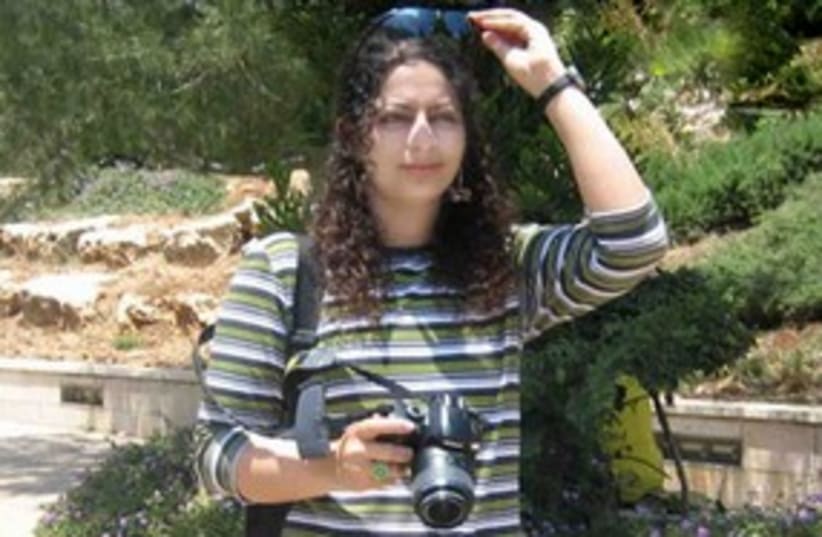
Award-winning Palestinian journalist forced into hiding
PA's Preventative Security Force in W. Bank arrest Majdoleen Hassouneh's brothers in attempt to put pressure on her to turn herself in.
By KHALED ABU TOAMEHMajdoleen Hassouneh 311(photo credit: Courtesy)
An award-winning Palestinian female journalist has been forced to go into hiding out of fear of being arrested by the Palestinian Authority security forces for covering a sit-in strike.Over the weekend, the PA’s Preventive Security Force in the West Bank arrested her two brothers in an attempt to put pressure on her to turn herself in.RELATED:'PA bans journalists from reporting human rights abuses''PA, Hamas systematically abuse Palestinian journalists'The journalist, Majdoleen Hassouneh, has twice refused to report for interrogation at the headquarters of the Preventive Security Force in Nablus.Hassouneh’s friends and colleagues have launched a Facebook campaign in solidarity with her and in protest against the PA government’s measures against Palestinian journalists and freedom of the media.
Hassouneh, a graduate of An-Najah University in Nablus, is the recipient of the best investigative reporter award from the Thomas Foundation for an investigation into the medical field in the Palestinian territories.Last week, she received a phone call from a Preventive Security Force officer who demanded that she report immediately at the headquarters of the apparatus in Nablus.When she failed to show up, the Preventive Security Force sent her a written summons asking her to report for questioning on Saturday morning.The letter warned that she would be arrested if she failed to show up.Hassouneh, who lives in Beit Umrin, near Nablus, announced that she would not go to the security headquarters and described the invitation as an attempt to restrict her freedom of expression.She said that the Preventive Security Force was trying to force her to sign a document that would limit her freedom of expression as a working journalist.A number of Palestinian journalists said they have already been asked by PA security forces in the West Bank to sign similar documents where they pledge to cover certain events.On Saturday night, PA security officers raided Hassouneh’s family home in an attempt to arrest her, but she was not there.The officers detained her two brothers and told the family that she must report for questioning immediately.Following the detention of her brothers, Hassouneh reiterated her refusal to report for questioning or to sign any pledge to refrain from covering issues that could reflect negatively on the PA.“They arrested my two brothers because I wasn’t at home,” she said. “I’m not going to report for interrogation.”Hassouneh appealed to human-rights organizations to intervene with the PA government in the West Bank to prevent her detention and other measures against Palestinian journalists.Palestinian journalists expressed outrage over the targeting of Hassouneh. They too appealed to the international community to pressure the PA leadership to stop targeting Palestinian journalists.Awad Abu Dakka, deputy chairman of the Palestinian Media Association, strongly condemned the move against the female journalist and the continued harassment of other Palestinian reporters and editors.Abu Dakka denounced the measures against Palestinian journalists as “illegal” and appealed to international human-rights groups and media outlets to expose the violations of the Palestinian media’s rights.Palestinian journalists in Nablus told The Jerusalem Post that Hassouneh was wanted by the PA security forces for covering a sitin strike organized by families of Palestinians held in Palestinian jails in the West Bank.In response, Hassouneh asked: “If a journalist is not allowed to cover an event that happens in front of her in her city, why did the Palestinian Authority allow the protest of the families to take place outside Jneid Prison? Why is a journalist being summoned to the security forces when these forces didn’t prevent the sit-in strike?” Hassouneh’s friends and colleagues hailed her decision to challenge the muchfeared Preventive Security Force as a “brave” move, but expressed concern over her safety.One journalist pointed out that he and his colleagues have come under heavy pressure from the PA security forces in the West Bank to refrain from reporting about stories that could embarrass the PA leadership.Last year, two journalists from Bethlehem were arrested by PA security agencies – one for reporting about the dispute between PA President Mahmoud Abbas and Fatah strongman Muhammad Dahlan, and the second for allegedly ridiculing the PA president on his Facebook page.
if(catID != 151){
var cont = `Take Israel home with the new Jerusalem Post Store