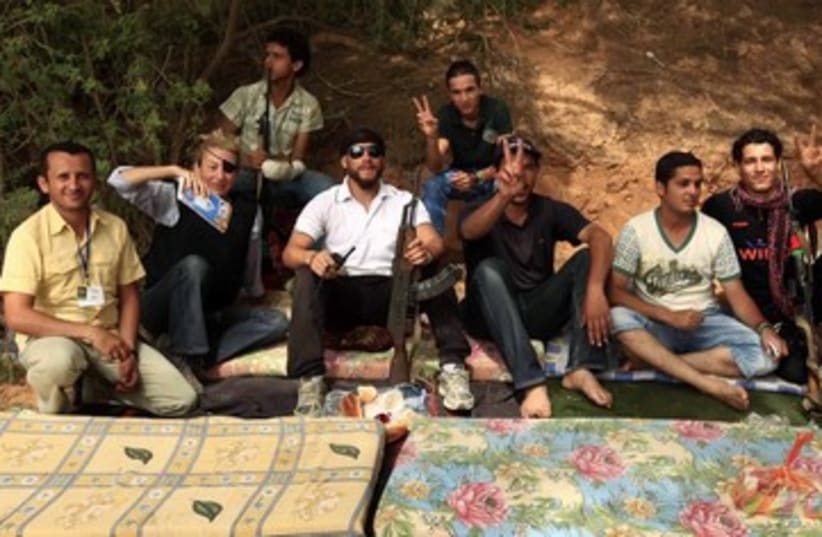
By SARAH HONIGMarie Colvin in Misrata_390(photo credit: Reuters)
More than anything, Marie Colvin, who was laid to rest Monday, will be remembered for sacrificing her life for the London Sunday Times’ circulation figures (albeit pro forma in the name of intrepid reporting on the siege of Homs). Her immortality in the annals of journalism is guaranteed.With that in mind, it’d be especially instructive for us to recall one of her eyewitness accounts which is most pertinent to our own circumstances.It was published nearly six years ago – in April 2006, only a few months after we disengaged from Gaza.Colvin tossed the truth about our self-bamboozlement directly in our faces. This perhaps was why that specific item generated near-zero resonance among us. Why focus on the unpleasant even if it’s the straightforward bottom line with profound implications for our possible future follow- up follies? If there’s anything we dislike, it’s to be confronted with evidence of our own inexcusable imbecility.Colvin unceremoniously gave us the facts. It was left up to us to draw conclusions which our establishment and Left-dominated media scoffed at. Therefore, Colvin’s singularly unpalatable feature never made our headlines back in the day.That in itself poses something of a riddle. One would expect our agenda-driven press to lap up her material, because Colvin was never remotely renowned for being a lover of Zion.Having gone where few men dared and promoted herself as dedicated to chronicling war’s worst, she covered conflicts in Kosovo, East Timor, Chechnya and Sri Lanka, where she lost an eye. In March 2006 she boldly ventured a tad beyond the reinstated Green Line to see what became of Morag, one of the spirited settlements razed by Ariel Sharon and sidekicks – Ehud Olmert, Tzipi Livni et al.“Four green flags of the extremist Palestinian party Hamas were flying last week at the gate of a military training camp built on the ruins of Morag,” she opened. “Inside the camp recruits from the Izzedine al-Qassam Brigades, the military wing of Hamas, ran mock attacks over dunes covered in dry grass. One of them stopped to launch a rocket-propelled grenade.”Colvin stressed that “the base is no makeshift encampment. A telecommunication tower rises from a dune; loudspeakers broadcast from masts... the stones from the old homes have been painted white and used to make guardhouses.Even the settlement’s gate has been cannibalized; now it swings to Toyota pick-up trucks bringing more armed men in uniform.”A senior Kassam honcho who showed Colvin around explained to her that his outfit’s deadly aims vis-à-vis Israel haven’t changed one iota since Hamas’s electoral victory.The insolence of the unnamed hotshot quoted by Colvin was underscored at exactly that same time by then-Palestinian Authority foreign minister Mahmoud Zahar of Hamas (during the Hamas-Fatah partnership).In an interview with China’s Xinhua News Agency, conducted just when Colvin toured the ruins of Morag, Zahar waxed ecstatic about “dreams of hanging a huge map of the world on the wall of my Gaza house which would not have a trace of Israel on it.”He exultantly gloried in the “dream to have our independent state on all Palestine... This dream will become real one day. I am certain of this because there is no place for the state of Israel in this land.”Official Israel and its retreat-advocating mouthpieces ignored Zahar, but he elaborated his comments in Lebanon’s Al-Mustaqbal newspaper. The most the Hamas regime can grant Israel, he intoned just as Colvin filed her report, is a “temporary cessation of hostilities,” in which “the Zionist entity would be countenanced temporarily but gradually be pushed into narrower confines.Borders can only be provisional,” because “there’s no place on earth for the state of Israel.”The very same Zahar was instrumental in negotiating yet another cease-fire a few days ago.Colvin might not have realized how in sync her Hamas guide was with his bosses, but she obviously didn’t misinterpret the mood in what became of Morag. After what she observed and heard, Colvin reckoned that “Israelis contemplating the evacuation of West Bank settlements will shiver at the discovery that al-Qassam fighters now live and train on the ruins of a place that was home to 37 Jewish families.”That, however, is where she got it all wrong.Reasonable folks would indeed be shaken to the core and rebuff those who uprooted the most dedicated of their compatriots in order to facilitate genocidal preparations against the entire national aggregate.But Colvin misjudged us. It’s not that our nonchalance is born of extraordinary courage in the face of adversity. Instead it’s the product of denial of adversity. We pretend we’ve nothing to worry about except for the price of cottage cheese and, more recently, of a commonplace chocolate-covered candy bar.Those who sway Israel’s public sentiment sanction our featherbrained fixation on the trivial. It serves their purposes that we not dwell on the existential dangers that loom ominously from every direction. It’s better to preoccupy our petty plebeian minds with gobbledygook.Still, to be fair, it’s not only us. Colvin’s coverage from Morag made no waves anyplace in the world. This should surely show us that a correspondent’s output is rarely treated on its merit and certainly not in light of the reality it might unmask. Correspondents are far less influential than myth would have it. They either go with the flow or are washed up.It’s not veracity which counts but whether what’s exposed meshes with the trends dictated to news consumers. If the designers of popular political fashion are inimical to Israel – or just apathetic about our minimal safety – they’ll keep the masses’ eyes wide shut even when assorted Colvins present opportunities to enlighten them.Conversely, when the Colvins of the world barely enhance common knowledge, as in the Syrian slaughter narrative, their truisms are sanctimoniously and unstintingly reverberated – if they suit the zeitgeist.That said, careless inattentiveness is foremost our sin. Foreigners are hardly likely to bother about what predominantly imperils Israel. That’s apart from the issue of fundamental morality.Our fellow democracies keep prodding us to risk our very survival in return for ephemeral verbiage (in the best case) and often not even that.They pressure us arrogantly and condescendingly as if they do in actual fact know what’s best. All the while, it’s no skin off their noses if dire consequences from their non-too-friendly advice befall us.The Iranian nukes-in-the-making are a trenchant case in point. For much of the free world a nuclear Iran is an inconvenience. Better it wasn’t so. Nevertheless, the real fly in the international community’s ointment isn’t a potential genocidal strike on Israel but a preemptive strike by Israel.Hence the world’s energies are homed in on stopping those troublemaking Jews from upsetting everyone else’s equanimity.For some, like US President Barack Obama, a deceptive calm is way preferable to shattering the illusion. With an election campaign around the corner, Obama has reluctantly put out the welcome mat for Prime Minister Binyamin Netanyahu. His seeming civility is quite a departure from March 2010. Then, with no campaign to mitigate his unmistakable aversion, Obama heaped unprecedented protocol-abuse on Netanyahu, going so far as to summarily walk out on him mid-conversation in order to “have dinner.”But two years later, we get a rhetorical rampup against Iran to soften the sit-tight admonition against Israel. The ostensible show of camaraderie isn’t merely geared to hoodwinking Jewish voters. Diplomatic dawdling is essential for Obama to curtail oil-price hikes ahead of Election Day (November 6) – even if this eventually kills Israelis. Our life-or-death interests take a back seat to his political interests.It’s not that we’re trigger happy to hit Iran (We’d suffer the vindictive backlash) but that the window of opportunity is narrow. Obama’s political calendar precludes timely preventative action.Obama’s demand is plainly that we subordinate our sovereignty to his reelection schedule. The cruel choice is either lose Obama’s backing (even if it’s merely nominal) or forfeit our self-reliance.No syrupy speechifying can cover this up.It’s our self-preservation on the line, as distinct from that of any professed well-wisher overseas.We cannot afford to fall for the insincerity lavished upon us – when expedient – by Obama or anyone else.The disingenuous counsel liberally dispensed by talking heads and scribblers here and abroad mustn’t distract us from this realization. Opinions are drummed up not because of their objective unassailability but because of vested interests.This is as basic now as it was when Colvin visited Morag.We don’t hear all the news. We get a glimpse of what those with media clout choose to play up. They chose not to play up Colvin’s report.Our media aids and abets our escapist penchants.Colvin received no proper hearing in the country that surrendered Morag to cold-blooded mass murderers.Hence it took countless rocket barrages, ambushes, mega-scale gunrunning and violent clashes to impress average Israelis with the truth – decidedly in defiance of opinion-molders whose latest line is to suggest that Hamas is a tolerable interlocutor, despite explicitly preaching for our absolute obliteration.They must be laughing out loud in Gaza – just like they were during Colvin’s stopover. It was coincidentally just then that Hamas chieftain Khaled Mashaal stated in a Lebanese TV interview that “Israel lacks the stamina to withstand a protracted struggle.”“Were Israel strong, it wouldn’t withdraw,” Mashaal explained. “But Israel did withdraw and speaks of more pullbacks. Israel is in deep crisis. It cannot defeat the Palestinians nor break their spirit.”This is the morale-boosting message Israel sends its foes whenever it dithers and dallies on Iran or when it accedes to the premise that it must cede strategic assets to still-viable enemies.Unbeaten armies don’t give up vital holdings, especially in an unconcluded war. That’s how conventional logic operates. Even Mashaal’s logic. You can’t fault him for not figuring us out.You can’t fault Colvin either. Her assumptions about what should have sent shivers down our spines were based on the norm. Israelis, though, are an anomaly. No one else like us in the world.www.sarahhonig.com
if(catID != 151){
var cont = `Take Israel home with the new Jerusalem Post Store