2013 will be a major test for Israel’s democracy. The world is waiting to see whether Israel will retain its membership among those nations for whom the values, not just the mechanics, of democracy remain a foundation stone of a vibrant and dynamic society.
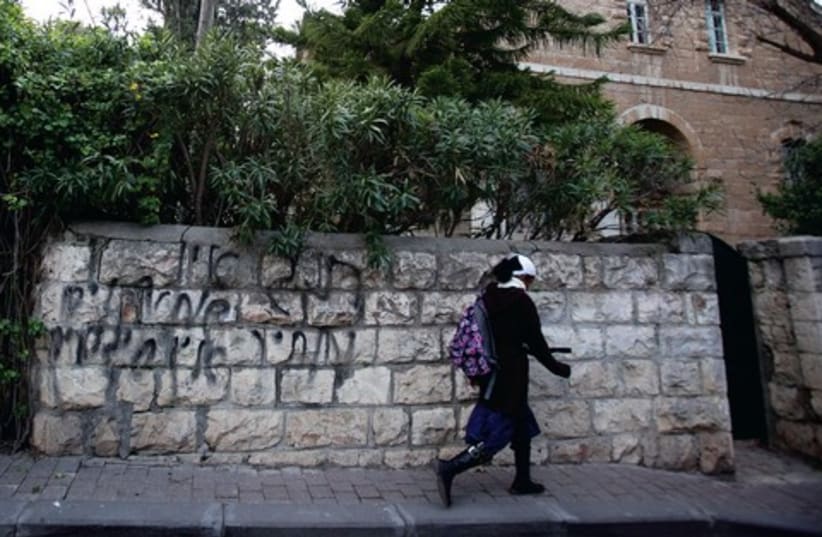
By DAVID NEWMANPrice Tag grafitti 521(photo credit: Marc Israel Sellem/Jerusalem Post Staff)
No hangover for me this morning. I don’t celebrate the civilian new year. One New Year at Rosh Hashana is sufficient for me. But just as the Jewish New Year enables a spiritual stock-taking of the year which has ended, the civilian new year also enables introspection.Some healthy soul-searching about the high and low points of Israeli politics, and New Year’s resolutions aimed at making our society a better place in which to live.This year, the beginning of the New Year coincides with elections. Israel can be proud of its vibrant democracy, as reflected in no less than 34 party lists contesting in the forthcoming elections. But democracy does not start and end with free elections.While there is no such thing as a democracy without elections, by itself the holding of elections every few years is not sufficient. Elected governments have to preserve democratic values throughout society and if they fail to do so, serious questions have to be asked about the very nature of that democracy.The past year has been one in which many basic democratic values have been eroded in Israel, not least by attacks on freedom of speech and expressions by right-wing politicians and think tanks who fail to understand that true democracy is not compatible with attempts to impose ideological hegemony on the rest of society. Democracy is equally about the rights of all – majorities and minorities – to fully express their views and opinions without the fear of being silenced or attacked.Leading Israeli government figures, not least former foreign minister Avigdor Liberman and Education Minister Gidon Sa’ar, have demonstrated, time after time, that they do not understand the basic principles of what a true democracy is about. In his attempt to shut down an academic department at a university, Sa’ar has been exposed as an enemy of freedom of speech. His direct interventions in the deliberations of the Council of Higher Education, under the guise of quality evaluation, have brought Israel’s academic standing and reputation in the world to an all-time low, as leading academic and scientific friends of Israel have voiced their protest and their disapproval.In their boycotting of leading Israeli philosopher Rivka Feldhai, preventing her from taking part in the meeting between Prime Minister Binyamin Netanyahu, German Chancellor Angela Merkel and a group of leading Israeli and German scientists, the government has demonstrated to the world that it does not understand the distinction between legitimate debate and criticism of government policies, and the dangers of a 2012 version of McCarthyism, where dissenting voices are targeted and threatened, or prevented from being heard in important international meetings and conferences.In their adoption of the highly distorted reports of right-wing organizations such as Im Tirtzu, the Council for Zionist Strategies, Israel Academic Monitor and NGO Monitor, government committees have demonstrated their preference for an ideological politics which has only served to damage the name of Israel as a place in which diversity and plurality of opinion is a cornerstone of the country’s higher moral standing. The fact that all of these groups would appear to be funded by foreign right-wing sources seems to be of little interest or concern to the Israeli authorities.The government’s adoption of the anti-European paranoia expressed in the biased research of NGO Monitor has led to a deep rift between Europe and Israel which could severely damage the future funding of both research and civil society activities in the country. Even following the dismissal of their case at the European Court of Justice, they continue to accuse the EU of politicized and secretive funding of legitimate NGOs in Israel, using this as a reason to solicit even more funds from right-wing, anti-democratic forces throughout the world, as they seek to continue their campaign of delegitimization and silencing of civil society groups which form an integral part of Israeli democratic discourse.And the government, for its part, instead of understanding the true source of the increasing world criticism of Israel and the erosion of its democratic values, points the finger of blame at the Left, accusing it of orchestrating an anti-Israel campaign among those who would otherwise not delegitimize and boycott Israel.This is a favorite ploy of the Right – ensuring that Israel stands alone in the world (Liberman has scored major successes on this front) and then blaming the “others” rather than themselves for having brought this about. It is hard to recall a period in which such universal and strong criticism of Israel has been rampant, criticism from those who have traditionally been our friends and only wish for the long-term good and security of the country.It is 35 years since the first right-wing government, under Menachem Begin, came to power. Begin and his government set about altering the previous ideological and institutional hegemonies of the Left, which had been controlled by the Mapai party ever since the establishment of the state. During the ensuing 35 years, there have been more right-wing governments than left-wing ones, but this has not prevented these political leaders from continuing to accuse the newspapers, the TV, the universities and the courts of being controlled by the Left, and thus justifying their continued attempts to target as many as possible as they impose their own version of contemporary newspeak.This oft-repeated mantra flies in the face of reality as one looks at the composition of such bodies as the media agencies (the right-wing Makor Rishon and Israel HaYom instead of the left-wing Davar and Al-Hamishmar), the politicized Council of Higher Education (which under Gidon Sa’ar has become a right-wing watchdog of the country’s universities) and increased political intervention in the appointment of High Court judges. And yet they continue to target any form of dissenting opinion as though they, the country’s leaders and government, still belong to a minority who continue to be disenfranchised, despite their gradual takeover of the country’s institutions in a way unsurpassed even during the periods of Mapai hegemony.This would surely have met with the strong disapproval of a right-wing democrat such as Menachem Begin. The recent unceremonious removal of the last of the right-wing democrats, such as Dan Meridor and Benny Begin, from the corridors of power is a clear indication of these dangerous trends.One small glimmer of hope for Israel’s democracy in the coming year was Sunday’s High Court decision to allow MK Haneen Zoabi to contend in the forthcoming elections, after her candidacy was vetoed by the right-wing-dominated election committee.The High Court, even with its political appointees under the Netanyahu administration, has sent a clear message to the government about the inherent dangers in the continued erosion of Israel’s democratic values. It is to be hoped that this message will not be lost on the next Israeli government which is likely to be even more right-wing than the outgoing administration.2013 will be a major test for Israel’s democracy. The test will stretch well beyond the polling booths on January 22. The world is waiting to see whether Israel will retain its membership among those nations for whom the values, not just the mechanics, of democracy remain a foundation stone of a vibrant and dynamic society.The writer is dean of the Faculty of Humanities and Social Sciences at Ben- Gurion University. The views expressed are his alone.
if(catID != 151){
var cont = `Take Israel home with the new Jerusalem Post Store