The US will withdraw in defeat from Iraq, and pro- American forces in the region and the US itself will reap the whirlwind of Washington’s irresponsibility.
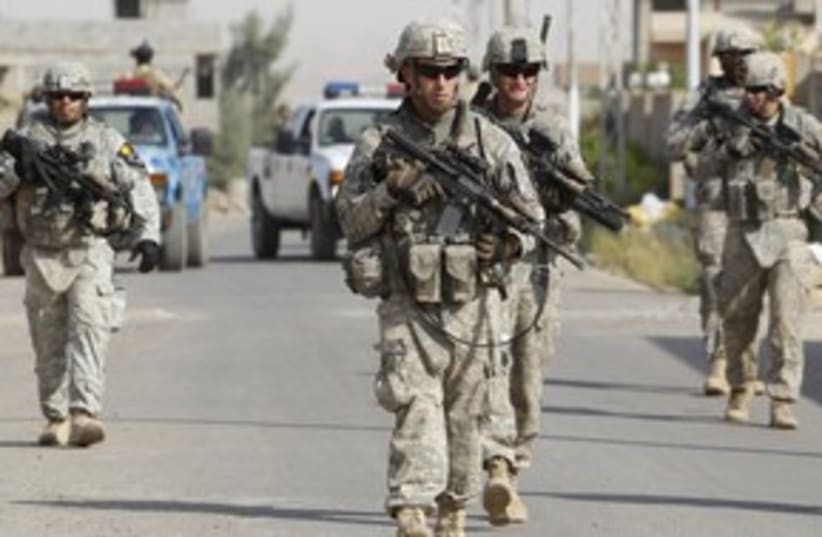
By CAROLINE B. GLICKUS soldiers in Iraq 311 (R)(photo credit: Saad Shalash / Reuters)
Next month, America’s long campaign in Iraq will come to an end with the departure of the last US forces from the country.Amazingly, the approaching withdrawal date has fomented little discussion in the US. Few have weighed in on the likely consequences of President Barack Obama’s decision to withdraw on the US’s hard won gains in that country.After some six thousand Americans gave their lives in the struggle for Iraq and hundreds of billions of dollars were spent on the war, it is quite amazing that its conclusion is being met with disinterested yawns.The general stupor was broken last week with The Weekly Standard’s publication of an article titled, “Defeat in Iraq: President Obama’s decision to withdraw US troops is the mother of all disasters.”The article was written by Frederick and Kimberly Kagan and Marisa Cochrane Sullivan.The Kagans contributed to conceptualizing the US’s successful counterinsurgency strategy in Iraq, popularly known as “the surge,” that president George W. Bush implemented in 2007.In their article, the Kagans and Sullivan explain the strategic implications of next month’s withdrawal.First they note that with the US withdrawal, the sectarian violence that the surge effectively ended will in all likelihood return in force. Iranian-allied Prime Minister Nuri al-Maliki is purging the Iraqi military and security services and the Iraqi civil service of pro-Western, anti- Iranian commanders and senior officials. With American acquiescence, Maliki and his Shi’ite allies already managed to effectively overturn the March 2010 election results. Those elections gave the Sunni-dominated Iraqiya party led by former prime minister Ayad Allawi the right to form the next government.Due to Maliki’s actions, Iraq’s Sunnis are becoming convinced they have little to gain from peacefully accepting the government.The strategic implications of Maliki’s purges are clear. As the US departs the country next month it will be handing its hard-won victory in Iraq to its greatest regional foe – Iran.Repeating their behavior in the aftermath of Israel’s precipitous withdrawal from southern Lebanon in May 2000, the Iranians and their Hezbollah proxies are presenting the US withdrawal from Iraq as a massive strategic victory.They are also inventing the rationale for continued war against the retreating Americans. Iran’s Hezbollah-trained proxy, Muqtada al-Sadr, has declared that US Embassy personnel are an “occupation force” that the Iraqis should rightly attack with the aim of defeating.The US public’s ignorance of the implications of a post-withdrawal, Iranian-dominated Iraq is not surprising. The Obama administration has ignored them and the media have largely followed the administration’s lead in underplaying them.For its part, the Bush administration spent little time explaining to the US public who the forces fighting in Iraq were and why the US was fighting them.US military officials frequently admitted that the insurgents were trained, armed and funded by Iran and Syria. But policy-makers never took any action against either country for waging war against the US. Above the tactical level, the US was unwilling to take any effective action to diminish either regime’s support for the insurgency or to make them pay a diplomatic or military price for their actions.As for Obama, as the Kagans and Sullivan show, the administration abjectly refused to intervene when Maliki stole the elections or to defend US allies in the Iraqi military from Maliki’s pro- Iranian purge of the general officer corps. And by refusing to side with US allies, the Obama administration has effectively sided with America’s foes, enabling Iranian-allied forces to take over the USbuilt, -trained and -armed security apparatuses in Iraq.ALL OF these actions are in line with the US’s current policy towards Egypt. There, without considering the consequences of its actions, in January and February the Obama administration played a key role in ousting the US’s most dependable ally in the Arab world, president Hosni Mubarak.Since Mubarak was thrown from office, Egypt has been ruled by a military junta dubbed the Supreme Council of the Armed Forces. Because SCAF is comprised of the men who served as Mubarak’s underlings throughout his 30-year rule, it shares many of the institutional interests that guided Mubarak and rendered him a dependable US ally. Specifically, SCAF is ill-disposed toward chaos and Islamic radicalism.However, unlike Mubarak, SCAF is only in power because the mobs of protesters in Tahrir Square demanded that Mubarak stand down to enable civilian, majority rule in Egypt. Consequently, the military junta is much less able to keep Egypt’s populist forces at bay.Throughout Mubarak’s long reign, the most popular force in Egypt was the jihadist Muslim Brotherhood. The populism unleashed by Mubarak’s ouster necessarily rendered the Brotherhood the most powerful political force in Egypt. If free elections are held in Egypt next week as planned and if their results are honored, within a year Egypt will be ruled by the Muslim Brotherhood. This is the outcome Obama all but guaranteed when he cut the cord on Mubarak.Recognizing the danger a Brotherhood government would pose to the army’s institutional interests, in recent weeks the generals began taking steps to delay elections, limit the power of the parliament and postpone presidential elections.Their moves provoked massive opposition from Egypt’s now fully legitimated and empowered populist forces. And so they launched what they are dubbing “the second Egyptian revolution.”And the US doesn’t know what to do.In late 2010, foreign policy professionals on both sides of the aisle in Washington got together and formed a group called the Working Group for Egypt. This group, with members as seemingly diverse as Elliott Abrams from the Bush administration and the Council on Foreign Relations, and Brian Katulis from the Center for American Progress, chose to completely ignore the fact that the populist forces in Egypt are overwhelmingly jihadist. They lobbied for Mubarak’s overthrow in the name of “democracy” in January and February. Today they demand that Obama side with the rioters in Tahrir Square against the military. And just as he did in January and February, Obama is likely to follow their “bipartisan” advice.
FROM IRAQ to Egypt to Libya to Syria, as previous mistakes by both the Bush and Obama administrations constrain and diminish US options for advancing its national interests, America is compelled to make more and more difficult choices. In Libya, after facilitating Muammar Gaddafi’s overthrow, the US is faced with the prospect of dealing with an even more radical regime that is jihadist, empowered and already transferring arms to terror groups and proliferating nonconventional weapons. If the Obama administration and the US foreign policy establishment acknowledge the hostile nature of the new regime and refrain from supporting it, they will be forced to admit they sided with America’s enemies in taking down Gaddafi.While Gaddafi was certainly no Mubarak, at worst he was an impotent adversary.In Syria, not only did the US refuse to take any action against President Bashar Assad despite his active sponsorship of the insurgency in Iraq, it failed to cultivate any ties with Syrian regime opponents. The US has continued to ignore Syrian regime opponents to the present day. And now, with Assad’s fall a matter of time, the US is presented with a fairly set opposition leadership, backed by Islamist Turkey and dominated by the Muslim Brotherhood. The liberal, pro-American forces in Syria, including the Kurds, have been shut out of the post-Assad power structure.And in Egypt, after embracing “democracy” over its ally Mubarak, the US is faced with another unenviable choice. It can either side with the weak, but not necessarily hostile military junta which is dependent on US financial aid, or it can side with Islamic extremists who seek its destruction and that of Israel and have the support of the Egyptian people.HOW HAS this situation arisen? How is it possible that the US finds itself today with so few good options in the Arab world after all the blood and treasure it has sacrificed? The answer to this question is found to a large degree in an article by Prof. Angelo Codevilla in the current issue of the Claremont Review of Books titled “The Lost Decade.”Codevilla argues that the reason the US finds itself in the position it is in today owes to a significant degree to its refusal after September 11, 2001, to properly identify its enemy. US foreign policy elites of all stripes and sizes refused to consider clearly how the US should best defend its interests because they refused to identify who most endangered those interests.The Left refused to acknowledge that the US was under attack from the forces of radical Islam enabled by Islamic supremacist regimes such as Saudi Arabia and Iran because the Left didn’t want the US to fight. Moreover, because the Left believes that US policies are to blame for the Islamic world’s hostility to America, leftists favor foreign policies predicated on US appeasement of its enemies.For its part, the Right refused to acknowledge the identity and nature of the US’s enemy because it feared the Left.And so, rather than fight radical Islamists, under Bush the US went to war against a tactic – terrorism. And lo and behold, it was unable to defeat a tactic because a tactic isn’t an enemy.It’s just a tactic. And as its war aim was unachievable, the declared ends of the war became spectacular.Rather than fight to defend the US, the US went to war to transform the Arab world from one imbued with unmentionable religious extremism to one increasingly ruled by democratically elected unmentionable religious extremism.The lion’s share of responsibility for this dismal state of affairs lies with former president Bush and his administration. While the Left didn’t want to fight or defeat the forces of radical Islam after September 11, the majority of Americans did. And by catering to the Left and refusing to identify the enemy, Bush adopted war-fighting tactics that discredited the war effort and demoralized and divided the American public, thus paving the way for Obama to be elected while running on a radical anti-war platform of retreat and appeasement.Since Obama came into office, he has followed the Left’s ideological guidelines of ending the fight against and seeking to appease America’s worst enemies. This is why he has supported the Muslim Brotherhood in Egypt. This is why he turned a blind eye to the Islamists who dominated the opposition to Gaddafi. This is why he has sought to appease Iran and Syria. This is why he supports the Muslim Brotherhood-dominated Syrian opposition. This is why he supports Turkey’s Islamist government. And this is why he is hostile to Israel.And this is why come December 31, the US will withdraw in defeat from Iraq, and pro- American forces in the region and the US itself will reap the whirlwind of Washington’s irresponsibility.There is a price to be paid for calling an enemy an enemy. But there is an even greater price to be paid for failing to do so.caroline@carolineglick.com
if(catID != 151){
var cont = `Take Israel home with the new Jerusalem Post Store