It was not inevitable that Shamir became a strong, dedicated, successful leader; many in his generation were not.
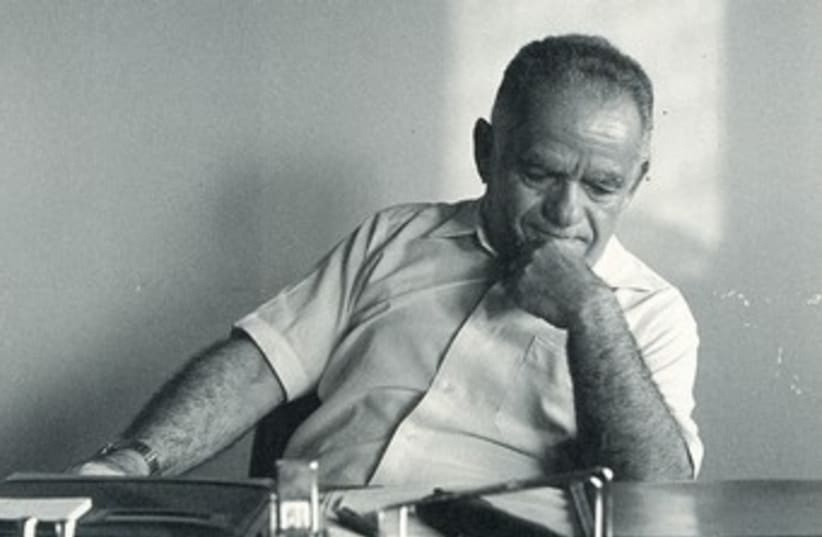
By CAROLINE B. GLICKShamir sits in contemplation in his office in 1983(photo credit: Sven Nackstrand)
There was something about Yitzhak Shamir, Israel’s seventh prime minister who passed away last Saturday, that made you feel shy, in awe when you stood in his presence. In his eulogy at Sunday morning’s cabinet meeting, Prime Minister Binyamin Netanyahu noted that Shamir “didn’t radiate charisma. He simply radiated inner strength.”Shamir, the diminutive, taciturn leader, was a strong man. And Netanyahu was absolutely right, Shamir’s strength owed to his commitment to his convictions. What motivated him to act were not external conditions, but an internal compass, an internal call to devote his life to the Jewish people and our freedom and safety in our land.Netanyahu began his eulogy to Shamir on Sunday morning by placing him in the context of his generation. Netanyahu said, “Yitzhak Shamir was from the generation of giants that founded the State of Israel.”There is much truth in this statement. The generation of Jews that came of age in the 1920s, 1930s and 1940s and established the State of Israel confronted challenges unmatched in human history. They survived the European Holocaust. They stood down and bested the British Empire. They withstood massive terror from the Arabs and repression and betrayal from the British. They defeated the invading armies of five Arab states with a ragtag force of Holocaust survivors and farmers, with little access to arms, and almost no money.They carved a beautiful, modern country out of the rocks and sands of a long-desolate land.They absorbed massive waves of aliya from all over the world. They brought together Jews with diverse customs, traditions and languages and reforged a unitary Jewish people bound to one another by our common heritage, faith, resuscitated language and land – all stronger than what divided us.They suffered agonizing losses at every turn.But they kept moving forward, sometimes in giant leaps, usually in tiny steps. But they kept moving forward.So it is true that Shamir’s generation of Jews had more than its normal share of great men and women. But to do Shamir’s memory the justice it deserves it is important not to obscure his personal greatness by bracketing him inside his generation. This is true for two reasons.First, it was not inevitable that Shamir became a strong, dedicated, successful leader.Many in his generation were not.Shamir faced enormous challenges. And his most serious challenges came from his fellow Jews. People like Chaim Weizmann – whom the late Benzion Netanyahu referred to as “a disaster for the Jewish people,” due to his chronic preference for British approval over Jewish national and legal rights – were more than willing to compromise away the national rights of the Jews to a state of our own in our historic homeland.Indeed, in the years preceding Israel’s declaration of independence, national sovereignty was only perceived as a viable option and reasonable goal by a minority. As Shamir said in a 1993 interview published this week by The Times of Israel, in 1945 David Ben-Gurion called for the establishment of a Jewish commonwealth, rather than a sovereign Jewish state. As Shamir put it, “It was curious that the Zionist movement officially didn’t accept the slogan of a Jewish state as the aim of the Zionist movement!... Weizmann was against it....He want[ed] Jewish unity here... not a state.”LATER, DURING Shamir’s tenure as prime minister in the unity government with then-foreign minister Shimon Peres and the Labor Party from 1986 to 1988, Peres sought to undermine his leadership and bring about his defeat in the 1988 elections by collaborating with foreign governments against him.According to top secret documents from 1988 first disclosed by Yediot Aharonot’s Shimon Schiffer in June 2011, Peres collaborated with then-Egyptian president Hosni Mubarak to destabilize Shamir’s government. Peres also sought US assistance in subverting Shamir and fomenting his electoral defeat. Aside from that, in breach of both Israeli law and the expressed wishes of Shamir, Peres dispatched his emissary, then-Foreign Ministry directorgeneral Avraham Tamir, to Mozambique for secret meetings with Yasser Arafat.Throughout his career, Peres, who is also a member of Shamir’s generation, has distinguished himself as a politician who prefers his personal gain over that of his nation. In keeping with this consistent preference, last month Peres traveled to Washington to receive the Presidential Medal of Freedom from US President Barack Obama, at the same time that Obama rejected Israel’s request to commute the life sentence of Jonathan Pollard. It is safe to say that Shamir would probably not have been offered such an award from a US president.But it is also safe to say that had he been offered the award, Shamir would have used the occasion to publicly press for Pollard’s release.The other reason it is wrong to view Shamir as a mere product of his times is because by doing so, we effectively say that there is no point in emulating him. If he only became the person he became because he lived through the times he lived through, then his story has nothing to teach us about what it means to lead, or to live a meaningful, good life in the service of a goal greater than ourselves. And this cannot be true.In a poetic coincidence of timing, as Netanyahu eulogized Shamir on Sunday morning, Netanyahu’s immediate predecessor, Ehud Olmert, entered a courtroom in Tel Aviv for the start of his criminal trial related to the so-called Holyland Affair. Olmert is accused of taking bribes from the developers of the capital’s architectural monstrosity cynically named “Holyland,” during his tenure as mayor of Jerusalem. He allegedly received money and other benefits in exchange for his willingness to allow the developers to expand the size of the project to more than 10 times the size initially allocated for it.Olmert’s Holyland trial is only the latest of the ex-prime minister’s legal troubles. On July 10, the Jerusalem District Court will hand down its verdict on two other corruption scandals – the Talansky Affair, in which Olmert is on trial for accepting bribes and for campaign finance irregularities, and the Rishon Tours Affair in which Olmert is accused of doublebilling his travel expenses.However Olmert’s legal travails pan out, the fact that he is facing corruption charges to begin with is wholly a function of his character.Unlike Shamir, Olmert is perfectly prepared to abandon the public interest to advance his personal comfort. During his tenure as premier, rather than stand up to US pressure for Israeli concessions of land and rights to the Palestinians, Olmert preemptively capitulated.He called for Israel to unilaterally surrender much of Judea and Samaria to the Palestinians, despite the latter’s rejection of Israel’s right to exist. He offered to carve up Jerusalem in his peace proposal to Palestinian Authority Chairman Mahmoud Abbas. He continued to embrace the cause of appeasement despite Abbas’s preference for peace with Hamas over peace with Israel.So too, during the Second Lebanon War, Olmert chose to lose the war, in a vain attempt to uphold his preference for appeasement over justice and victory. To that end, he accepted a cease-fire that left Hezbollah in charge of south Lebanon. That cease-fire led directly to Hezbollah’s takeover of all of Lebanon in 2007.Olmert defends his behavior through a mixture of lies and self-justification. At The Jerusalem Post Conference in New York on April 29, Olmert claimed that the Second Lebanon War was the greatest military victory in Israel’s history. Apparently he thought we had forgotten about every other war Israel has fought. So, too, Olmert claims that he had no choice other than to submit to US pressure regarding the Palestinians.SHAMIR’S RECORD is a standing rebuke of Olmert’s excuses for his failures. Yes, in two key instances, Shamir caved in to US pressure.He did not respond to Iraq’s missile offensive against Israel during the 1991 Gulf War. And he agreed to participate in the Madrid Conference in 1991 where then-US president George H.W. Bush forced Shamir to hold negotiations on the basis of “land for peace,” with the Palestinians and the Syrians.In both cases, Shamir’s acquiescence to American demands may have been unjustified.Certainly he didn’t exact a high enough price for his sacrifice. Yet even these concessions did not change the situation on the ground.Shamir did not agree to give the Arabs any land. And during his tenure the US significantly upgraded its strategic ties with Israel.Moreover, from the perspective of Israel’s long-term viability and prosperity, Shamir exacted the greatest concession Israel ever gained from the US. He convinced Bush to stop steering Soviet Jewish émigrés to the US and away from Israel. This ensured that one million Soviet Jews made aliya. The Soviet Jewish aliya fundamentally transformed Israel’s economy and demographic posture, and upgraded its strategic position. Whatever damage Israel may have incurred as a result of Shamir’s concessions to Bush was likely outweighed by his success in bringing Soviet Jews to Israel.And it is true that Shamir was never beloved or even liked by the US government or the leaders of Europe. But it is also true that during his tenure in office major countries, including China and India, renewed their diplomatic relations with Israel.By standing up for his country, he earned the respect of the world – not just for himself, but for Israel as a whole. And in international affairs it is far more important to be respected than liked.In his obituary for Shamir, Rabbi Shlomo Aviner explained that Shamir was a successful leader because he was intelligent and tenacious.Aviner noted that Shamir’s intelligence was hard-earned. He took the time to learn the details of every subject he had to contend with. He was a voracious reader and wanted to gather as much information as possible before he made decisions.Shamir’s devotion to learning made it possible for him to intelligently weigh the costs and benefits of various courses of action.Aviner wrote that Shamir’s tenacity was a consequence of his life experiences. He was the commander of the Stern Group (Lehi) guerrilla force in pre-state Israel. He was imprisoned and escaped, twice. He was a Mossad officer. At each stage of his life, he faced great challenges and overcame them.And each experience steeled him for the next until he gradually became the force to be reckoned with he was as prime minister.It is important to recognize that Shamir was the product not only of his times, but of his values and of the choices that he made throughout his extraordinary career. The greatest compliment one can pay another person is to say that he is a model to be emulated, and that his life should serve as an example for what a good life can and should be.We were blessed to have had him as our leader. And his memory should be a blessing in the annals of Jewish history.caroline@carolineglick.com
if(catID != 151){
var cont = `Take Israel home with the new Jerusalem Post Store