The victims of Israeli-Palestinian violence over the past 10 years were the victims of the absence of peace.
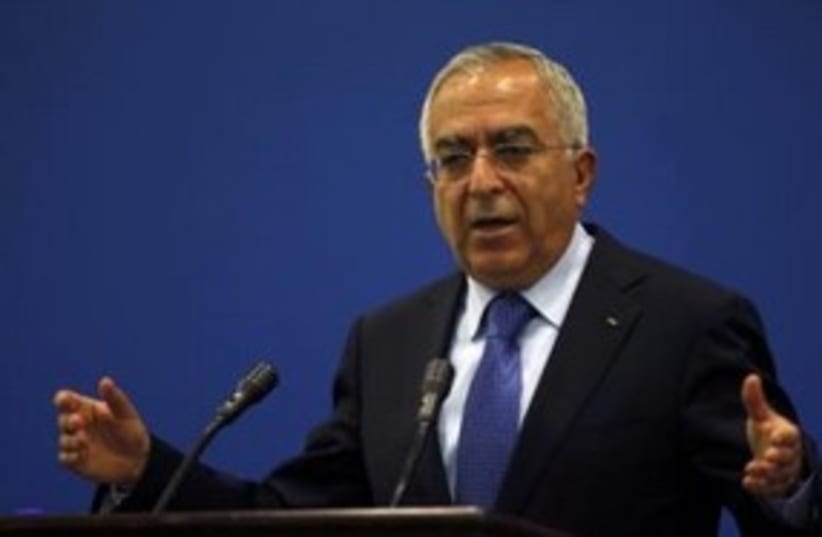
By GERSHON BASKINPalestinian Authority Prime Minister Salam Fayyad 311 (R)(photo credit: REUTERS/Mohamad Torokman)
Palestinian Authority Prime Minister Salam Fayyad was interviewed in the UK-based Jewish Chronicle this week (“PA shares Israel’s nuclear Iran fears” by Stephen Pollard, January 12, 2012). “We are greatly harmed by [Iranian] President [Mahmoud] Ahmadinejad projecting himself as a spokesman for the Palestinians,” said Fayyad.“He seeks the destruction of Israel. We do not. We are deeply troubled by Iran’s interventions and we suffer from them.”I have known Fayyad for a long time, and this statement is completely aligned with the work he has been doing over the past years to make the Palestinian state a reality by tackling the nitty-gritty of state building. He is not perfect, as no one is. He has his faults and everyone seems to enjoy criticizing him these days. I am quite sure that this does not deter him from seeking to accomplish his mission of seeing the healthy and rapid birth of the Palestinian state. He has encountered serious problems along the way, no shortage of them caused by Israel, and no doubt more are still ahead. But he remains fully committed to seeing the Palestinian state born through the work done by Palestinians for Palestinians on the ground.Fayyad has often reminded me of The Sermon (1942), a short story written by the Zionist author Haim Hazaz in which the kibbutz philosopher Yudka says: “We didn’t make our own history, the goyim made it for us.”In a way, the statement could also be made about Palestinian history – with the Palestinian Yudka complaining of the corruption, as he sees it, of a passive political existence that turns suffering, or victimhood, into a virtue.These are Hazaz’s words (imagine replacing the word Jewish with Palestinian): “Jewish history is dull, uninteresting. It has no glory or action, no heroes and conquerors, no rulers and masters of their fate, just a collection of wounded, hunted, groaning and wailing wretches, always begging for mercy.... I would simply forbid teaching our children Jewish history. Why the devil teach them about their ancestors’ shame?” I could easily hear Fayyad preaching the same words. He would/could/should say: enough complaining, enough moaning about our victim status; it’s time to roll up our sleeves and take control of our destiny.
Victimhood is a curse, one that has afflicted too many of us in this region for far too long.I HAVE spent far too many hours hearing stories of victimhood from both Israelis and Palestinians. In the mid-1980s there was a production of a wonderful play by Nola Chelton in which at one point two boxers faced each other in a ring. They were dressed for the fight standing in two corners, one dressed very obviously as a Jew and the other as an Arab. In the center of the ring was the referee, who, after the bell rang and the two boxers came out punching at the air, chanted the historical tragedies that had befallen their respective peoples.A score-keeper appeared at the back of the stage with a huge chalkboard on which was written: “Tournament of Suffering,” with points awarded for suffering and victimhood.He easily filled the blackboard, making it almost impossible to determine who the bigger victim was.Even now when I think about it, so many years later, we all seem to revel in our suffering and we certainly want the other side of the conflict to know who the bigger victim here is. So much of what Haim Hazaz wrote in 1942 continues to be pertinent today. We all continue to allow ourselves out to be the victims of circumstance, as if we bear no responsibility for the choices we (and/or our leaders) make. Oh, it’s so easy to place the blame on the other side, across the conflict line. We want peace, it’s they who don’t. We are a partner for peace, but we have no partner on the other side. We are ready to negotiate, anytime, anyplace, but they won’t even come to the table.Rather than rise up against the insanity of doing nothing to grab what is perhaps the last real opportunity for peace, people on both sides of the conflict are deflated with despair. We have become the people Hazaz despises in his “Sermon.” Been there, tried it – what can I say, peace didn’t work. Look at how many casualties of peace there have been – how many people have lost their lives because of peace – how many victims! Wake up people! These are not casualties of peace, they are causalities of the absence of peace. They are the casualties of failed attempts to make peace, of the failure of our leaders to make the right decisions, the tough decision, the decisions that they know they must make. Both sides, both leaders – they know what they have to do to make real peace. Prime Minister Binyamin Netanyahu and PA President Mahmoud Abbas are both smart enough and have been around long enough to know what the conditions for real, comprehensive and lasting peace are.There can be no trickery here. There is no way to get a better deal than Abbas would have gotten with Olmert, or even Rabin with Arafat. The cards are all on the table and the rules of the game are known. We all know how to resolve this conflict.I, for one, do not want to be a victim of history.I don’t want my people, the Jewish people in the land of Israel, to fall victim to the curse of not taking our lives in our own hands. I don’t believe the Palestinian people want to be the eternal victims of history leaving them in the gutters of political failures.We have all been brainwashed for too long that we have no partner and no chance. We are told that this conflict cannot be resolved; we have to manage it, not end it.Those who say so are wrong, they are lying and they are dangerous to our future. Real leaders would know that. Real leaders make history by making historical decisions that shape their nations and their people.Netanyahu and Abbas both believe that they are historical leaders. But history is not made by just talking about it and it certainly isn’t made by claiming victimhood. History is made by doing – by taking our futures in hand and making bold decisions that can and will resolve this conflict.The writer is the co-chairman of IPCRI, the Israel Palestine Center for Research and Information and a radio host on All for Peace Radio.
if(catID != 151){
var cont = `Take Israel home with the new Jerusalem Post Store