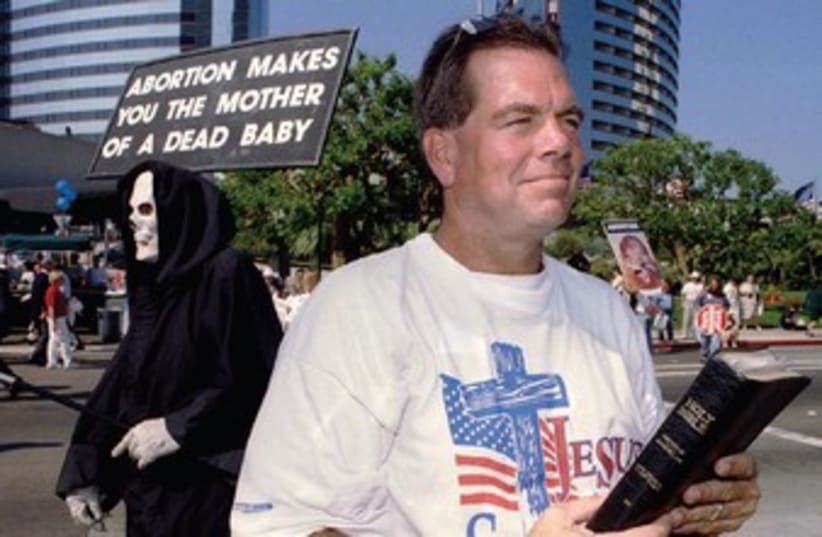
Is abortion in Christianity a mistranslation of Bible?
No Holds Barred: The Guttmacher Institute’s data that 85% of all abortions take place outside of marriage would have us address the subject not as a social wedge issue but by cultivating a culture that commits to marriage.
By SHMULEY BOTEACHAbortion 370(photo credit: REUTERS)
For four decades, abortion has dominated the social values debate in America and deeply divided our nation into factions of pro-life and pro-choice. This year Republicans paid a huge price at the ballot box for extreme positions, like not allowing abortion even in the case of incest or rape, with two Republican Senate candidates going so far as to speak of “legitimate rape” and divinely-sanctioned pregnancies that result from rape.What is lost in this discussion are the biblical underpinnings of abortion and how this is not primarily a legal issue but a religious one. Opponents of abortion do not look to the Constitution to cement their opposition but to the Bible, and, as such, it is worth reviewing the biblical text pertaining to abortion, which yields surprising results.The Hebrew Bible makes only one reference to abortion, and this is by implication. Exodus 21:22-23 states: “And if two men strive together and hurt a woman with child, so that her fruit depart, and yet no harm follows, he shall be surely fined, accordingly as the woman’s husband shall lay upon him, and he shall pay as the judges determine. But if any harm follows, though shalt give life for life....”There is a significant parting of the ways in the interpretation of this passage between Judaism and Catholicism which will, in turn, mark the much more lenient rulings on abortion of the former and the much more severe views of the latter.According to the ancient rabbis, the text is to be read simply as written. The Bible talks of a woman who is hurt by a man in a fight and miscarries as a result. Monetary restitution is paid for her miscarriage. But if the woman dies, then one must give a life for a life. The passage thus implies that the fetus is not alive, but that the mother is.THE INTERPRETATION is straightforward and matches the Hebrew original precisely. According to the Jewish interpretation the Bible only says that the woman, rather than her fetus, is living.This interpretation that a fetus is not fully alive and thus that the destruction of a fetus does not carry a death penalty is also borne out by the rabbinical interpretation of the verse defining the law of murder: “He that smiteth a man, so that he dieth, shall surely be put to death” (Exodus 21:12), which the rabbis construed to mean “a man, but not a fetus.”These passages clearly indicate that the killing of an unborn child is not considered murder.But the Christian tradition disputing this view goes back to a mistranslation in the Septuagint, the early Greek translation of the Bible that sometimes contains significant errors (see my book Kosher Jesus for a comprehensive list). There, the Hebrew for “no harm follows” was replaced by the Greek for “[her child be born] imperfectly formed.”This interpretation, distinguishing between an unformed and a formed fetus and branding the killing of the latter as murder, was accepted by Tertullian and by later church fathers and was subsequently embodied as canon law and in Justinian law. In the Christian interpretation, therefore, both parts of the verse refer not to the mother’s life, but to the fetus’s. And the verse concludes that you must “give life for life,” meaning a fetus is fully alive and destroying a fetus constitutes murder, punishable by death.This is the source for the Catholic view that since a fetus’s life is the equal of a mother’s life, even if the mother’s life is at risk one cannot perform an abortion as it constitutes murder.Judaism, however, strongly disputes this interpretation, which is not faithful to the Hebrew original.Therefore, the Talmud declares (Ohalot 7:6): “If a woman is in hard travail [and her life cannot otherwise be saved], one cuts up the child in her womb and extracts it member by member, because her life comes before that of the [the child]. But if the greater part [or the head] was delivered, one may not touch it, for one may not set aside one person’s life for the sake of another.”A fetus is only alive when it is born, not before.The great Jewish law codifier Maimonides adds the further argument that such a fetus, being in “pursuit” of the mother’s life, however unintentionally, may be destroyed as an “aggressor,” following the general principle of self-defense. Rashi, the greatest of all Jewish Bible commentators, says this is so because as long as the baby does not come out it is not a nefesh, not a human being and therefore, not fully alive. (Sanhedrin) Judaism still prohibits abortion, but on the grounds that it constitutes either “wasting seed,” “personal, self-inflicted harm to the body,” or, in the case of a minority of rabbis, a form of manslaughter, with an even smaller minority saying it can be considered murder.But because, according to most rabbinical authorities, the nature of the prohibition, following the Biblical text, is not murder, when it comes to cases of rape, incest, or even psychological harm to the mother, even if such harm may result from severe financial distress, abortions have been permitted.To be sure, Judaism does not in any way allow abortion as a form of contraception and we dare never be cavalier about the issue. Most abortions are prohibited by Jewish law for the reasons outlined above. But the rabbis take a much more sympathetic approach with leading authorities allowing abortions in the case of Tay Sachs babies and other genetically lethal diseases.What emerges is a strong argument against viewing abortion as murder and the biblical latitude to certainly allow abortions in extreme circumstances like rape, incest, and when the health of the mother is at risk.My own belief is that abortion should not be a divisive legal issue and we should stop trying to overturn Roe v Wade. Rather, abortion should be reduced by focusing instead on building up the institution of marriage.The Guttmacher Institute’s data that 85 percent of all abortions take place outside of marriage would have us address the subject not as a social wedge issue but by cultivating a culture that respects women, commits to marriage, and emphasizes the intimate nature of sex over its recreational dimension.The writer is the international best-selling author of 29 books, and will shortly publish The Fed-up Man of Faith: Challenging God in the Face of Tragedy and Suffering. Follow him on Twitter @RabbiShmuley.
if(catID != 151){
var cont = `Take Israel home with the new Jerusalem Post Store