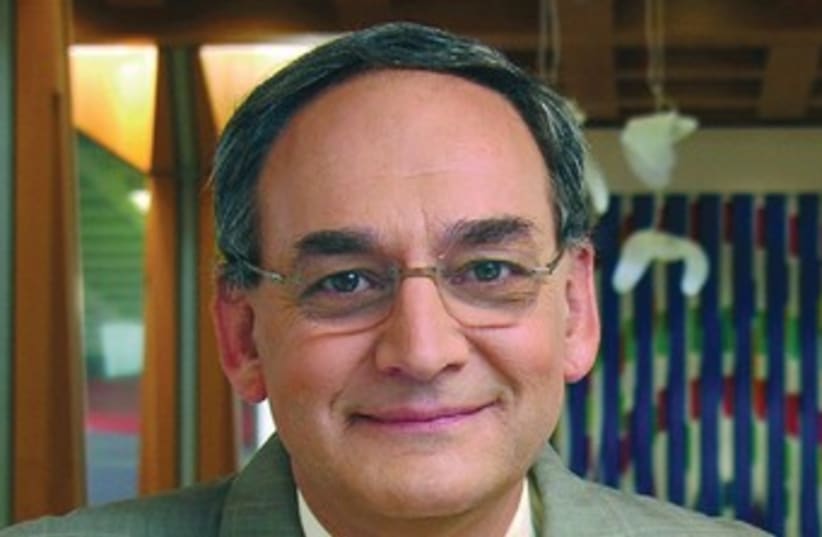
Editor's Notes: A candid interview with Sheba’s director, Prof. Zeev Rotstein.
By STEVE LINDEZeev Rotstein 370(photo credit: Sheba)
Prof. Zeev Rotstein, director of the Sheba Medical Center/Tel Hashomer Hospital, has much to be proud of as he sits in his office and talks to The Jerusalem Post about his hospital’s myriad achievements.And he is. But he is also angry, mostly at the government for not putting public health high on its agenda. In a year that ended with a nurses’ strike, Rotstein believes that the failing state of the country’s health system should also be a key issue in the January 22 elections.“It is depressing that in this election campaign, the subject of health doesn’t make news,” he says. “The State of Israel is standing by as the public health system deteriorates. The government is taking no responsibility for ensuring that the glorious achievements of our health system over the years – in innovation, physician excellence, and a high standard of patient care for all – are maintained. Instead, it watches limply as money, doctors and patients are being sucked out of the public health system to private institutions, making quality medical care inequitable and inaccessible for many Israelis. This is a great tragedy and I fight against it every day.”The Sheba Medical Center was born in 1948 along with the fledgling State of Israel to treat the wounded of Israel’s War of Independence. David Ben-Gurion, the prime minister, personally tasked Dr.Chaim Sheba with the opening of a small military hospital at Tel Litwinsky (later renamed Tel Hashomer, meaning “Hill of Guardians”), in American and British army barracks, to heal the brave men and women injured in the pivotal battle for Jerusalem.Tel Hashomer Hospital became the Chaim Sheba Medical Center, and it is today the State of Israel’s flagship medical center, combining six facilities: A vast medical research complex, a medical education academic campus, an acute care hospital, a children’s hospital, a women’s hospital, and the country’s main rehabilitation hospital. Some 7,000 healthcare professionals and scientists work on Sheba’s sprawling 150 acre campus, and more than 1.5 million patients from Israel and abroad are treated there every year by 1,100 doctors and almost 2,000 nurses.Despite the worsening structural problems of the public health system that so frustrates and infuriates Rotstein, Sheba somehow remains a classic Israeli success story. In medical research, innovative treatment, and medical education of the next generation it is clearly the country leader.It clinical services excel by any international standard, especially in hemato-oncology, cardiovascular diseases, genetics, gynecology, orthopedics, psychiatry and surgery. In fact, more than 30,000 operations are at conducted at Sheba every year – an amazing figure.“Every day, 365 days a year, we take care of Israelis and people from all over the world – which does wonders for Israel’s image,” says Prof. Rotstein.“We recently treated a pastor from Uganda who sustained severe burns in an acid attack because of his pro-Israel views, and a Cypriot woman who was also injured in an attack and needed eye treatment.“Over the years, we have taken in dozens of people wounded in terrorist attacks who are immediately referred to us. We always rush to help wounded IDF soldiers and victims of terror, because we believe that this is the national hospital of Israel. As such, it is our first duty to help anyone hurt in attacks against the state.In this sense, we are a hospital primarily for residents of Israel, but also open to everyone else.“Unfortunately, despite being the main hospital in the country, we receive a budget of zero shekels from the government of Israel,” Rotstein says. “Our running budget is completely balanced through careful management and cooperation with the health funds. But in order to buy new equipment, build new buildings, and support the massive research infrastructure and education facilities that exist at Sheba, we have to rely on the magnificent friends of Sheba Medical Center around the world.“As director of the hospital, I devote a great deal of time to philanthropic efforts around the world. I have no choice.And here is an absurd: When I go abroad to participate in fund-raising efforts for the medical center, I am penalized by the Health Ministry. Believe it or not, they deduct the days I am abroad from my salary!” Asked about the just-ended nurses’ strike, Rotstein – who began his work at Sheba as a nurse – says: “If a young nurse earns less than the average salary, it means that the government doesn’t see this profession as one that is important, and worth investing in and encouraging. Evidence of this is that we don’t have enough nurses, there aren’t enough applications to nursing school, and more than a few nurses are leaving the profession.”Rotstein vividly recalls the strike by doctors and residents at public hospitals in 2011.“We haven’t forgotten the devastating doctors’ strike. To my deep regret, the Israeli health system has recently gotten into the routine of strikes, and it is the citizens of Israel who pay the price. I look into the eyes of all those we could be helping, but we don’t have the capability, the support and the back-up to do so. The public health system is losing its credibility and its raison d’être.“My heart aches when I see that our decision-makers don’t realize we are at a strategic crossroads where the exemplary health system that we once had is being sucked dry.”How did the situation get like this?Israel invested so much for so long in the health system, and then suddenly stopped. This government is no longer involved in developing public hospitals, and not at all in capital investment.Essentially, the healthy equilibrium between public and private health systems has been shattered. Huge sums of money, more than NIS 6 billion a year, are being extracted from the public in various health service fees and supplementary insurance premiums, and public hospitals have no access to these funds under regulations drawn up by the Finance Ministry. Instead the monies flow to the private hospitals.Along with the funds go the doctors and patients.Fifty-one percent of Israel’s overall health expenditures now come out of the average citizen’s personal pocket – one of the highest rates in the world. As a result, all Israel HMOs (kupot holim) are running budget deficits double the size of last year’s deficits. As a result, the HMOs don’t properly reimburse the public hospitals for the patient services we provide. As a result, the quality of service in our public hospitals is deteriorating as are the hospital infrastructures.We are harming everything good that we have built up.And when I see this, I ask myself, “Until when? When will someone do something? Who will stand up and say, I am going to change things in a significant way?” Unfortunately, the easiest thing for a hospital director today is just not to do anything.Don’t stand up, make a noise, open your mouth, sound the alarm, or go the extra mile. But this is against my whole worldview.Initiative and a drive for excellence are what created and built the State of Israel. Unless we serve as an example, and insist on developing our institutions to the highest levels, the state will go backward.Public hospitals should be conducting advanced research and developing new treatments for the people of Israel.The easy option is to make much more money in private medicine, at the expense of public health system. But we mustn’t take the easy way out!To whom do you address your grievances?The address is the government. It should be written on the wall: “Government of Israel, stop ignoring the needs of the system!”Remember: We are in the midst of a period in the Middle East that is not good. We are not happy with what is happening in Egypt, where [President Mohamed] Morsi seems to be taking things in a worrying direction. We are not happy with the situation in Lebanon, where the Shi’ites are taking over. Syria is in turmoil.The fact that it’s quiet now doesn’t mean there won’t be rockets fired at Tel Aviv tomorrow morning or next week. All this means that we should be smart, and say, let’s protect our people, and not just from rockets, but also in treatment. If we want to be able to save the lives of people who are wounded, we must develop and protect our health system.Let me give you one example.The State of Israel should be supporting the building of bomb shelters at hospitals. We have very little protected space to take care of people, including soldiers, in mass emergencies while under bombardment.So the Sheba Medical Center just built underground facilities at our expense for the Sheba maternity (OB/GYN) hospital, where 10,000 births are recorded a year. Three-quarters of the cost came from philanthropy, and I am hoping to yet successfully conclude a negotiation with the government for perhaps the last one quarter of the costs. I hope and – I pray that we are able to reach an agreement.The bottom line is that government faces many problems, but health doesn’t seem too high on its agenda. I want health to be catapulted high up on the national agenda. It’s no less important than education, and I would say it’s just as important as defense.The government should also be investing much more in medical-scientific infrastructures.Twenty-five percent of all scientific research work that is being done at hospitals in Israel is conducted at the Sheba, including most of the human clinical trials of scientists at the Weizmann Institute and Bar- Ilan and Tel Aviv universities – and that’s a lot. Right from the start, Sheba has invested heavily itself in the infrastructures necessary for world-class research: laboratories, equipment and of course, personnel of an international level.Today, I am happy to say, despite the difficult situation of the hospitals and the doctors, we have managed through philanthropy to maintain and advance this infrastructure to produce a high standard of research. There are some amazing things that come out of here.Can you give an example?Take, for example, cancer research. The whole approach to treating cancer is changing, and we are leading the big change. Rather than bombarding the body with chemotherapy which destroys all its cells, we are developing and now using therapies, which target the specific area of cancer. It’s just like in artillery, where you surgically pinpoint a specific area to cause minimum damage outside of the area. It’s personalized medicine in which you conduct patient-tailored targeting. Today we do a genetic breakdown on a patient, so that we can focus on treating the disease to achieve the greatest effect with minimum sideeffects.It’s really a revolution.We just bought the most advanced linear accelerator in the world, the true beam radiotherapy machine, and built a special wing for it. It’s very focused and radiates the minimum amount of cells.The Sheba Cancer Research Center is a world-leader in this revolution, and our collaborators are top hospitals here and around the world. Our networking extends from the Weizmann Institute to the M.D. Anderson Cancer Center in Houston, which is the US’s top cancer hospital. We are a formal sister hospital to M.D Anderson.Anderson in cancer treatment and research, and our researchers work together, shoulder to shoulder, and I’m very proud of it. We share treatment protocols and conduct joint clinical and basic research. M.D. Anderson recently launched a campaign against cancer to the tune of $17 billion. We can’t come close to raising that sum, not in our wildest dreams. But the fact that we work together is amazing and impressive – and very beneficial to our patients.We also run world-class multidisciplinary research centers in autoimmune diseases, diabetes and metabolic diseases, onco-genetics and fertility, lipids and arthrosclerosis, neurosciences, and stem cell and regenerative medicine.ROTSTEIN, who was born in 1950 and is married with five children, lost his mother to cancer at a young age, and it’s been with him as a personal issue for many years.“Fighting cancer is a personal issue, but it’s a national issue and an international issue too,” he says. “There’s no reason today for losing so many young people to the disease when we are so aware of the causes of cancer, and we know when to intervene to stop it spreading.“An important example is what we have done with melanoma. We opened the Ella Institute for Treatment and Research of Melanoma, through the generous philanthropy of a family who lost their daughter to melanoma.The treatments we give patients are a combination of medicine and cellular therapy are, in some cases, world pioneering and our success rate approaches 50 percent in combating melanoma, which is a devastating disease that can kill within a year. And, of course, we are invited to conferences all over the world, which is very good for us.Rotstein is the only director of a hospital in Israel who started as a nurse.“I first came here in 1994 as a medical student who needed to make a living. I started working as a nurse in Sheba until I began as a medical intern, then worked in cardiology as a doctor for about five years,” he says. “Then I got the bug to do more, to contribute more, so I did a business degree in health care management, and returned to work in management, and eventually worked my way up to becoming director of the medical center nine years ago.”What’s your main challenge?One of our primary obligations is to prepare the next generation of doctors.Together with the Sackler School of Medicine at Tel Aviv University, we have doubled the number of students we have studying here to over 1,400. We have worked hard to collaborate with universities abroad, in Hungary for example, to bring back Israeli medical students studying there so they can complete their studies in Israel. We have about 80 at the moment. We are also accredited to teach students from the University of London. We are now a formal campus for clinical instruction of students at that university, which once was very difficult for Israeli academia to enter.We are open to everyone – to Israelis, Jews in the Diaspora, and non-Jews.In the case of the students from the University of London, we give them two degrees, MD and MBBS, two years of which they study here. Afterward, they can all practice as doctors in Israel. I think this is a supreme Zionist initiative, because it appeals to all young people who want to make a medical career in Israel. The Immigrant Absorption Ministry and Nefesh B’Nefesh both help us in getting young Jews interested in practicing medicine to make aliya and study here.Another pioneering initiative of ours is Sheba’s Talpiot Medical Leadership Program. We based this project on the army’s wellknown Talpiot program. The Sheba Talpiot program advances the brightest young physicians for leadership positions in medicine and healthcare in Israel, and transforms outstanding young MD/PhD physicians into “renaissance” doctors and senior medical executives who serves as agents of change – both for Sheba and for the entire Israeli medical system.This is the tool through which the hospital seeks to produce the innovative medical leaders of tomorrow, to meet Israeli society’s critical healthcare needs; it is our central contribution to the longterm health and high quality of Israel’s medical system.We provide Talpiot doctors with coaching and personal enrichment studies, along with special funds, to help build their personal careers. Today we have 30 such Talpiot scholars, some of whom have already made an international reputation for themselves, who represent a valuable future for Sheba and for the State of Israel.What other national programs does Sheba offer?Sheba has always taken on national leadership roles. We wear a nationalist hat, if you will. For example, today we do newborn screening in an infant’s first week for all Israeli babies. We receive blood samples from children born across Israel, and we look for 10 metabolic diseases. As soon as a diagnosis is made, we inform the hospital, and treatment begins to save the child’s life. This is a national project which we have taken upon ourselves.Other national health institutions at Sheba include the Israel Blood Bank, Israel Center for Autoimmune Diseases, Israel Center for Cystic Fibrosis, Israel Center for Glaucoma, Israel Center for Hemophilia, Israel Center for Medical Simulation, Israel Center for Multiple Sclerosis, Israel Center for Spinal Cord Injuries, Israel Center for Tay Sachs, and more.We also have one of the largest and most comprehensive rehabilitation hospitals in the world with 800 beds, providing rehab services in the orthopedic, neurological, cardiac, respiratory, psychiatric, geriatric, trauma and MS fields.Israel does not yet have a national burns treatment center yet, but I hope that over the coming year Sheba will raise the money for this critical center. Last year’s Carmel forest fire and the recent wars show how important burns treatment is, and it is a very expensive and specialized field.Tell me about your international patients.The Sheba Medical Center is a hospital without borders; a hospital of peace; a color- and raceblind institution. Patients come to Sheba from across the Middle East, including from Arab countries that have no diplomatic relations with Israel and from the Palestinian Authority. Our Edmond and Lily Safra Children’s Hospital, in particular, plays a special role in treating Palestinian children, especially in the fields of pediatric oncology and cardiac surgery. Increasingly, we are getting patients from eastern Europe too.One of our best known recent patients is Umar Mulinde from Uganda, because he is a pastor who converted from Islam and who suffered severe burns [from an acid attack last Christmas] because of his support for Israel.So it was natural for us to take him and treat him free of charge. For us, he’s a symbol.Sheba also is very active and experienced in delivering medical assistance beyond Israel’s national boundaries. Sheba doctors have provided international relief and medical training in Armenia, Azerbaijan, Brazil, Cambodia, China, Georgia, Equatorial Guinea, Haiti, Ivory Coast, Kazakhstan, Kosovo, Mauritania, Mongolia, Myanmar, Peru, Russia, Rwanda, Slovenia, Sri Lanka, Ukraine, Uzbekistan and more.Sheba also maintains a special medical treatment agreement with the Republic of Cyprus. We are still active in Haiti.These activities stem from the State of Israel’s long-time tradition of contributing to humanitarian relief efforts abroad; and out of an abiding concern for healing and compassion that is ingrained in Jewish history and tradition.Ultimately, this also rebounds to Israel’s credit and favor. Through the work we do here, Israel is seen as a country that gives life and saves lives, not as an evil state.Let’s take the Palestinian example.Sometimes, in our hospital, a family from Gaza coming for pediatric treatment meets Israelis for the first time. The only thing they know about Israel is from incitement and the attacks by Israeli artillery or helicopters on them.And what do we hear them say in the corridors? They say: ‘These Israelis, who we thought were monsters, are treating us exactly as they treat other Israelis?! Amazing!” When you hear a sentence like this, you nestle a hope that your patients will become ambassadors of goodwill – and perhaps one day be a bridgehead toward peace.Thanks to David M. Weinberg from the Public Affairs Department at Sheba Medical Center for his help in writing up this interview.
if(catID != 151){
var cont = `Take Israel home with the new Jerusalem Post Store