Israel’s new two-party system: A force for extremism
iENGAGE: A new feature has emerged in Israeli politics this election season: the evolution of our political culture into a de facto two-party system similar to the Republican and Democrat divide in the US, referred to here as the Right and the Center-Left.
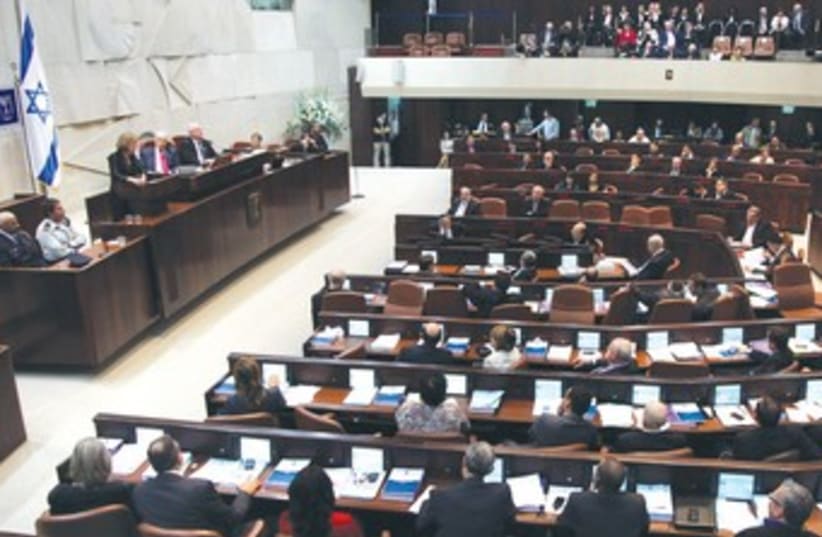
By DONNIEL HARTMANKnesset 370(photo credit: Marc Israel Sellem/The Jerusalem Post)
A new feature has emerged in Israeli politics this election season: the evolution of our political culture into a de facto two-party system similar to the Republican and Democrat divide in the US, referred to here as the Right and the Center-Left.There are indeed two sectorial groups outside this divide – haredim and Arabs. The former, however, will join either of the two “parties,” depending on which is willing to greater serve the interests of its sector, while the latter always remains in the opposition.It is true that these two parties are divided into multiple mini-parties. However, the fact that the two major parties (the Likud and Yisrael Beytenu) on the Right have amalgamated, and the third (Bayit Yehudi) is running on the platform of being their coalition partner, while on the Left, politicians are jumping from sub-party to sub-party, avoiding a formal unification primarily because of ego, are all evidence of the fact that the old multiple party system is dead.Voters and politicians are no longer loyal or bound to a sub-party but to the larger party bloc, and shift their affiliations freely within this bloc without feeling any remorse or nostalgia. The sub-party is but a means and a platform to serve them without any ability to generate sustained loyalty.Thus, for example, Amir Peretz can wake up in the morning as one of the leaders of the Labor Party and go to sleep at night as one of the leaders of The Tzipi Livni Party (Hatnuah), itself formed by Livni, the former leader of the Kadima Party. Those who see all of this as opportunism fail to realize the profound shift within Israeli political culture from the multiparty to the twop-arty system.Similarly, the dramatic growth in popularity of the heretofore religious-Zionist sectorial party, the Bayit Yehudi, with the support of secular former Likud loyalists, the significant infiltration into the Likud Knesset candidates list of individuals and ideologues who are using the Likud base to mainstream positions which in the past were the domain of the extreme Right, and on the Left, with the disintegration of the popular base of Kadima, the largest party in the last Knesset, and its redistribution within the Center-Left “party,” are again evidence of the fact that the electorate is thinking within the context of a two-party model, with the sub-parties being merely the vehicle du jour to best represent their core commitments.While this emergence of a two-party system generates greater clarity for the electorate and promises stability for the government, the fact that, as distinct from the United States, it is based on sub-party components, creates a foundation for a particularly toxic and destructive phenomenon.Because most voters are already clearly aligned within one of the two blocs, the main campaigns of the sub-parties are not against those within the other bloc but within their own. This reality generates a move to unnecessary radicalism, as each sub-party attempts to brand itself as unique.In the current election season, the right-wing “party,” which will win the next election, is plagued by a competition amongst its sub-parties as to who is more “pro-settlement,” more “anti-Mahmoud Abbas” and more vociferous in protecting and caring for the “Jewish Israel.”In the past, the conventional wisdom was that you could only win an election in Israel from the Center. While Binyamin Netanyahu, from the perspective of those on the Left, is clearly on the Right, the cornerstone of his political success was his laying hold to the position of the Center- Right. His embrace of Bennie Begin, with his steadfast commitment to democracy and liberalism, and Dan Meridor, a longstanding supporter of both of these values, as well as moderation in foreign policy, together with his 2009 Bar-Ilan University speech and ongoing vetoes of most of the anti-democratic legislation put forward by the Knesset, all served to make Netanyahu both electable and acceptable to a broad spectrum of Israelis on both sides of the political divide.In this campaign, however, not only is Netanyahu going into the electoral battle without the above allies, but more and more of his party members believe that the most effective way to combat the Bayit Yehudi is to outflank it on the Right. In this context, the Bar-Ilan speech accepting a two-state solution in theory is now a liability, and spokespeople for the heretofore center-right Likud allow themselves to vocalize a nationalistic, xenophobic and at times even anti-democratic rhetoric that in the past never would even have been considered.One of the lessons of the recent US election is that you cannot win the country from either extreme, and the Republican Party, if it wants to return to power, will have to look carefully at the consequences of a platform that represents the radical Right within the party. The advantage that the Republican Party has is that it lost the election. There is nothing like the harsh reality of failure to generate reevaluation and refocus.In the Israeli dual-party, sub-party system, however, such a corrective does not exist. The right-wing party will win on the basis of a center-right majority within Israel. However, this center-right will be governed by individuals and platforms which represent extreme sub-party ideologies.There are some who find comfort in the belief that election rhetoric does not represent day-after Election Day policies. This is the case only when there are moderating forces at the table. In our frenzy to win the sub-party battles, however, we have stacked the deck against moderation, and I am fearful that we lack the internal forces to heal ourselves.As we move toward the end of the election season it is critical that Center-Right voices emerge with moral and ideological clarity, compelled by a vision of what will be good for the country, regardless of its significance in the sub-party conflict. It will be a mistake if these voices remain silent, waiting to emerge in the safety of the day after the elections. A culture, rhetoric and public discourse about policy are taking root in these elections which will not be easily uprooted. As our rabbis teach us, if not now, when? Every day that this discourse is allowed to rule dramatically changes not the outcome of this election but the future of Israeli society.Finally, sub-parties on the Center-Left must enter into the fray, not as voices in the opposition but as unabashed coalition partner aspirants. The cynics will say that in doing so they are expressing a void of values and a commitment to power over ideology.Nothing could be further from the truth.Politics is about using power to actualize ideology. In the new Israeli two-party system, we don’t need a national unity government.We need sub-parties from both “parties” to join together to save us from ourselves.Rabbi Dr. Donniel Hartman is president of the Shalom Hartman Institute and director of the Institute’s iENGAGE Project – iengage.org.il.
if(catID != 151){
var cont = `Take Israel home with the new Jerusalem Post Store