As a small country and the world’s only state with a Jewish majority, Israel already has reason to be anxious about its demographic balance.
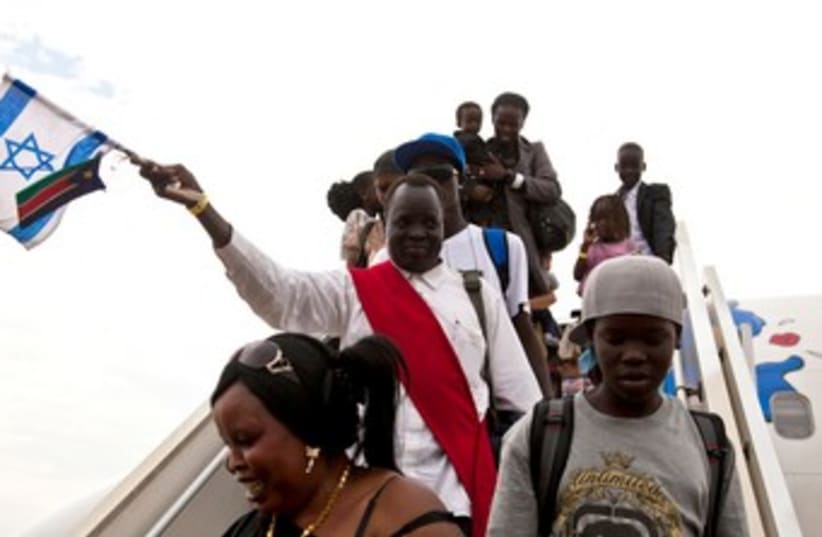
By ELLI FISCHERSouth Sudanese disembark in Juba after TA flight 370(photo credit: REUTERS/Adriane Ohanesian)
Developed countries inevitably attract migrants in search of freedom or economic opportunity; no less inevitably, some native-born citizens react negatively, occasionally with violence, as neighborhoods change and livelihoods become threatened by the influx of cheaper labor. The US, throughout its history, has hardly been immune to such stirrings; in Europe, political parties running on openly anti-immigrant platforms have enjoyed significant electoral success.Against this background, the news of a recent backlash in Israel against the country’s many illegal migrants was entirely to be expected. Things came to a head in late May in response to the alleged rape of an Israeli woman by an African migrant. As protests broke out, accompanied by scattered acts of violence, the government announced a decision to implement a policy of selective deportation.But if the Israeli case sounds typical, several factors also make it unique. For one thing, although it has long been a magnet for foreign workers, Israel is a relative latecomer to the ranks of the world’s most developed nations, so that only in the past two years have the sheer numbers of illegal immigrants reached anxiety-producing levels. For another, since Israel offers more freedom and economic opportunity than do its neighbors, migrants once in Israel are unlikely to leave voluntarily. Third, migrants from the Horn of Africa – the bulk of today’s newcomers – are able to enter the country by land through Egypt, evading any sort of border control.Perhaps most importantly, as a small country and the world’s only state with a Jewish majority, Israel already has reason to be anxious about its demographic balance.In the face of millions of Palestinian “refugees” claiming a right to repatriation, it is little wonder that non-Jewish immigration is seen as an existential threat to the Zionist enterprise and indeed to the Jewish right of self-determination.But that brings us to another unique factor: namely, the Jewish state’s predisposition to an open heart and abnormal displays of compassion. Jews harbor a long memory of estrangement and rootlessness – a memory that stretches back to ancient Egypt and that certainly was not diminished by the experiences of the 20th century. On countless occasions, the Torah, the prophets and rabbinic literature enjoin Jews to love and embrace the ger – the sojourner, the migrant – for we were migrants in the Land of Egypt.Can Israel find a way to uphold Judaism’s concern for the stranger without compromising its demographic makeup? On the far Left, some who are largely unconcerned with the preservation of the state’s Jewish majority vehemently oppose the border fence with Egypt now being constructed, not to mention any move to deport illegal immigrants.On the other side of the political spectrum, some Knesset members have denounced migrants as a “cancer” and a “plague”; one went so far as to demand that anyone trying to cross illegally into the country be shot.These politicians have tapped into a sentiment that, according to a recent poll, is most pronounced among Israel’s religious citizens. Then there is Interior Minister Eli Yishai, who accused African migrants of spreading AIDS by raping Jewish women.These are the extremes; as against them, an emerging political consensus, running from moderate Left to moderate Right, favors a sensible middle way. The consensus is reflected in statements by senior government officials and even in government policy, which itself appears to be moving fitfully toward a mixed and balanced resolution.In the case of today’s most neuralgic issue, the one posed by illegal migrants from Africa, a balance has already been struck by means, essentially, of inaction.On the one hand, the state acknowledges that wholesale deportation to an enemy or otherwise dangerous regime like Sudan or Eritrea, which together account for the vast majority of migrants, is a non-starter because of the risk to life and limb. On the other hand, granting any sort of de jure right of residence would only encourage increased migration.The upshot is that illegal migrants remain in limbo: although not granted work permits or a political horizon of any kind, they are also, for the most part, not deported. There is even an official agreement not to enforce laws prohibiting illegal migrants from working.In practice, then, migrants arrested along the Egyptian border suffer a brief detention – during which little effort is made to determine the migrants’ legal status – and are then delivered to the central bus station in south Tel Aviv and simply turned loose. Their next stop is generally the nearby Levinsky Park, a de facto absorption center and the focal point of non-governmental relief efforts.Eventually, most migrants move out of the park into overcrowded apartments and find work as manual laborers.This half-baked arrangement was developed before migration reached its present levels; in the face of today’s rapid growth, it has obviously proved untenable.Coming under sustained pressure for its failure either to foresee or to contain the burgeoning crisis, the government is slowly forging a more comprehensive policy.Hence the border fence with Egypt: scheduled for completion by the end of this year, the fence is designed to slow migration to a fraction of its current levels.Meanwhile, a large detention facility under construction in the Negev will house migrants for up to three years while their status is being resolved. Prime Minister Binyamin Netanyahu and Deputy Foreign Minister Danny Ayalon have explicitly stated that migrants will not be returned to Sudan or Eritrea, but Israel has indeed begun to turn back illegal migrants from South Sudan and the Ivory Coast, both of which maintain diplomatic ties with Jerusalem and neither of which is deemed a threat to the lives of deportees. On the domestic front, the prime minister, Knesset Speaker Reuven Rivlin, Foreign Minister Avigdor Lieberman and Arab MK Ahmed Tibi have all condemned racist rhetoric and violent behavior toward migrants even as they support measures to limit migration and deport those who can be deported.By making it more difficult to enter the country, and by indefinitely delaying access to its civic life, Israel hopes to deter those seeking economic opportunity alone. But bona fide refugees and asylum- seekers will be properly processed and, if approved, granted some sort of permanent status. As for migrants already in Israel, the majority will also gain some form of recognition or amnesty. Although the government is keeping mum about its intentions until the fence is completed, once that infrastructure is in place there will at least be no risk of 60,000 migrants turning into 600,000.Before that happens, of course, the situation on the street could deteriorate. Still, there is reason to be optimistic that Israel will succeed in balancing the need to preserve its demographic character with the Jewish tradition of care for the sojourner – just as there is reason to hope that responsible government policy will have a trickle-down effect on a restive citizenry. Elli Fischer is a writer and translator who lives in Modi’in. He is involved in a grassroots initiative to educate Israel’s religious community about African migration
This article was first published by Jewish Ideas Daily and is reprinted with permission.
if(catID != 151){
var cont = `Take Israel home with the new Jerusalem Post Store