The Internet plays an ever-increasing role in our life and certainly when it comes to election campaigns.
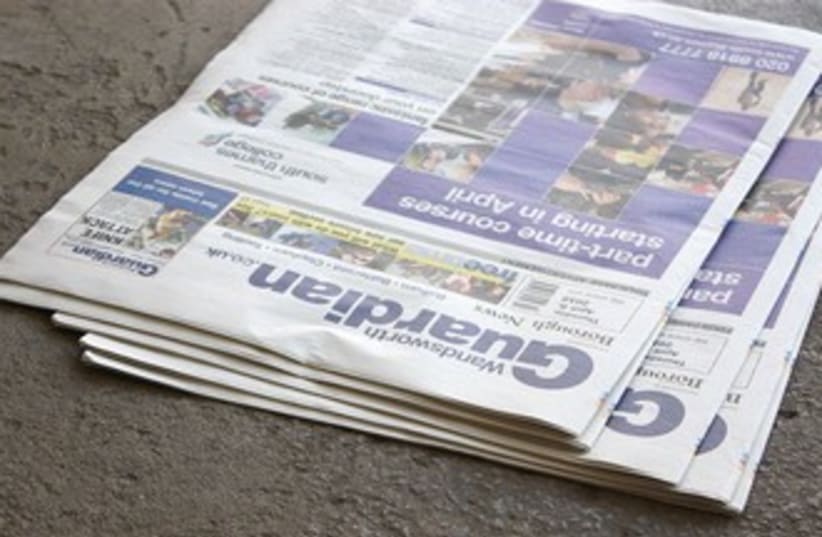
By YISRAEL MEDAD, ELI POLLAKGuardian Newspaper 370(photo credit: Toya, Wikimedia Commons)
Writing in the November 7 Guardian, Dan Gillmor had this opinion of the recent US presidential election: “America’s top journalists have pretty much gotten out of [the] business [of holding candidates to account]... I’ve never seen a worse performance in a major political campaign. On issue after issue – again, with some important exceptions, many in the alternative or new media – the press simply couldn’t be bothered to do its job.”He was especially critical of “Big Journalism’s tendency to suck up to power, not confront it.” His dislike for Mitt Romney and the Republican Party was more than apparent, nevertheless, he also noted that “Obama has largely been given a pass by news organizations on his own worst deeds.”For him, journalism’s “decline overall is simply too stark to deny.”Observers more attuned to foreign policy issues saw the coverage of the Benghazi attack and Obama’s refusal to term it terror as an instance, to quote one critic, when the media “suppressed evidence in order to help a Democratic president. Simply shameful, as was the media’s disregard of any scandal or story that could have jeopardized the Obama reelection.”An uncritical press combined with media personnel prejudiced against one candidate can be deeply affect the chances of a candidate to get elected. We only need recall Barack Obama, referring to the love the press expressed for him, joking at the October 2009 White House correspondents’ dinner, “Most of you covered me. All of you voted for me.”Here in Israel, we have entered our own election period and already foibles and insidious behavior are observed, a situation that demands close monitoring as well as vigorous civic action to call this behavior to account and stop it.There are academic papers claiming that voter decision-making during election campaigns is not significantly affected by the media.They base themselves on the assumption that especially during the campaign period, information abounds. Voters are able to update their thinking sufficiently frequently during the campaign period so as to make decisions which are largely independent of one bias or another. But academia aside – and as we all know, especially in the social sciences it is very difficult to “prove” such assertions – the fact remains that every candidate is always interested in favorable and broad media coverage.There isn’t one media adviser who suggests to his boss that the media may be ignored. We certainly know that the media has the ability to set an agenda. This sets a baseline for the voter who may then evaluate politicians based on how they dealt with the issue. The fact that one day after the elections the agenda turns out to be meaningless is irrelevant, setting the agenda has done its electoral job.To prevent such situations from developing, reporters have a duty to be “careful not to get co-opted,” as America’s National Security Council spokesman Tommy Vietor once stated.A clear example of agenda setting issues is polls. Professor Amiram Goldblum, a radical left-wing activist, initiated a biased poll to show that Israelis are proapartheid.Haaretz and fellow extremist Gideon Levy publicized this broadly. It was immediately picked up worldwide. The fact that a few days later, all involved were forced to admit that the conclusions drawn from the poll were in fact baseless and false could not undo the damage. Israel was falsely colored as a racist, apartheid state, backed by supposed “evidence” from an Israeli newspaper.Perhaps with this in mind, public opinion pollsters were warned by the Knesset’s Central Election Commission to follow legislated guidelines or face punishment, in some cases of up to six months in jail or a fine of up to NIS 29,000.Poll results must be communicated to the Committee with detailed information on who commissioned the poll, how it was conducted and how the results were analyzed. Two days before election day, public opinion polls are no longer allowed to be published at all. It is a fact, that pollsters, like any normal human being, do not like to be the bearers of bad news.A poll commissioned by Meretz to see whether it passes the minimum quota needed to be elected might lead to conclusions which are quite different from one commissioned by an extreme right-wing party. People considering voting for small parties are affected by such results, as certainly some of them do not want to see their vote wasted.Not less important are the various appearances and interviews given to candidates. For example, Eldad Yaniv, who heads a new party called “A New Country,” was given a prime-time seven-minute interview on Channel 2 News, on November 5.Seven minutes on TV is the length of time allotted by law by the Central Elections Committee to any new party. The interview was not a “tough” one. Questions dealing with Mr. Yaniv’s political failures in the past (he was a strong supporter of the disengagement from Gaza) were just not tabled.His not exactly successful efforts to create a new national left-wing agenda, including the publication of a radical manifesto with controversial and some would say defeatist content, were ignored.His financial links and related heavy involvement with the recent social protest campaign were not investigated nor discussed.He was allowed to come across as a penitent or a Robin Hood, with interviewer Tzion Nanus’s virtual wide-eyed identification.One could characterize the interview as flattering of, if not fawning on, Mr. Yaniv. No other politician, so far, from across the spectrum, has received such gracious treatment.As is obvious from the election campaign in the US, political debates are not only captivating, but impress the voter. President Obama could not afford to refuse presidential debates. Candidate Netanyahu, in the previous election, did not enter any public debate. Will the press allow Netanyahu to get away with this? Doesn’t the voter deserve to be able to judge directly the values and performance of the various candidates from the candidates themselves rather than being filtered through political commercials?The Internet, the truly free media communications network, plays an ever-increasing role in our life and certainly when it comes to election campaigns. The social media outlets, from Facebook to Twitter and beyond, are a whole new world. Yet the mainstream media still dominates our sources of information. It is not enough to say that the media should provide us with a fair campaign.We, as citizens, should do all that we can to impress upon the media that it must be fair and, if not, that we will punish media outlets who do not obey the accepted ethical guidelines. This is, at the end of the day, to assure not only their accountability but more importantly, to protect our democratic system.The authors are, respectively, vice chairman and chairman of Israel’s Media Watch (www.imw.org.il).
Related TagsSocial
if(catID != 151){
var cont = `Take Israel home with the new Jerusalem Post Store