The status quo in Iran and Syria is unacceptable and poses security threats beyond their respective borders.
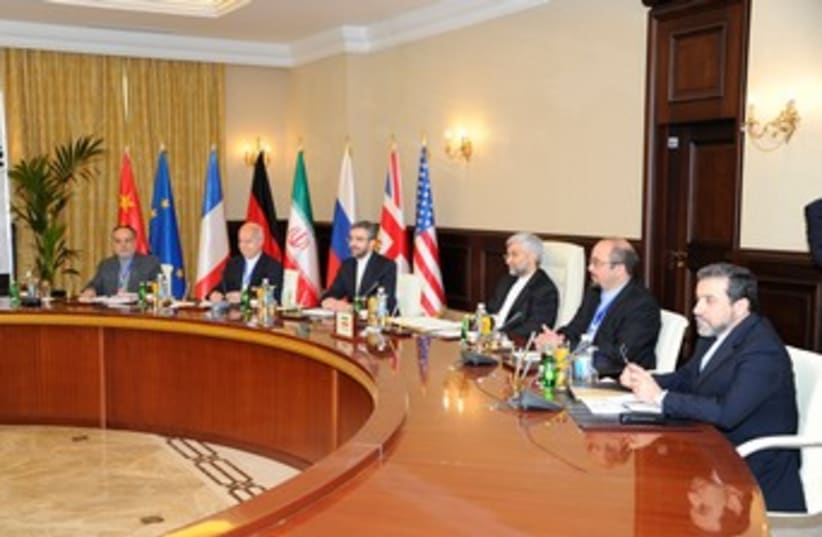
By KENNETH BANDLERIran- P5+1 negotiations 370(photo credit: REUTERS/Government Spokesman Office/Handout)
Impasses can engender complacency. That is precisely the danger underlying the current international positioning regarding Syria and Iran. President Bashar Assad’s dubious assent to a cease-fire and Iran’s talks with world powers over its nuclear program are the latest tactic of these two allies to resist mounting economic and diplomatic pressures.Both regimes have gained some reprieve. Further action on Syria awaits the outcome of the UN observer mission. What more to do with Iran is on hold ahead of a third round of talks with the five permanent UN Security Council members and Germany, known as the P5 + 1 group.Yet, while world powers ponder what to do with these two recalcitrant regimes, neither Damascus or Tehran is changing its behavior or goals. In Syria, the costs in human suffering are rising far above the UN estimate of 9,000 dead. The quest for Iranian nuclear weapons capability advances as more centrifuges are installed to expand uranium enrichment.Assad’s ostensible acceptance of Kofi Annan’s cease-fire plan did not come from the merciless Syrian dictator. It was announced by the former UN secretary general’s spokesman. Yet, the plan’s doom was foretold when Assad’s forces continued to pummel Syrian cities during Annan’s visit to Damascus in March.Now, with more than 250 UN monitors in Syria, Assad has demonstrated again that he has no interest in ending his 15-month-old brutally violent crackdown. The weekend massacre of more than 100, a third of them children, in Houla, was a particularly bloody outrage. It also was a reminder that Assad forces began assaulting the Syrian people by arresting and torturing schoolchildren in March 2011.As long as Assad continues to ignore the cease-fire he allegedly accepted, the Annan plan will remain fanciful. And the observers’ mission, born out of the failure of the UN Security Council, due to Russia’s and China’s opposition, to adopt meaningful action, will continue to be ineffectual. The UN should reconsider, admit failure, remove the international monitors and regroup with stronger action.Most disappointing for the Syrian opposition, international pressure on Assad has been steadily weakening. Nowadays, there is barely a mention of Assad’s need to step down, which was the call to action issued by the US and the European Union in the summer and fall of 2011.The UN presence helps to legitimize Assad who continues living in an illusory world where he promotes a view that foreign terrorists, not Syrians, are against his regime. He expounded that view recently in a Russia TV interview. And, he now blames the Houla massacre on insurgents.SYRIAN ACCEPTANCE of the Annan cease-fire came just a day before the representatives of Iran and the P5 plus one gathered in Istanbul, for the first time in more than a year. Whether or not that was a coincidence, Iranian-Syrian relations have tightened, with Tehran providing support to the Assad regime.Iran’s record of deceit is similar to Syria. Tehran has ignored four UN Security Council resolutions, International Atomic Energy Agency reports, and ever-tightening economic and financial sanctions imposed by the US, EU and many other countries.Meeting in Istanbul on April 13, and again last week in Baghdad, the P5 + 1 group spent a lot of time talking with Iran but no agreements were reached other than to convene again in a few weeks in Moscow. On the positive side, the US, Britain, France, Russia, China and Germany rejected Iran’s requests to weaken sanctions without concrete, verifiable actions that Iran will abandon its quest for nuclear weapons capability.Skepticism is warranted regarding any assumed sincerity by the Syrian or Iranian regimes in resolving their respective crises in good faith. But they do have an advantage over an international community that is not fully united, or may not have the staying power, in dealing with them.The sad reality is these dual impasses, with their inherent dangers, can continue as world powers are distracted by other, seemingly more pressing matters. With US elections in less than five months, and the electorate concerned about the economy, debate and discussions about crises in lands far away will recede. Similarly, new governments emerging from elections in Europe will be tempted to focus on the deepening economic recession, rather than entertain new initiatives to deal with Iran and Syria.The status quo in Iran and Syria, however, is unacceptable and poses security threats beyond their respective borders. The international community, led by the US, will need to make clear that patience is not limitless. Firm deadlines to end Assad’s crackdown in Syria and to stop Iran’s nuclear weapons program are needed, with credible warnings that compelling actions will be taken if they continue to defy the international community.In short, complacency is not an option.The writer is the American Jewish Committee’s director of media relations.
if(catID != 151){
var cont = `Take Israel home with the new Jerusalem Post Store