From a military perspective, the longer Israel waits to attack Iran, the harder it will become to accomplish the mission.
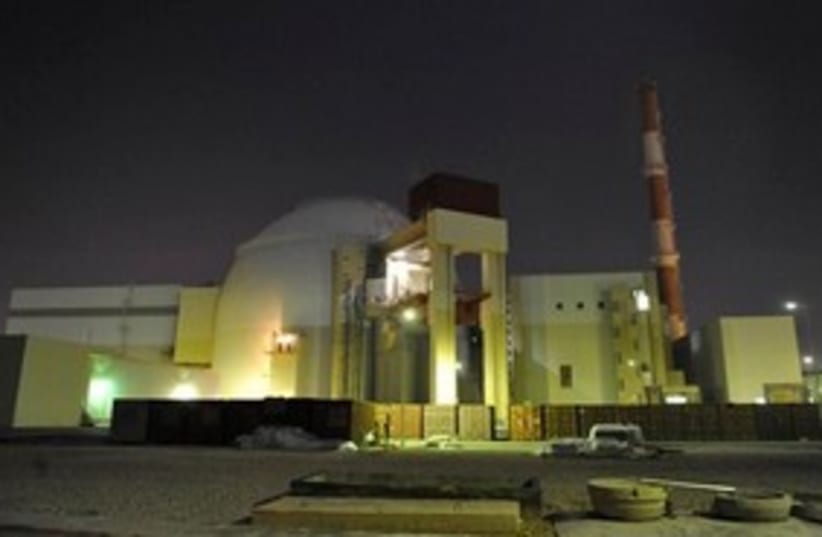
By CAROLINE B. GLICKBushehr Plant 311(photo credit: Associated Press)
Last weekend the mullahs took a big step towards becoming a nuclear power as they fueled the Bushehr nuclear reactor.Israel’s response? The Foreign Ministry published a statement proclaiming the move “unacceptable.”So why did we accept the unacceptable? When one asks senior officials about the Bushehr reactor and about Iran’s nuclear program more generally, their response invariably begins, “Well the Americans...”Far from accepting that Israel has a problem that it must deal with, Israel’s decision-makers still argue that the US will discover – before it is too late – that it must act to prevent Iran from becoming a nuclear power in order to secure its own interests.As for Bushehr specifically, Israeli officials explain that it isn’t the main problem. The main danger stems from the uranium enrichment sites. And anyway, they explain, given the civilian character of the Bushehr reactor; the fact that it is under a full International Atomic Energy Agency inspections regime; and the fact that the Russians are supposed to take all the spent fuel rods to Russia and so prevent Iran from using them to produce weapons-grade plutonium, Israel lacked the international legitimacy to strike Bushehr to prevent it from being fueled last weekend.BEFORE GOING into the question of whether Israel’s decision-makers were correct in opting out of attacking the Bushehr reactor to prevent it from being fueled, it is worth considering where “the Americans” stand on Iran as it declares itself a nuclear power and tests new, advanced weapons systems on a daily basis.The answer to this question was provided in large part in an article in the National Interest by former Clinton administration National Security Council member Bruce Riedel. Titled, “If Israel Attacks,” Riedel – who reportedly has close ties to the current administration – asserts that an Israeli military strike against Iran will be a disaster for the US. In his view, the US is better served by allowing Iran to become a nuclear power than by supporting an Israeli attack against Iran.He writes, “The United States needs to send a clear red light to Israel. There’s no option but to actively discourage an Israeli attack.”Riedel explains that to induce Israel to accept the unacceptable specter of a nuclear armed mullocracy, the US should pay it off. Riedel recommends plying Israel’s leaders with F-22 Stealth bombers, nuclear submarines, a mutual defense treaty and perhaps even NATO membership.Riedel’s reason for deeming an Israeli strike unacceptable is his conviction that such an operation will be met by an Iranian counter-strike against US forces and interests in the Persian Gulf and Afghanistan. While there is no reason to doubt he is correct, Riedel studiously ignores the other certainty: A nuclear-armed Iran would threaten those same troops and interests far more.Riedel would have us believe that the Iranian regime will be a rational nuclear actor. That’s the regime that has outlawed music, stones women, and deploys terror proxies throughout the region and the world. That’s the same regime whose “supreme leader” just published a fatwa claiming he has the same religious stature as Muhammad.Riedel bases this view on the actions Iran took when it was weak.Since Iran didn’t place its American hostages on trial in 1980, it can be trusted with nuclear weapons in 2010. Since Iran didn’t go to war against the US in 1988 during the Kuwaiti tanker crisis, Mahmoud Ahmadinejad can be trusted with nuclear bombs in 2010. And so on and so forth.Moreover, Riedel ignores what any casual newspaper reader now recognizes: Iran’s nuclear weapons program has spurred a regional nuclear arms race. Riedel imagines a bipolar nuclear Middle East, with Israel on the one side and Iran on the other. He fails to notice that already today Saudi Arabia, the United Arab Emirates, Kuwait, Jordan, Egypt, Syria, Lebanon, Sudan and Turkey have all initiated nuclear programs.And if Iran is allowed to go nuclear, these countries will beat a path to any number of nuclear bomb stores.Some argue that a multipolar nuclear Middle East will adhere to the rules of mutual assured destruction. Assuming this is true, the fact remains that the violent Iranian response to an Israeli strike against its nuclear installations will look like a minor skirmish in comparison to the conventional wars that will break out in a Middle East in which everyone has the bomb.And in truth, there is no reason to believe that a Middle East in which everyone has nuclear weapons is a Middle East that adheres to the rules of MAD. A recent Zogby/University of Maryland poll of Arab public opinion taken for the Brookings Institute in US-allied Arab states Egypt, Lebanon, Morocco, Saudi Arabia and the UAE shows that the Arab world is populated by jihadists.As Herb London from the Hudson Institute pointed out in an analysis of the poll, nearly 70 percent of those polled said the leader they most admire is either a jihadist or a supporter of jihad.The most popular leaders were Turkish Prime Minister Recep Erdogan, Venezuelan President Hugo Chavez, Ahmadinejad, Hizbullah chieftain Hassan Nasrallah, Syrian President Bashar Assad and al-Qaida leader Osama bin Laden.So if popular revolutions bring down any of the teetering despotic regimes now occupying the seats of power in the Arab world, they will likely be replaced by jihadists. Moreover, since an Iranian nuclear bomb would empower the most radical, destabilizing forces in pan-Arab society, the likelihood that a despot would resort to a nuclear strike on a Western or Israeli target in order to stay in power would similarly rise.All of this should not be beyond the grasp of an experienced strategic thinker like Riedel. And yet, obviously, it is. Moreover, as an alumnus of the Clinton administration, Riedel’s positions in general are more realistic than those of the Obama administration. As Israeli officials acknowledge, the Obama administration is only now coming to terms with the fact that its engagement policy towards Iran has failed.Moreover, throughout the US government, the White House is the most stubborn defender of the notion that the Iranian nuclear threat is not as serious a threat as the absence of a Palestinian state. That is, President Barack Obama himself is the most strident advocate of a US Middle East policy that ignores all the dangers the US faces in the region and turns American guns against the only country that doesn’t threaten any US interest.And now, facing this state of affairs, Israeli leaders today still argue that issuing a Foreign Ministry communiqué declaring the fueling of the Bushehr nuclear reactor “unacceptable,” and beginning worthless negotiations with Fatah leaders is a rational and sufficient Israeli policy.WHAT LIES behind this governmental fecklessness? There are two possible explanations for the government’s behavior. Prime Minister Binyamin Netanyahu may be motivated by operational concerns or he may be motivated by political concerns.On the operational level, the question guiding Israel’s leaders is when is the optimal time to attack? The fact that government sources say that it would have been diplomatically suicidal to attack before Bushehr became operational last weekend makes it clear that nonmilitary considerations are the determining factor for Israel’s leadership. Yet what Riedel’s article and the clear positions of the Obama administration demonstrate is that there is no chance that nonmilitary conditions will ever be optimal for Israel. Moreover, as Israel’s 1981 attack on Iraq’s nuclear reactor shows, Israel can achieve its strategic objectives even without US support for its operations.From a military perspective, it is clear that it would have been better to strike Iran’s nuclear installations before the Russians fueled Bushehr.Any attack scenario from now on will have to either accept the prospect of nuclear fallout or accept leaving Bushehr intact. Indeed from a military perspective, the longer Israel waits to attack Iran, the harder it will become to accomplish the mission.So unless Israel’s leaders are unaware of strategic realities, the only plausible explanation for Netanyahu’s decision to sit by idly as Israel’s military options were drastically diminished over the weekend is that he was moved by domestic political considerations.And what might those political considerations be? Clearly he wasn’t concerned with a lack of public support. Consistent, multiyear polling data show that the public overwhelmingly supports the use of force to prevent Iran from becoming a nuclear power.Then there is the issue of Netanyahu’s coalition.It cannot be that Netanyahu believes that he can build a broader coalition to support an attack on Iran than he already has by bringing Kadima into his government. Kadima leader Tzipi Livni is not a great supporter of an Israeli attack on Iran. Livni views being liked by Obama as more important than preventing Iran from becoming a nuclear state.The prospect of a Kadima splinter party led by former defense minister Shaul Mofaz joining the coalition is also raised periodically. Yet experience indicates there is little chance of that happening.Mofaz apparently dislikes Netanyahu more than he dislikes the notion of facing a nuclear-armed Iran (and a nuclear-armed Saudi Arabia and Egypt and etc., etc., etc.).Only one possibility remains: Netanyahu must have opted to sit on his hands as Bushehr was powered up because of opposition he faces from within his government. There is only one person in Netanyahu’s coalition who has both the strategic dementia and the political power to force Netanyahu to accept the unacceptable.That person is Defense Minister Ehud Barak.Barak’s strategic ineptitude is legendary. It was most recently on display in the failed naval commando takeover of the Turkish-Hamas terror ship Mavi Marmara. It was Barak’s idea to arm naval commandos with paintball guns and so guarantee that they would be attacked and forced to use lethal force to defend themselves.Barak’s ability to dictate government policy was most recently demonstrated in his obscene abuse of power in the appointment of the IDF’s next chief of staff. Regardless of whether the so-called “Galant Document,” which set out a plan to see Maj.-Gen. Yoav Galant appointed to replace outgoing IDF Chief of Staff Lt.-Gen. Gabi Ashkenazi, was forged or authentic, it is clear that its operative clauses were all being implemented by Barak’s own office for the past several months. So, too, despite the fact that the document is still the subject of police investigation, Barak successfully strong-armed Netanyahu into agreeing to his lightning appointment of Galant.Even if Galant is the best candidate for the position, it is clear that Barak did the general no favors by appointing him in this manner. He certainly humiliated and discredited the General Staff.Barak is the Obama administration’s favorite Israeli politician. While Netanyahu is shunned, Barak is feted in Washington nearly every month. And this makes sense. As the man directly responsible for Israel’s defense and with his stranglehold on the government, he alone has the wherewithal to enable the entire Middle East to go nuclear.How’s that for unacceptable? caroline@carolineglick.com
if(catID != 151){
var cont = `Take Israel home with the new Jerusalem Post Store