Israel needs a strong, coherent government to meet the challenges it will face in the next four years, including working with a hostile Obama administration.
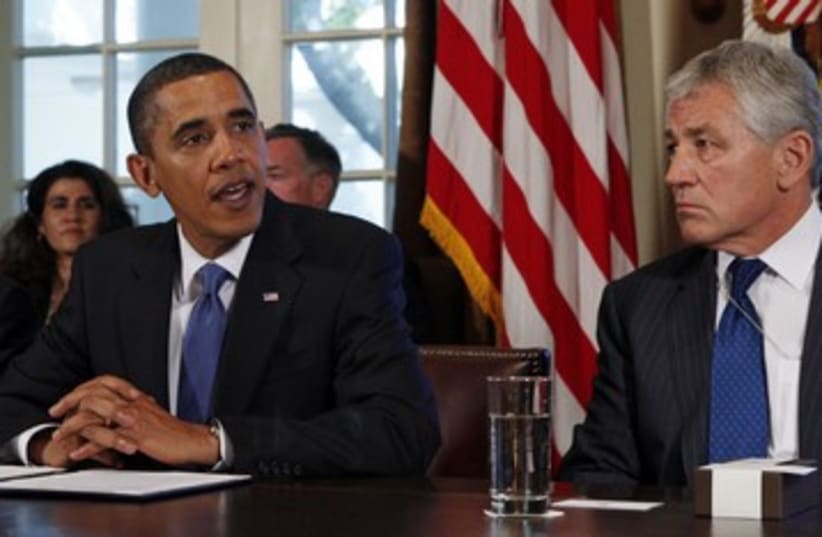
By CAROLINE B. GLICKUS President Barack Obama and Chuck Hagel 390(photo credit: Jim Young / Reuters)
Monday the National Journal reported that President Barack Obama is reconsidering his decision to appoint former Senator Chuck Hagel secretary of defense.Hagel’s looming appointment provoked angry responses from many leading Jewish voices in the US.Whether this opposition made a difference in driving Obama to reconsider his choice is unclear. Other influential groups – including senators, members of the military and lobbyists for homosexual rights – expressed their discomfort and opposition to the prospect of having Hagel serve as defense secretary.Still it is notable that Hagel’s possible appointment sparked an outcry among prominent American Jews and that this outcry had some unknown impact on Obama’s possible decision to cancel Hagel’s appointment.If Obama indeed scuttles Hagel’s elevation to defense secretary, it shows that it is possible to fight Obama on foreign policy even in his second term, and win, at least sometimes. This is important information for Republicans, American Jews and the Israeli government.Obama will have multiple, massive domestic challenges to contend with in his second term. If he wishes to focus on advancing his domestic agenda, he may well punt on foreign affairs.The US president’s inbox is always overflowing. One of the hardest things for a president to do is take control over his own agenda.Just consider the issue of gun control.Certainly, as a liberal Democrat, Obama is for it. But Obama has never made the issue of restricting gun ownership a priority during his presidency. Now in the aftermath of the Newtown massacre, he is suddenly spending a lot of time on the issue and going into a head-to-head battle with the National Rifle Association.Maybe Obama will win this battle. Maybe he’ll lose it. But he will be focusing on it a lot in the coming weeks.Again, this is not an issue that was ever central to his agenda. But due to an unforeseen event, it has become an issue that he is now forced to spend time on.There are, of course, foreseeable issues to which Obama will have to devote his presidential time, energy and capital.The biggest among them is the implementation of Obamacare. Budgetary and tax woes are not far behind. With only 24 hours in the day, Obama will not be able to focus on Israel or foreign policy on a daily basis. And in order to make time for other things, which are more important to him, or more immediately pressing, Obama may be willing to make concessions on his foreign policy agenda.Recently, I came across an article I wrote the month before the 2006 elections in Israel. In it, I argued that the reason the Sharon government had such good relations with the US was because it bowed to every US demand, no matter how antithetical it was to Israel’s national interests.In the piece, I mentioned then prime minister Ariel Sharon’s decision to set aside his concerns and bow to US pressure to permit Hamas to participate in the Palestinian Authority’s legislative elections in January 2006. For bending to Washington’s will, Israel got plaudits from US secretary of state Condoleezza Rice and president George W. Bush. But Israel also got Hamas in charge, an even more radicalized Fatah racing to prove its own terror bona fides to measure up to Hamas, and increased international isolation for the Jewish state as nation after nation began softening to the idea of Hamas being a legitimate organization.In retrospect, it would certainly have been better for Israel – and for America – if Sharon had stood up to Rice and simply refused to permit Hamas to participate in the elections. It would have been better to have had a public fight with Washington and kept Hamas out of power than maintain warm relations with the Bush administration while empowering a terror group that openly seeks the annihilation of Israel and the Jewish people.This brings us to Obama, his apparent decision to stand down on Hagel, US relations with Israel in Obama’s second term in office, and finally to how the Israeli election campaign plays into all of these things.The Israeli Left’s basic critique of Prime Minister Binyamin Netanyahu’s stewardship of Israel in the international arena revolves around its accusation that Netanyahu has wrecked Israel’s relations with the US by standing up to Obama.But whereas by not standing up to Bush and Rice, Israel got Hamas in power and missiles on Jerusalem, by standing up to Obama, Israel is still in control of Judea and Samaria and the two-state delusion has been increasingly discredited in Israel, and to a lesser degree in the US.Moreover, Israel has coaxed a reluctant US administration into passing serious sanctions against Iran. Although economic pressure hasn’t made any dent in Iran’s nuclear weapons program, Israeli pressure has made it harder for Obama to simply accept Iranian nuclear weapons. Vocally expressing Israeli concerns has also helped lawmakers from both parties maintain pressure on Obama to prevent Iran from acquiring nuclear weapons and publicly support a potential Israeli strike against Iran’s nuclear installations.It is understandable that Netanyahu is keeping mum on his diplomatic achievements. He can’t risk even worse relations with Obama by mentioning his success in keeping the US president at bay in his quest to diminish Israel’s strategic options.What makes less sense is his decision to adopt the Left’s talking points against the Right in his assault on the Bayit Yehudi (Jewish Home) party and its leader Naftali Bennett.Last Thursday, Bennett was conned by television personality Nissim Mishal into discussing how he would personally respond as a soldier to the completely hypothetical issue of IDF expulsions of Jews in Judea and Samaria. The reason the issue is artificial is because no one is proposing a mass expulsion of Jewish communities in Judea and Samaria today. The Palestinians are uninterested in negotiating with Israel.Netanyahu is uninterested in surrendering land. And the Left, which would like to surrender land, has no chance of winning next month’s elections.So Mishal manipulated Bennett into an irrelevant policy discussion in order to embarrass him. Bennett responded by saying he would personally object to fulfilling an order to expel Jews from their homes, and if necessary, bear the personal consequences.Netanyahu himself is quite familiar with Nissim Mishal’s manipulations of political theater to embarrass candidates on the Right. In 1999, during a televised candidates’ debate when Netanyahu ran for reelection as prime minister, Mishal repeatedly interjected himself into the debate to support rival candidate Yitzhak Mordechai’s character attacks on Netanyahu.Mordechai, who would be convicted of serial sexual harassment two years later, accused Netanyahu of lacking honesty, integrity and decency, saying “You know your best friends don’t believe you.”Mishal then chimed in, asking Netanyahu if he had any friends.Bennett and the Bayit Yehudi party are potentially the Likud’s largest coalition partner in the next government.Rather than leave Bennett alone, the Likud has opened an all-out war against him, castigating him as an extremist.Likud’s impulse to attack is eminently understandable. Bennett is cannibalizing Likud voters. And recently, he opened an ill-advised, counterproductive attack on the Likud and Netanyahu.But by attacking one another, Bennett and Netanyahu are discrediting their own positions.Does Netanyahu really want to argue that it is extremist to oppose the forcible expulsion of Jews from land Netanyahu himself argues Israel needs to defend itself from external invasion? Does Bennett really want to argue that the prime ministerial candidate he favors, and in whose government he hopes to sit, is too weak to be trusted to lead Israel? Israel faces massive challenges in the coming years. The apparent scuttling of Hagel’s appointment is a hopeful sign that if we keep our heads about us, we can prevent Obama from taking steps that are truly antithetical to Israel’s survival.But we must understand, the reason Hagel was apparently defeated is because the opposition to his appointment was strong, coherent and unified.Israel needs a strong, coherent government to meet the challenges it will face in the next four years, including working with a hostile Obama administration.We won’t get one if the leaders of the nationalist camp are using the Left to weaken and discredit one another.caroline@carolineglick.com
if(catID != 151){
var cont = `Take Israel home with the new Jerusalem Post Store