Tunisian president’s regime was not the only thing destroyed. The two main foundations of ‘expert’ Western analysis of the Mideast have also been undone.
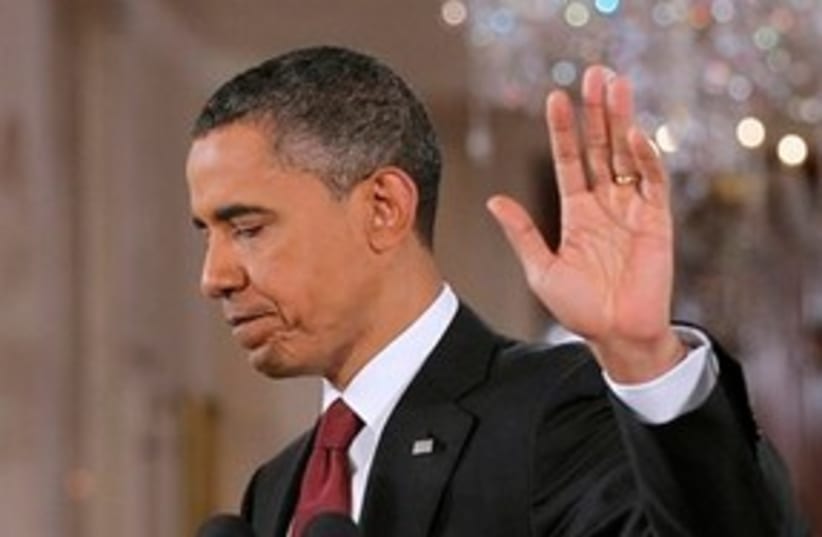
By CAROLINE B. GLICK311_Obama says talk to the hand(photo credit: ASSOCIATED PRESS)
If at the height of the anti-government protests in Tunisia last week, Israel and the Palestinians had signed a final peace deal, would the protesters have packed up their placards and gone home?Of course not.So what does it tell us the nature of US Middle East policy that at the height of the anti-regime protests in Tunisia, the White House was consumed with the question of how to jump start the mordant peace process between the Palestinians and Israel?According to Politico, as the first popular revolution in modern Arab history was in full swing, last week the White House organized two “task forces” to produce “new ideas” for getting the Palestinians to agree to sit down with Israeli negotiators. The first task force is comprised of former Clinton and Bush national security advisers Sandy Berger and Stephen Hadley.The second is led by former US ambassador to Israel under the Clinton administration Martin Indyk.And as these experts were getting in gear, US President Barak Obama dispatched his advisor and former Middle East peace envoy under the Bush 1, Clinton and Bush 2 administrations Dennis Ross to Israel to meet with Israeli and Palestinian leaders to ask them to put out “new ideas.” Amazingly, none of these task forces or meetings has come up with anything new.Again, according to Politico, these task forces and consultations generated three possible moves for the Obama White House. First, it can put more pressure on Israel by announcing US support for a “peace plan” that would require Israel to surrender its capital city and defensible borders.Second, the US can pressure Israel by seeking to destabilize Prime Minister Binyamin Netanyahu’s government.And third, the US can pressure Israel by pumping still more money into the coffers of the unelected Palestinian government and so raise expectations that the US supports the unelected Palestinian government’s plan to declare independence without agreeing to live at peace with Israel.So much for new ideas.THEN THERE is the unfolding drama in Lebanon. It is hard to think of a greater slap on the face than the one Hizbullah and Syria delivered to Obama last Wednesday. Hizbullah brought down Lebanese Prime Minister Saad Hariri’s government with the open and active support of Syria while Obama was meeting with Hariri in the Oval Office.And how did Obama respond to this slap in the face? By dispatching Ambassador Robert Ford to Damascus to take up his new post as the first US ambassador in Syria since Syria and Hizbullah colluded to assassinate Hariri’s father, former Lebanese prime minister Rafik Hariri six years ago.Reality is crashing in on the Obama administration. But rather than face the challenges presented by reality, the Obama administration is burying its head in the sand. And it is burying it head in the sand with the firm support of the inbred US foreign policy elite.The overthrow of Tunisian President Zine El Abedine Ben Ali last Friday is a watershed event in the Arab world. It is far too early to even venture a guess about how Tunisia will look a year from now. But it is not too early to understand that Ben Ali’s regime was not the only thing destroyed last Friday. The two main foundations of “expert” Western analysis of the Middle East have also been undone.The first foundation of what has passed as Western wisdom about the region is that the only that thing that motivates the proverbial “Arab street” to act is hatred of Israel.For nearly a generation, successive US administrations have based their Middle East policies on the collective wisdom of the likes of Ross, Hadley, Berger, Indyk, George Mitchell, Dan Kurtzer, and Tony Blair. And for nearly a generation, these wise men have argued that Arab reform, democracy, human rights, women’s rights, minority rights, religious freedom, economic development and the rule of law can only be addressed after a peace treaty is signed between Israel and the Palestinians. In their “expert” view, Arab autocrats and their repressed subjects alike are so upset by the plight of the Palestinians that they can’t be bothered with their own lives.Tunisia’s revolution exposes this “wisdom,” as complete and utter piffle. Like people everywhere, what most interests Arabs is their own standard of living, their relative freedom or lack thereof, and their prospects for the future.Mohammed Bouazizi, the 26-year-old Tunisian college graduate who set himself on fire last month after regime security forces destroyed his unlicensed produce cart did not act as he did because of Israel.The Egyptian man who set himself on fire in Cairo on Monday outside the Egyptian parliament, and the Algerian man who set himself on fire in Tebessa on Sunday, did not choose to self-immolate in the public square because of their concern for the Palestinians. So too, the anti-regime demonstrators in Jordan are not demonstrating because there is no Palestinian state west of the Jordan River.The Tunisian revolution demonstrates that “Arab unity” and commitment to “Palestinian rights,” is little more than a sop for Western “experts.”The chief concern of Arab dictators is not Israel, but the prolongation of their grip on power. From their perspective, one of the keys to maintaining their iron grip on power is neutralizing US support for freedom.By arguing that Israel is the root cause of all Arab pathologies, Arab despots put the US on the defensive. Having to defend its support for the hated Jews, the US feels less comfortable criticizing the dictators for their repression of their own people. And without the Americans breathing down their backs, Arab dictators can sleep more or less easily. Since Europe doesn’t mind that they trample human rights, only the US constitutes a threat to the legitimacy of these Arab autocrats’ iron fisted repression of their people.And this brings us to the second fallacious foundation of “expert” Western analysis of the Middle East destroyed by the recent events in Tunisia. That foundation is the belief that it is possible and desirable to build a stable alliance structure on the back of dictatorships.Tunisia’s revolution exposed two basic truths about relationships with dictatorships. First, they cannot outlast the regime. Since dictators represent no one but themselves, when the dictator leaves the scene, no one will feel bound by his decisions.The second fundamental truth exposed by Ben Ali’s overthrow is that all power is fleeting. Ben Ali’s day came last Friday. The day of his Arab despot brethren will also arrive. And when they are overthrown, their alliances will be overthrown with them. To a significant degree, the Obama administration’s failure to understand the chronic instability of dictatorships explains its obsession with appeasing Syrian dictator Bashar Assad. Because the US wrongly assumes that Assad’s regime is inherently stable, it misunderstands Assad’s rationale for preferring Iran and Hizbullah to the US.Assad is a member of the Alawite minority community. He fears his people not only because he represses them through state terror, but because given his Alawite identity, most Syrians do not view him as one of them.As dictators and murderers themselves, Iran’s ayatollahs and Hizbullah’s terror masters support Assad’s regime in a way that the US never could, even if it wished to. Indeed, as Assad sees things, given the nature of his regime, there is no chance that an alliance with the US would do anything but weaken his regime’s grip on power.US attempts to build relations with Assad tell this dictator two seemingly contradictory things at the same time. First they signal to him that his alliance with Iran and Hizbullah strengthen his regional stature. Without those alliances, the US would not be interested in appeasing him.Second, due to the chronic instability of his tyrannical terror state, and his consequent utter fear of democracy, Assad views American attempts to draw him into the Western alliance as bids to overthrow his regime. The more the likes of Obama and Clinton seek to draw him in, the more convinced he will become that they are in league with Israel to bring him down.ON THE face of it, the Tunisian revolution vindicates former president George W. Bush’s policy of pushing democratization of the Arab world. As Bush recognized in the aftermath of the 9/11 attacks, the US is poorly served by relying on dictators who maintain their power on the backs of their people.Bush got into trouble however by seeing a straight line between the problem and his chosen solution of elections. As the Hamas victory in the Palestinian Authority and the Muslim Brotherhood’s victories in Egypt’s parliamentary elections on the one hand, and the undermining of pro- Western democratically elected governments in Lebanon, Afghanistan and Iraq on the other hand made clear, elections are not the solution to authoritarianism.The Tunisian revolution provides several lessons for US policymakers. First, by reminding us of the inherent frailty of alliances with dictatorships, Tunisia demonstrates the strategic imperative of a strong Israel. As the only stable democracy in the region, Israel is the US’s only reliable ally in the Middle East. A strong, secure Israel is the only permanent guarantor of US strategic interests in the Middle East.Second, the US should proceed with great caution as it considers its ties with the Arab world. All bets must be hedged. This means that the US must maintain close ties with as many regimes as possible so that none are viewed as irreplaceable.Saudi Arabia has to be balanced with Iraq, and support for a new regime in Iran. Support for Egypt needs to be balanced with close relations with South Sudan, and other North African states.As for engendering democratic alternatives, the US must ensure that it does not make any promises it has no intention of keeping. The current tragedy in Lebanon is a blow to US prestige because Washington broke its promise to stand by the March 14 movement against Hizbullah.At the same time, the US should fund and publicly support liberal democratic movements when those emerge. It should also fund less liberal democratic movements when they emerge. So too, given the strength of Islamist media, the US should make judicious use of its Arabic-language media outlets to sell its own message of liberal democracy to the Arab world.Tunisia’s revolution is an extraordinary event. And like other extraordinary events, its repercussions are being felt far beyond its borders. Unfortunately, the behavior of the Obama administration signals that it is unwilling to acknowledge the importance of what is happening.If the Obama administration persists in ignoring the fundamental truths exposed by the popular overthrow of Tunisia’s dictator, it will not simply marginalize US power in the Middle East. It will imperil US interests in the Middle East. caroline@carolineglick.com
if(catID != 151){
var cont = `Take Israel home with the new Jerusalem Post Store