There is much talk in Israel these days, and it is quite justified, about violence and racism in sports.
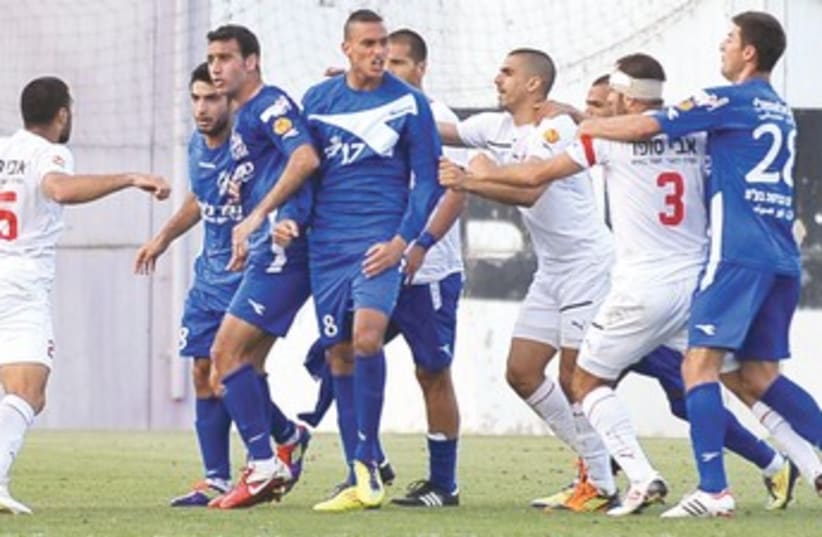
By URI SAVIRBnei Lod - Hapoel Ramat Gan brawl 370(photo credit: Asaf Kliger)
There is much talk in Israel these days, and it is quite justified, about violence and racism in sports. Yet I believe that while these ugly phenomena must be eradicated, sport is globally, and also here, an important pathway to coexistence, integration and social cohesion.In ancient Greece, it was decided that during the Olympic sporting events, there would be a total truce. Sport became then the symbol of peaceful coexistence and for a different type of human relations: competition according to agreed-upon rules and values.The London 2012 Olympics this July and August will be a great global get-together of the world’s youth competing for medals, records and country – with billions of people watching from around the world. Undoubtedly a beautiful moment, but without a global truce; on the contrary – this will be the most secured Olympic Games in history, with almost £500 million spent on protecting the events and the Olympic Village from terrorism, and it is doubtful that anyone in the world will put down their arms.Yet in general sport is an important activity and industry for furthering peaceful coexistence between peoples and nations. While terrorism and violence do erupt during sports events, they are counter-balanced by the coming together of competing athletes. Sports in many areas of the world have been and still are conducive to peaceful coexistence and social cohesion. There are many examples: the role and position of African-Americans has been dramatically altered by their enormous success in sports. During the infamous Berlin Olympics in 1936, under the hateful eyes of Adolf Hitler, Jesse Owens made all Americans proud by winning four gold medals. And through the years African-Americans have come to dominate in a variety of sports, from track and field to basketball, boxing, American football and much more. This has helped in the greater integration of American society and in the erosion of still lingering racism in certain parts of the country.In Europe, the European Football Federation, UEFA, has perhaps done more for integration than most other pan- European mechanisms. The UEFA Champions League is today more attractive than any other European competition, as we witnessed in the widespread enthusiasm around the Chelsea-Bayern Munich championship final last weekend. Local patriotism often overshadows national patriotism when it comes to affiliation with soccer clubs. You can be Italian (or Israeli for that matter) and still your greatest support will go to F.C. Barcelona (every child in the world is proud to wear a Messi jersey).Asia grew closer to the West thanks to sports – the Beijing Olympics of 2008 brought the world closer to more than a billion Chinese, more so than any other event or process. Ping-pong games between the US and China in the early 1970s marked the start of normalization between the two nations.As for Africa, the continent too often thought of only in terms of poverty and disease; thanks to sports, it is also invading the consciousness of the world with success stories – from the African soccer stars on European teams (from Didier Drogba of Ivory Coast on Chelsea) to the long-distance runners who won almost every medal in the World Championships and the Olympics, representing mostly Kenya, Eritrea and Ethiopia.As for our region and Israel, we are part of the global sporting phenomena as sport is for many, including here, the “new religion,” and it is not a fundamentalist one. It entails a combination of positive and negative reflections of society, yet gives an opportunity for the positive outlet of emotions and patriotism. Take the Palestinian Authority – last week the Palestinians lamented the Nakba Day, in memory of the creation of the independent State of Israel, which according to their narrative created the Palestinian refugee problem. We expected furious marches on Jerusalem; instead in Ramallah, the PA, under the guidance of the man in charge of Palestinian soccer, the well-known security operative Jibril Rajoub, created the “Nakba Football Tournament” and thousands of Palestinians rejoiced in their national team’s goals against six other national teams, rather than taking part in violent demonstrations.As for Israel, from the very beginning of the nation-building process, sport was, and in many ways still is, a great integrator, in particular soccer.New immigrants play with veterans, Sephardi with Ashkenazim, Arabs with Jews, religious with secularists, foreigners with Israelis. And the affiliation of supporters is for their teams – be it Ashdod or Kiryat Shmona, our new soccer champion – over every other identity. If you are Hapoel Tel Aviv you are red, if Maccabi, you are yellow, even before blue and white.There are also ugly expressions that occur around sports, most recently violence among fans and players as was witnessed in the last Tel Aviv derby, or in the recent Petah Tikva-Haifa match. While soccer has brought, in general, a rapprochement between Jews and Arabs, who play on the same teams, and even on our national team, there are ugly exceptions of racism, most prominently those pronounced by the Beitar Jerusalem club. Their supporters love to chant “Death to the Arabs” and the team officially announced that it will not hire any Arab players.This phenomenon should be outlawed. The violence and racism in our sports are reflections of phenomena in society at large, they are important warning lights.Yet as it does the world over, there is no reason why sport should not play a cohesive and integrating role in the Middle East and in Israel. I witnessed many times in the activities of the Peres Center for Peace’s Sport Department, young teenagers – Israeli Jews, Israeli Arabs, Palestinians – boys and girls competing together on the soccer pitch, basketball court and swimming pool, forging new friendships.When a combined Israeli-Palestinian youth team scores a goal in these tournaments, the players all embrace, forgetting their national identity, proud of their team.As we want to work for peaceful coexistence, within the country and the region, sports here, as all over the world, can bring people together from a very early age. Arab countries should put an end to their unjustified ban on competing with Israeli teams, and on our side, those responsible for sports should eradicate violence and racism and then see it as a great integrator; it is a real opportunity both internally and regionally. Sport is not just a game – it expresses profound traits and feelings of people as to their identity, ambition and self-expression; it is a great unifier and, when it is not, it is the best sort of competition. If we internalize this, then maybe a 2030 Olympic Games in Tel Aviv and Ramallah together is not impossible – it would certainly bring more than just a truce. The writer is president of the Peres Center for Peace and served as Israel’s chief negotiator for the Oslo Accords.
if(catID != 151){
var cont = `Take Israel home with the new Jerusalem Post Store