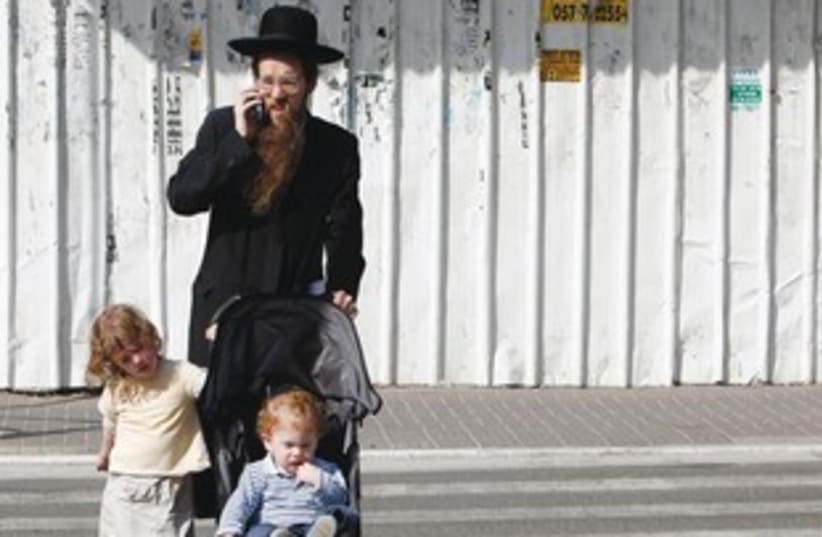
There is no way to undercut the devotion it takes to bring up 10 children, as is common for haredim.
By BARBARA SOFERHaredi man with kids on mobile phone 311(photo credit: REUTERS)
I’m listening to the radio talk show discussion of the new proposal that nursery school will be free from age three. You’d think this might be a rare moment of national unity. Any parent who has been paying steep preschool fees, and any grandparent who remembers that nursery school used to cost as much as university, should be happy about this decision. It is a substantive response to the summer protests’ demand for improved conditions for working couples. But every Knesset speaker who gets on the airwaves in the morning is griping. Each glorifies his or her sector and complains about the others. Listening in traffic, I had the fantasy that each speaker would say something positive about those in a different sector. Are we so busy defending our lifestyles for secular grandparents to admit that they would love to have 50 grandchildren like their haredi counterparts? Would haredi parents really mind if their gifted sons and daughters had the educational tools to become oncologists like their secular counterparts?Instead of making lists of what’s wrong with each other, here are a few examples of what we might appreciate. Please excuse the generalizations. My apologies in advance for stereotyping and for not including the Arab sector in this column.What we can learn from haredim 1. Devotion to bringing up many children. Remember when David Ben-Gurion asked all families to have one additional child? No matter how others might want to explain away the reasons that haredi Jews have large families, there is no way to undercut the devotion it takes to bring up 10 children. Each one starts with nine months of pregnancy and a painful delivery. They get ear infections and cry at night. They need comfort when they come home from school after quarreling with friends or failing a test. They need Purim costumes and birthday cakes. Imagine going to all those parent-teacher meetings. Yet haredi families are willing to take this on despite limited financial resources.2. Using consumer pressure. Way before the cottage cheese boycott, haredi supermarkets were offering cheaper brands and lower prices on many goods. They used consumer power to convince manufacturers to change their kashrut supervision to suit their needs. They are energetic at networking and gathering consumer and health information. Even secular Jews often consult rabbi specialists in finding expert physicians.3. Long school days. Those school buses bring home little boys in the late afternoon when secular peers have been home for hours. School vacations are also shorter than in the secular sector.4. Learning by heart and argument. Students used to memorize poetry and were able to quote historic statements by rote. In the haredi sector, children are encouraged to mentally own key passages of Torah and Oral Law. Talmudic study encourages comprehension of complex issues and dialectic.5. Commitment to following Jewish tradition is reinforced at school and at home. This includes values like honoring your father and mother.6. Even the poor dedicate a portion of their funds for the needier. Copious numbers of lending societies (gemahs) provide loans for everything from party dresses to chickpeas. Volunteer organizations run soup kitchens and food distribution.7. Parents’ proactive role in helping their children find appropriate marriage partners is accepted and encouraged. Choices may be less romantic but better geared for marital success.
What we can learn from secular Jews 1. Patriotism is expressed through readiness for self-sacrifice in low salary, enduring extreme discomfort and risking your life by military service.2. Men and women take pride in their working life and careers, understanding that personal development and the gross national product are linked and are essential.3. Schools stress math, science and English, providing the tools for those who choose to enter professions of the future. Creativity is encouraged through a wide variety of after-school programs that yield original achievements in visual arts, music and theater. Even Israeli TV shows are copied by Hollywood.4. Innovators in hi-tech, science, medicine and economics aim at making the world a better place. These opportunities are open to men and women who can lead political parties, play pro basketball or head the Supreme Court without any concern that this is an insult to the public sensibility. Quite the opposite.5. Zionist pioneers were willing to withstand extreme privation to build this country. They have passed on a love of country, Israeli history and Hebrew culture. Beloved Israeli music is a vehicle for celebration as well as for mourning.6. The act of walking the historic byways and nature trails is reverential. From this love of the Land of Israel comes a concern for the environment – from preserving wildflowers to recycling.7. A wide range of behavior is accepted in children. leaving ample space for individuality.What we can learn from modern Orthodox Jews 1. An attitude of “we can do it all” translates into the belief that Jewish observance can be combined with large families and involvement in the general community. You can be an Torah-observant computer whiz, pilot or real-estate developer and work in any setting whether you are a man or woman.2. Creative endeavors combining tradition and modern ideas are flourishing. Take for instance the Tzohar rabbis, the Ma’aleh Film School and Kehillat Shira Hadasha. Modern Orthodox filmmaker Joseph Cedar earned an Academy Award nomination. Srugim, a TV series based on modern Orthodox life made by modern Orthodox film makers, has an international following.3. Willingness to live in difficult and dangerous places. Groups of modern Orthodox Jews have created communities not only as part of the settlement movement in places like Gush Katif but also in troubled towns and cities like Yeroham and Lod. Does anyone think that living in a caravan is fun for more than a week?4. Outreach and hospitality. Modern Orthodox Jews routinely invite non-observant guests, visiting students and immigrants into their large and busy households for elaborate Shabbat meals even though most are two-career families.5. Religious Zionist youth movements reinforce family values of leadership and a strong ethic of contributing to society. Many modern Orthodox soldiers volunteer for combat and officer positions, with moralebuilding enthusiasm. National Service volunteers spend two years contributing badly needed human resources to help the needy in schools, hospitals and youth villages.6. According to studies, modern Orthodox couples have the most parity of married couples: men and women are likely to have the same educational and occupational status, modeling greater equality in family life. This makes it possible for them to successfully balance careers and large families.7. Schools offer high levels of general and Torah studies, giving young men and women a wide choice of personal options.What an impressive plethora of ideas and choices. Now there’s a subject for a talk show!The author is a Jerusalem writer who focuses on the wondrous stories of modern Israel. She serves as the Israel director of public relations for Hadassah, the Women’s Zionist Organization of America. The views in her columns are her own.
if(catID != 151){
var cont = `Take Israel home with the new Jerusalem Post Store