Palestinians know approximately what they will have to accept. Finding the least bad solution consonant with defeat is their unenviable task.
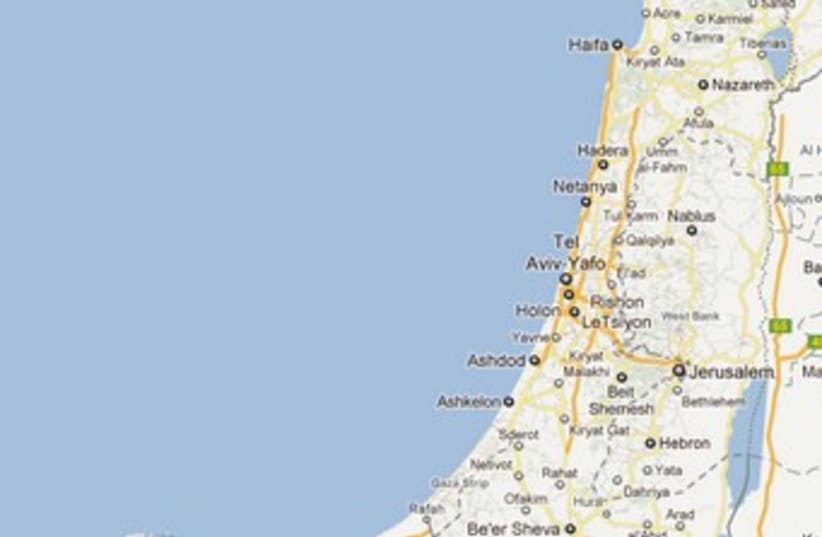
By RONALD TIERSKYMap of Israel - Google Maps(photo credit: Courtesy of Google Maps)
Israel’s strategic problem in historical terms is, ultimately, how to win a war well. The Palestinian problem is to avoid losing this war in the most drawn-out, worst possible way.Palestinians (including any realistic Hamas leaders), know approximately what they will have to accept. Finding the least bad solution consonant with defeat is their unenviable task. Yet neither is Israel completely free, because victory can be dangerous. Israel needs a strategy that isn’t in the end self-defeating.Realistically, the Israeli-Palestinian dilemma is this: In what circumstances could the strong safely show magnanimity and the weak believe they are getting an acceptable result? Intractable conflicts can sometimes be unblocked by enlarging the problem, by increasing the number of players, stakes and potential rewards.All the “one-state” solutions – whether bi-national or a federation – are non-starters because Israeli Jews rightly refuse to sacrifice their own interest in a grand gesture of philanthropy.Majorities in Israeli and Palestinian public opinion would doubtless accept a simple two-state solution if leaders agreed on it. Israel’s current government, however, seems not really interested whatever lip-service it is given from time to time. Prime Minister Binyamin Netanyahu’s “economic peace” formula in effect replaces the creation of a Palestinian state with Israeli-sponsored economic development in the West Bank combined with an oppressive, volatile political status quo.A way forward is to find a larger formula that increases the rewards and reduces costs for Israelis and Palestinians, and involves outside states as guarantors. Complexity and flexibility in this case are advantages. What is necessary is an institutional structure that limits to a minimum the binding links for Israel and at the same time provides time and space for Palestinian self-government and proof of competence to evolve, including stopping the violence on both sides.A minimal, complex and flexible Israeli-Palestinian confederation, here meaning a two-state solution within the confines of a larger confederation, is a promising alternative.Two sovereign states wrapped in a semi-state, a less-than-a-state.Confederation – political and economic – could provide what Israelis and Palestinians, and outside powers, want most: guaranteed mutual security of the two states, reliable peace in the region, diminished capacity for Islamist terrorist groups to use the conflict as a pretext, and economic and social progress.What is a confederation, how does it differ from a one-state solution, and what would be its international legal basis? A confederation differs from a binational single state and also from a federation of two states.Some states are unitary, ruled entirely from the national capital (France). Others are federations in which power is shared in some balance between a national government and the states that compose it (the US, Germany). A few are confederations (Switzerland is a modern example).Unique in world political development, the European Union is extremely complex: a hybrid combination of historical nation-states and national capitals with European-level institutions located in Brussels and elsewhere.EU institutions are in part confederal (EU summit meetings in various cities), part federal (the European Court of Justice in Luxembourg, the European Central Bank in Frankfurt) and part strict national sovereignty (major foreign policy decisions, above all decisions for war or peace in Afghanistan, Iraq, Libya).In the EU, complexity is often a curse but it does provide benefits as well, for example deflecting conflict into ambiguity and permitting the whole to survive even as one part falls into crisis (cf. the current Eurozone debt mess).The EU is of particular relevance here because, although not wellknown, in international legal terms the entire EU is still a treaty organization (Maastricht) because a proposed constitution for it didn’t achieve ratification in 2005.The Israeli-Palestinian conflict, because it is also unique, requires a particularly imaginative legal and institutional structure.Why not one state or two states? In the Holy Land a unitary state called Israel-Palestine makes no historical or political sense. A federation called The United States of Israel and Palestine is not much better.What of a confederation? Normally a confederation means a constitution, weak but nonetheless more than a treaty. Sovereignty rests with the composing states.(The American Articles of Confederation before 1789 are an example.) But if a Holy Land confederation is based on a treaty rather than a constitution, Israel’s national constitution and sovereignty are always superior (as would be true also for a Palestinian state). A treaty in this case would be more durable than a constitution.A treaty is usually made for a specified period of years and renewed (NATO is an example). A constitution, however, is implicitly permanent.If the situation on the ground goes sufficiently bad, a treaty can perfectly well be renounced (cf. current concerns about Egyptian repudiation of the peace treaty with Israel.) What would happen in practice as politics in the confederation? For example, there would be no common elections or governments.Israeli and Palestinian parliaments might meet jointly once or twice a year for a few days, to get to know each other and create common culture more than to legislate. Existing Israeli-Palestinian security cooperation could be given formal legal status in the treaty. Once or twice yearly summit meetings of top national leaders could be mandated along with more frequent councils of ministers in a particular policy area, say agriculture (as in the EU).In short, a treaty-based confederation sidesteps the entire zero-sum one-state two-state drama.For Israel, in particular, confederation deals with intractable issues of Palestinian political sovereignty.Creating a Palestinian state within a confederation would not increase but actually diminish threats to Israel’s security. Having their own state, Palestinian obsession with Israel, the ideological passion about sovereignty, borders and revenge, would shift to ambitions for more prosperous lives with individual dignity. Gaza, now such a special case, could join the Palestinian state immediately combined with the West Bank. If, however, Palestinian unity were impossible, Gaza could evolve over time one way or another.For Palestinians, entrepreneurial energy and private sector business development would stimulate the growth of a more complex civil society connected to the wider world. A Palestinian state that issues internationally recognized passports permitting its citizens to freely visit the world would change the mind-set of young and old generations alike.Speculating even further ahead, the confederation could encompass not just Israel and Palestine but, sooner or later, Jordan as well. Stimulating Jordanian economic and social development is a good in itself. Security across the entire confederation could be guaranteed by a combination of sovereign Israeli military and police forces, a Palestinian internal police force, a Jordanian participation, and overlapping security guarantees in the form of international boots on the ground: the US, UN and NATO (including Turkey). Jordanian domestic political reform would be de-dramatized.A more cosmopolitan Israel can afford to deal differently with the Palestinians, who have by now suffered and been punished enough for disastrous policies of the past.Israel would win its war well if a Palestinian state were created not against Israel’s will but sponsored and even mentored by Israel.Inevitably, new international esteem would follow. The high cards are in Israeli hands.The writer is the Eastman Professor of Political Science at Amherst College.
if(catID != 151){
var cont = `Take Israel home with the new Jerusalem Post Store