It’s tradition in the Assad family to massacre civilians; Bashar’s father did it for nearly 30 years before him.
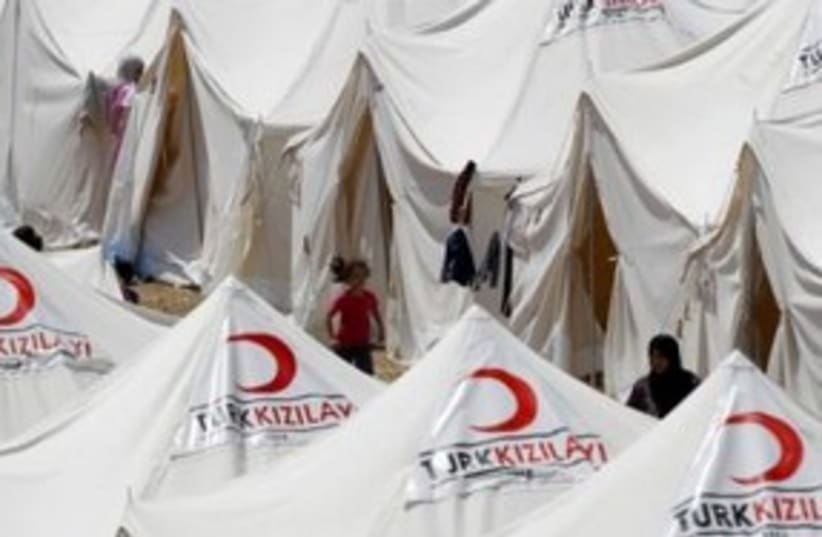
By DOUGLAS M. BLOOMFIELDSyrian refugee camp Turkey 311(photo credit: Reuters)
Does Bashar Assad seriously expect anyone to believe his promise – repeated again Monday – to reform? His 11 years in power are littered with dashed hopes, broken promises, and the bodies of thousands of Syrians who believed he would bring a better tomorrow. Instead, the myopic ophthalmologist proved the apple doesn’t fall far from the tree.President Barack Obama once hoped he could wean Assad away from the Iranians’ embrace and bring him to the peace table with Israel and closer to the western camp, but that hope proved ephemeral.On the same day Assad spoke of reform, Obama and Turkish Prime Minister Recep Tayyip Erdogan urged him to “enact meaningful reforms that respect the democratic aspirations of the Syrian people.”Judging by his reluctance to demand that Assad step down, Obama may be the last person who still believes the increasingly brutal and desperate dictator can change.Face it, Assad is no more interested in democratic reform than in being a bar mitzva at the Kotel.Obama moved faster to dump an old ally like Hosni Mubarak or an old foe like Muammar Gaddafi than he has for Assad – a dangerous enemy of the Untied States who has played a major supporting role in the Iraqi insurgency and for terrorist groups targeting America and its friends.Assad is on his way to history’s trash heap, but the best the Obama administration can come up with is to tell him to clean up his act or “get out of the way” – a choice, not a demand. Assad has done neither, and Obama has done little to back up his words.Former State Department spokesman P.J. Crowley found it “odd” that Obama should demand the resignation of sexter Anthony Weiner, but not mass murderer Bashar Assad.Hesitation, Crowley noted, “carries real costs” in terms of reduced American credibility throughout the region.MANY IN Israel – including those who criticized Obama for being too quick to abandon Mubarak – are urging caution because of uncertainty over who or what will follow.Assad may be terrible, they say, but better the devil you know than the devil you don’t.Here’s what we know about this devil: He has so little regard for the lives of his own people that he sends tanks, helicopter gunships and soldiers to massacre unarmed women and children, kills his own soldiers as an excuse to blame demonstrators, sends thousands into exile, and slaughters thousands more seeking to escape. And that’s just at home.It’s a family tradition; his father did it for nearly 30 years before him.He also gives safe haven, weapons and other support to assorted terror groups, notably Hamas and Hezbollah. Assad seeks to regain control of Lebanon, and has been blamed for ordering the assassination of former Lebanese prime minister Rafik Hariri and other critics of his regime.Earlier this month, he sent dozens of Palestinians to cross the border with Israel on the Golan Heights in a transparent ploy to divert attention from his bloody crackdown.He is the loyal lynchpin in Tehran’s goal of regional domination, and like Iran, he wants to build his own nuclear arsenal, threatens to wage war against Israel (which he already does through his surrogates), and has a massive arsenal of missiles with chemical and biological warheads aimed at Israel’s population centers.That’s the devil we know.We may not know what will replace him, but we know that the longer Assad stays, the better for Iran, Hezbollah, Hamas and their henchmen – and the worse it is for the United States, Israel, Lebanon and the Syrian people.One of those most upset with Assad’s brutal response to Syria’s Arab Spring is his old friend Erdogan, who trashed his country’s longstanding friendship with Israel in order to impress Assad and Iranian President Mahmoud Ahmadinejad.There’s a certain poetic justice in that Erdogan now finds himself responsible for housing and caring for the thousands of Syrian refugees fleeing the brutality of his former BFF, as thousands more wait just across the border.Now the Turks are telling Assad to do more than talk about reform or face foreign intervention. They’re in the best position to carry out that threat; the US and NATO are having trouble forcing Gaddafi out of Libya, and aren’t about to take any military action against Syria.And don’t look to the United Nations, where Russia and China – both fearing their own version of the Arab Spring – have vowed to veto any Security Council resolution condemning Assad’s crackdown.Even without UN backing – forget about the Arab League – there is more the West can do. For starters, stop buying Syrian oil; it may not mean much for the customers (there’s plenty more elsewhere), but it’s a lot for Assad’s economy. And add further and faster tightening of the economic screws, and more restrictions on anyone who trades with Syria.The Obama administration has hinted at referring Assad and other top officials to the International Criminal Court in The Hague to face war crimes charges. A more practical first step is a clear call by America and its allies for Assad to resign.By failing to apply maximum pressure and the presidential bully pulpit – and we haven’t seen that yet – we are abetting not only Assad, but also his sponsors in Iran and their terrorist clients.bloomfieldcolumn@gmail.com
if(catID != 151){
var cont = `Take Israel home with the new Jerusalem Post Store