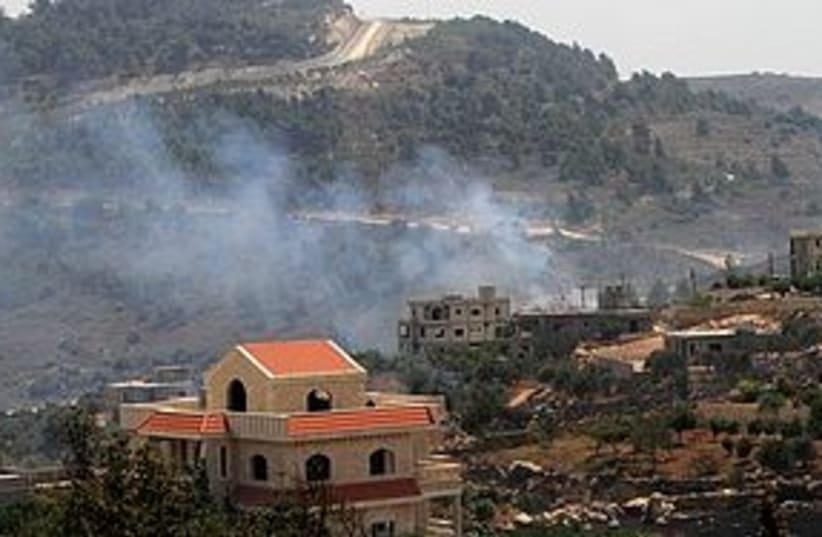
By JPOST EDITORIALIsrael Lebanon clash(photo credit: Associated Press)
The IDF on Tuesday gave the Lebanese army the benefit of the doubt and retaliated only locally against provocative sniper fire that killed one officer and seriously wounded another. It’s far from certain, however, that this was exclusively a local initiative. What is certain is that an ambush was prepared, with members of the press invited in advance to view the attack.Such malevolent planning was made possible by the fact that Israel had coordinated with UNIFIL that it was going to carry out routine pruning of shrubs and trees near the border – overgrowth that could provide cover to terrorists. UNIFIL requested a two-hour delay. Israel agreed, the Lebanese were apprised of Israel’s plans, and they exploited the notice to orchestrate a surprise attack.The location of Israel’s security fence afforded the pretext.The fence isn’t constructed directly on the border but inside Israeli terrain. The overgrowth that was to be cleared lay beyond the fence but not outside the Blue Line international border.Lebanese officers – whether locally or higher in the chain of command – unilaterally and arbitrarily decided that the fence constitutes the border and that any movement outside it constitutes infiltration of Lebanon. In any case, the fire wasn’t directed at the crews that ventured beyond the fence but at officers clearly on the Israeli side of it. UNIFIL personnel shouted at Lebanese marksmen to stop but their entreaties were ignored.Though called “peacekeepers,” the UNIFIL forces did not raise, much less use, their weapon to foil what was obviously outright aggression.For Israel, this still further undermines UN Security Council Resolution 1701, adopted to end the 2006 Second Lebanon War. The resolution utterly failed to prevent Hizbullah rearmament, which has been achieved openly via the border from Syria, but Israel has taken comfort in the fact that both a much-enlarged UNIFIL and the Lebanese Armed Forces are deployed in south Lebanon.But on Tuesday, UNIFIL proved impotent. And the LAF was far worse than useless. The hope was that its units would restore order in what had become Hizbullah’s dominion. But instead of central government control over Hizbullah-land, we witness growing Hizbullah control of both the central government and its army.Lebanon’s military is increasingly Shi’ite (including the command of the southern region) and overtly sympathetic to Hizbullah, if not actually in active cahoots with it.Hence sporadic attacks are only to be expected from the very force Israel wanted to believe would stymie such attacks. This is all the more so given the turmoil in Lebanon ahead of the report due from the international tribunal appointed to investigate the 2005 assassination of former premier Rafik Hariri, father of current Prime Minister Saad Hariri.Syria and Hizbullah, together the prime suspects, have served notice that the entire Lebanese state would suffer dire consequences were they to be accused of the murder.Syrian-proxy Hizbullah and/or its allies are highly motivated to divert attention from the upcoming report. So is Saad Hariri, who has become Damascus’s lackey. Caught in a vise, his governing coalition – which includes Hizbullah – promulgates particularly vicious anti-Israel propaganda.ALL THIS, moreover, may reflect a wider problem than Lebanon’s internal turbulence. The quiet along Israel’s other borders has also been violently disrupted in recent days. From Gaza, rockets have been fired at Ashkelon and Sderot. Eilat was targeted from Sinai. This, too, wasn’t unexpected. Ironically, in our region each renewal of the moribund negotiation process with the Palestinians is invariably accompanied by terror and warfare.The very talk of again kick-starting direct contacts between Israel and the PA may well have inspired Hamas and assorted Islamist allies in the south. Since this is likely encouraged by Teheran, Iranian-surrogate Hizbullah and its sidekicks may be just as eager to stir trouble.In all these incidents, not a shred of doubt exists about the aggressor’s identity. Yet, particularly regarding the Lebanese ambush, the reaction of the UN, US, EU and Russia has been implausibly “evenhanded.”Israel, in fact, was cautioned not to “overreact.”Were there even a fraction of a pretext to lay blame on Israel, we can be sure that this would have been done with extraordinary vehemence. The reaction from abroad, therefore, is hardly an expression of neutrality but obfuscates the truth. Rather than promote peace, it underscores Israeli apprehensions regarding international guarantees and international peacekeeping.The international community cannot feign ignorance of incontrovertible evidence of Lebanon’s status as a Syrian vassal. Yet Lebanon’s military is directly and massively underpinned by the US and France. Both need to reassess their aid to what has become an arm of the Iranian- Syrian axis.
if(catID != 151){
var cont = `Take Israel home with the new Jerusalem Post Store