Israel’s social activists should embrace anti-racism, not only regarding immigrants but also Ethiopian citizens, as a cause.
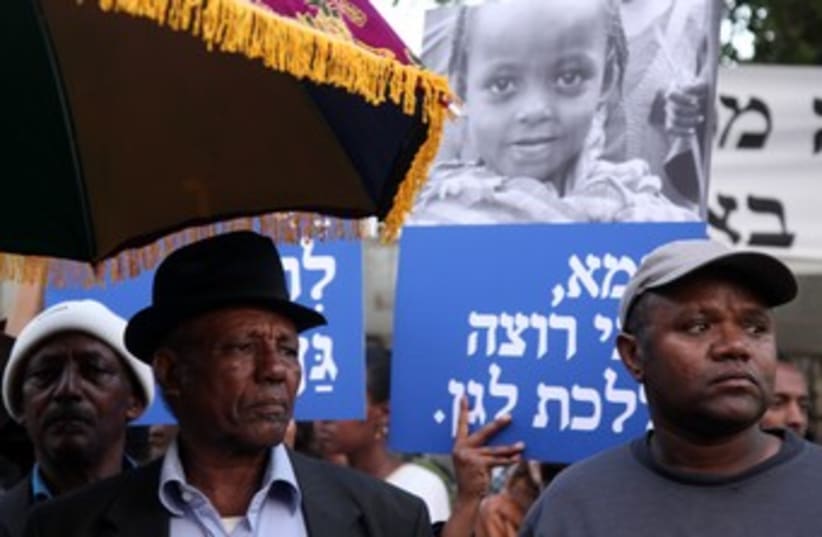
By JPOST EDITORIALEthiopian Israelis demonstrate outside PMO in J'lem 370(photo credit: Marc Israel Sellem)
On July 24, a Jewish woman of Ethiopian origin reported that she was subject to racist abuse while trying to help an elderly Ethiopian immigrant couple board a bus in Beersheba.The elderly couple did not have the small change that the driver demanded and when the woman tried to help negotiate she reported that he called her a “stinking Ethiopian” and cursed her.The Metrodan bus company defended the driver. “What’s baffling is that the driver allowed the elderly couple to board the bus, so why would he go through all the trouble?” Metrodan operates buses under a state license to provide public transport to people in the Beersheba. Under Israeli law people do not have to have exact or small change to board a bus. It is not uncommon, as many Israelis or visitors to the country can attest, that bus drivers get into altercations with the public that result in cursing and shouting. However this incident, if the accusations are accurate, is part of a wider pattern of racist abuse that is all too common in our country.In a 2011 case, an Egged bus driver was accused of racially abusing an Ethiopian Jewish student by telling her he didn’t let blacks ride the bus. “Ethiopians are stupid people who don’t belong in Israel,” he told Yadena Varka. Luckily in this case the Rishon Magistrate’s Court found in favor of the victim and ordered her to receive NIS 60,000 in compensation.Egged roundly condemned the racist comments.In 2009, an Egged bus driver was fired after telling an Ethiopian security guard at the Hebrew University’s Mount Scopus campus, “Perhaps you should drink milk and be white like me.”In 2005, another driver at Mount Scopus refused to let an Ethiopian security guard enter the bus, saying, “Hey, cushi [a pejorative term for blacks], you’re nothing, who put you here?” The abuse directed at Ethiopians by bus drivers crosses ethnic and religious lines. The bus driver accused in the Beersheba incident is a Beduin and one of the bus drivers at Mount Scopus was an Arab. This points to a wide pattern of acceptance of racist attacks on the public and security workers. The list of incidents is longer than presented here and it can be assumed that many other incidents go unreported because the victims either do not know the verbal attacks could result in legal actions against the perpetrators or choose not to speak up.Bus companies, such as Egged, and courts are starting to take notice and punish this kind of racism. But more can be done.In January, thousands of Ethiopians took to the streets in a mass anti-racism rally after it became known that a group of homeowners in Kiryat Malachi had signed a letter not to rent to Ethiopians. However, this protest was never supported by the mainstream Israeli public.Elias Inbar, an activist, said at the time that “the [social justice] protests were very middle class and they don’t want to reach down into the lowest layers of society, where Ethiopians are.”In May, when anti-African-immigrant protests and attacks broke out in south Tel Aviv, some of the public was mobilized against racism, but they were interested only in the racism directed at immigrants. The local Ethiopian community exists in a public blind spot. When Ethiopians set up a tent protest outside the Prime Ministers Residence it was ignored for months.Organizing the Israeli public also demands educating the public about what the Ethiopian community finds offensive. It is still incredibly common to hear the word “cushi” on television and in the street, despite the fact that Ethiopians find it highly offensive.Ziva Mekonen Degu of the Israel Association for Ethiopian Jews says that the term can be considered like the n-word for African-Americans, “it derides people as if they are slaves and harms them grievously.”On the reality singing show The Voice Israel, judge Shlomi Shabat, who since apologized, described one of the contestants as singing “like an American cushi from Harlem.”In the Hebrew subtitles to the film Scary Movie broadcast last week on YES, the word “black man” is translated as cushi. This mainstreaming of offensiveness demeans Israeli society.Israel’s social activists should embrace anti-racism, not only regarding immigrants but also Ethiopian citizens, as a cause. Legal aid organizations that help Ethiopians, such as Tebeka, should be encouraged through government and private financial support to provide more tools and awareness for members of the Ethiopian community, particularly the elderly who often cannot read and sometimes may not know Hebrew well.As the civil rights movement learned in the American South, recourse to the courts can be as effective as public mobilization.
if(catID != 151){
var cont = `Take Israel home with the new Jerusalem Post Store