It is impossible to ignore the many points of dispute between Israel, Russia; Moscow supports antagonistic countries like Syria, Iran.
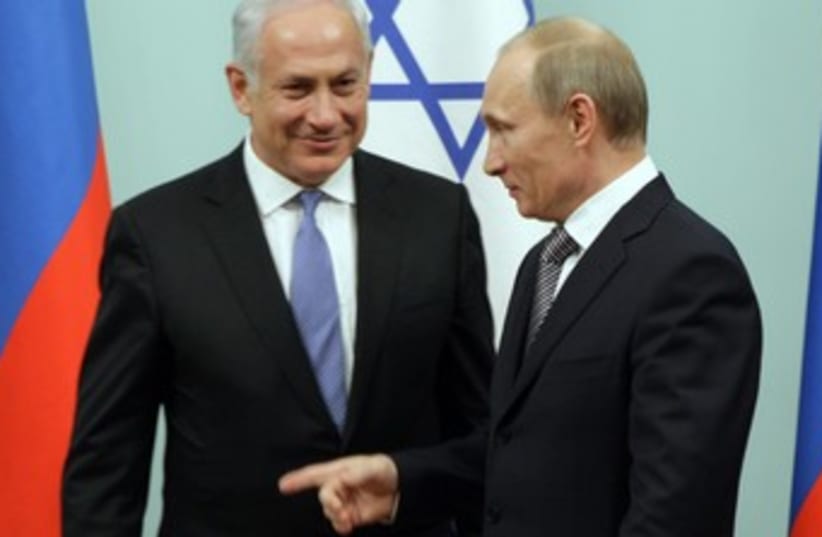
By JPOST EDITORIALRussia's Putin with Netanyahu in Moscow 370 (R)(photo credit: RIA Novosti / Reuters)
As Israel prepares for Russian President Vladimir Putin’s visit here today, it is impossible to ignore the many points of dispute between the nations. Despite the strong relations between Jerusalem and Moscow, the Kremlin provides crucial support to countries extremely antagonistic toward Israel – particularly Syria and Iran.Russia has reportedly supplied Syria with cruise missiles and other arms paid for in large part by Iran and sometimes transferred to Hezbollah; Russia’s only military base outside the former Soviet Union is located in Syria; and Russia has provided Iran with crucial nuclear know-how – most notably a $1 billion reactor in Bushehr.Russia has, in short, succeeded in developing significant economic and military ties with Israel’s archenemies, and this goes a long way toward explaining Moscow’s strident opposition to both the ouster of Syria’s Bashar Assad and to more crippling sanctions aimed at stopping the Islamic Republic’s nuclear program – two Israeli interests.Notwithstanding these developments, there has been a dramatic improvement in Israeli-Russian relations over the past two-and-half decades.During the Cold War, the Union of Soviet Socialist Republics not only supported the enemies of the Jewish state, it was openly inimical to Israeli interests.Today, while they may not be actively working to advance Israeli interests in the region, the Russians under Putin’s leadership are no longer interested in undermining the Jewish state. Israeli and Russian interests may not dovetail, but the points of dispute between the two countries are primarily a byproduct of Moscow’s desire to counter US influence in the region, and have little if anything to do with Russia’s intentions with regard to Israel.Indeed, there are numerous factors that have helped bring the two countries closer, most notably the population of approximately one million Russian-speakers living in Israel. Russia is second only to the US as the country that sends the largest number of tourists to Israel. Economic and cultural ties are also very strong between the countries.Indeed, though talks between Putin and Prime Minister Binyamin Netanyahu will inevitably focus on the divisive issues of Iran and Syria, the official reason for Putin’s 24-hour visit touches on precisely the sorts of cultural ties that exist between the two countries.Putin will travel to Netanya to attend the dedication of a memorial to the Red Army and its defeat of the Nazi regime. With World War II figuring prominently in Russian culture and with hundreds of Red Army veterans now living in Israel, the importance of this dedication ceremony for Putin should not be taken lightly. It might even help explain why, just months after being elected president again in March, he made a visit to Israel a priority.Yet, while relations between Israel and Russia are, in some respects, very warm, it is highly unlikely that Israel will succeed in influencing in the least Russian policy vis-à-vis Iran and Syria.Israel has much to offer Russia, particularly in the field of military technology. Moscow has showed interest in Israel’s pilotless planes and drones. And Russia is interested in developing a pilotless plane of its own in conjunction with Israel. Another possible “carrot” that Israel could offer Russia is cooperation in the distribution and sale of natural gas discovered off Israel’s coastline. Such cooperation would significantly upgrade economic ties between the two nations.But in the final analysis, Putin will develop policies in the region that he sees as serving Russian interests.Russia wants good relations with both Muslim states and Israel, but will pursue its own interests even if this means snubbing Israel by, for example, selling arms to Syria or pushing a diplomatic solution on Iran.The Russians have acquiesced to Israeli requests – most notably when it stopped shipment of S-300 long-range missiles to Iran. But it is unlikely that Russia will budge on more principled positions.Still, Israel must make it clear to Putin that all options are still on the table. If Putin does not want Israel to reach the point where it feels cornered, the newly reelected Russian president would do well to use his influence with the Islamic Republic to stop its nuclear quest before it is too late.
if(catID != 151){
var cont = `Take Israel home with the new Jerusalem Post Store