Readers should be aware that news coverage is likely to be colored by political bias of a paper, which in turn is influenced by its ownership.
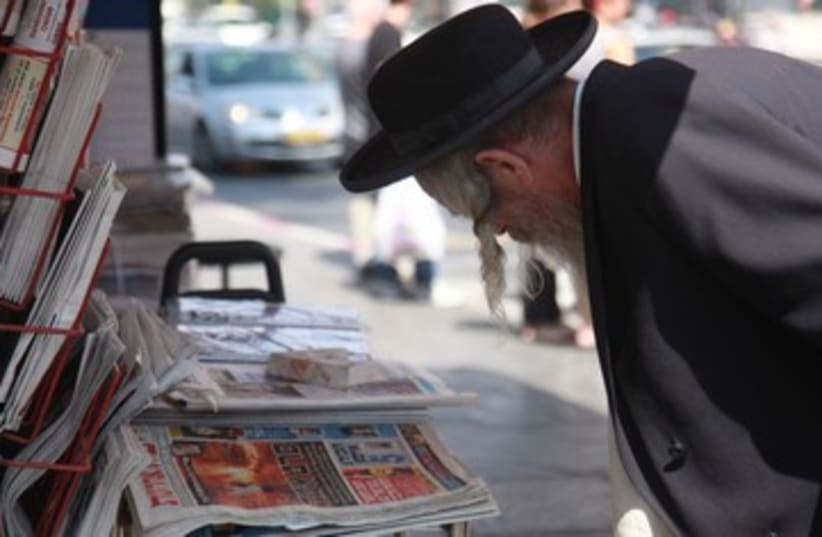
By JPOST EDITORIALOrthodox haredi man reads newspapers media news 390(photo credit: Marc Israel Sellem / The Jerusalem Post)
Most Israeli newspapers tend to take political stands, especially ahead of national elections. They don’t just report election news. Often, just like the campaign ads launched in the media this week, they convey a political message to their readers, telling them – overtly or indirectly – for whom they should be voting or not voting.Thus, Israel HaYom – the Hebrew free daily newspaper owned by American billionaire Sheldon Adelson, a strong backer of Prime Minister Binyamin Netanyahu – is almost always supportive of Netanyahu’s Likud Beytenu list.Yediot Aharonot, on the other hand, seems to find any way it can to bash the prime minister. This was most evident last Friday when the Hebrew tabloid splashed what was termed “The Diskin Document” on its front page.The backdrop to the sensational comments made by former Shin Bet (Israel Security Agency) director Yuval Diskin (2005-11) to Dror Moreh was the latter’s new documentary called The Gatekeepers which features candid interviews with Diskin and five other former Shin Bet directors.After promoting the story for several days, Yediot unleashed an unbridled assault against Netanyahu less than three weeks before the January 22 elections. In the article, headlined “Netanyahu is afraid, zigzags,” Moreh first establishes Diskin’s apparent credibility (“Diskin, a self-professed patriot and war hawk who insists he has no political agenda, served the defense establishment for 38 years”), and then – in his own words – “paints a disconcerting picture of how Israel’s most sensitive decisions are made.”Diskin tells Moreh how the prime minister, together with Defense Minister Ehud Barak and then-foreign minister Avigdor Liberman, held high-level consultations on Iran’s nuclear program, smoking cigars while waiting for chefs in white hats to serve a splendid lunch.“My colleagues and I were very unsure whether Netanyahu and Barak could lead an Iran campaign,” Diskin says. “We didn’t trust their motives. We were worried that they might pursue various moves that would compromise Israel based on irrelevant considerations or via underhanded ways. We had a feeling that they were trying to sneak something under the radar.“Unfortunately, my feeling – and many others in the defense establishment share it – is that in the case of Netanyahu and Barak, their personal, opportunistic interests came first.”The Prime Minister’s Office said in response: “Diskin’s ridiculous statements, made by a man who until six months ago wanted to be head of the Mossad, have been recycled at this time for political reasons and stem from his own frustration with not being named director of the Mossad.”But why has Yediot, which is not considered a leftist newspaper, become so anti-Netanyahu? One explanation is that this is the response of its major shareholder, Arnon Mozes, to the serious competition posed by Israel HaYom. Since 2010, Israel HaYom has surpassed Yediot as the country’s most read newspaper, according to the Target Group Index annual survey.And what about Israel’s other major newspapers? When you read Haaretz, you know you’re reading a paper that generally supports left-wing parties, particularly Labor and Meretz. Haaretz, whose primary shareholder remains the Schocken family, has strong historical ties with the labor movement and leftist elites.Since Shlomo Ben-Zvi took over Ma’ariv last year, it has moved in the direction of his other paper, Makor Rishon, backing the right-wing Bayit Yehudi party of Naftali Bennett.The Jerusalem Post and its Hebrew sister publications, Israel Post and the new Sof Hashavua, owned by Eli Azur’s Mirkaei Tikshoret, strive to present a balanced picture, free of political considerations. We don’t toe any party line or back any candidate, and we provide a platform to columnists representing a wide range of political parties.But where do the political affiliations of other papers, in print and online, leave their readership? For one thing, these readers should be aware that the news coverage is likely to be colored by the political bias of the newspaper, which in turn is influenced by its ownership.In order to make informed decisions before they cast their ballots, voters are urged to keep this in mind when they read political stories.Consumers must maintain a healthy skepticism while they digest the daily news, and ask themselves if they agree with the direction in which a writer – or newspaper – is taking them.
if(catID != 151){
var cont = `Take Israel home with the new Jerusalem Post Store