The Jerusalem Post
Jpost search icon google-icon iphone
  Set as Homepage
Thu, Jun 20, 2013   12 Tammuz, 5773
newspapers magazines
 
    • Breaking News
    • Diplomacy & Politics
    • Defense
    • National
    • Mideast
    • Syria
    • Iran
    • World
    • Business
    • Sports
    • Health & Science
    • Environment
  • Video
  • Opinion
    • Columnists
    • Editorials
    • Op-Eds
    • Letters
  • Jewish World
  • Lifestyle
    • Arts & Culture
    • Food & Wine
    • Travel
  • Features
    • Insights & Features
    • Week in review
    • On the Web
    • Shalva Superheroes
    • Obama in Israel
  • Blogs
    • In the news
    • Judaism
    • From the Middle East
    • Lifestyle
    • Aliya
    • Science and Technology
  • JPost Apps
    • iPhone app
    • iPad app
    • Android app
    • Twitter
    • Facebook
    • RSS feeds
    • JPost Toolbar
    • JPost Newsletter
    • JPost Alert
  • Premium Zone
    • The Jerusalem Report
    • Magazine
    • Metro
    • In Jerusalem
    • ePaper
    • Expert Opinion
    • Q&A
    • Dash
    • Christian Edition
    • Ivrit
  • French
    • Politique & Social
    • Affaires Palestiniennes
    • Diplomatie & Monde
    • Art & Culture
    • Israel
  • Green Israel
JPost Learn Hebrew  
Advertise with us  
Nefesh Guided Aliyah  
Eldan  
AFMDA  
YTA  
Isram Group  
JPost Twitter  
JPost Facebook  
Classifieds  


Breaking News
 
 
  • JPost.com
  • Opinion
  • Op- Ed Contributors
 

A tale of three capitals

By CHUCK FREILICH
04/29/2012 23:25
Tweet

According to recent reports, the US and EU have reconciled themselves to the need to allow Iran to retain some nuclear enrichment capability.

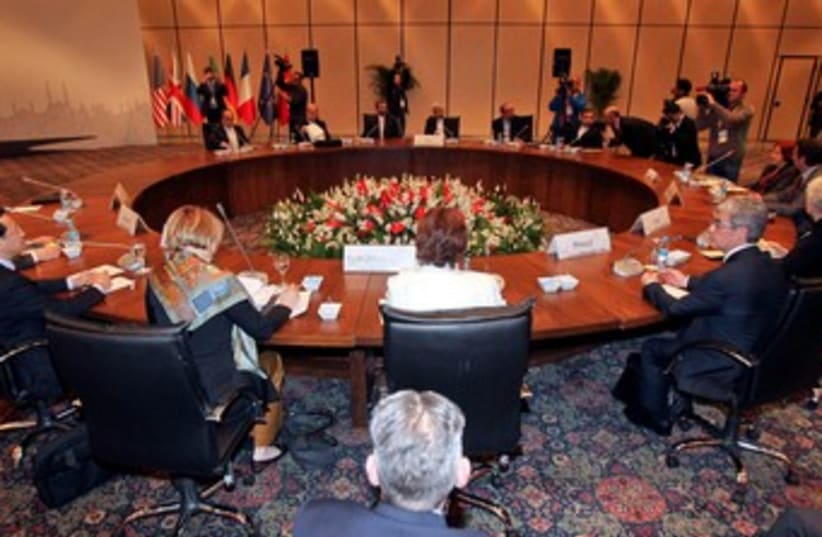
Iran nuclear talks in Istanbul
Iran nuclear talks in Istanbul Photo: REUTERS/Tolga Adanali/Pool
The need to resolve the growing international crisis over Iran’s nuclear program has never been greater.

In Jerusalem, fears of a threat to Israel’s very existence, at the very least of a dire strategic threat, have animated the public bluster of recent months. Designed first and foremost to put pressure on the international community to finally deal with the Iranian issue effectively, so that Israel will not actually have to strike, rather than as a true indication of imminent action, the policy has worked well. The world has finally gotten serious about Iran and Tehran is clearly worried, jingoistic bravado notwithstanding. Israel may ultimately be forced to act militarily, but clearly hopes that the hard-line approach will forestall the need to do so.

In Washington, a marked upturn in both bluster and activity regarding the issue reflect a sincere belief in the dangers attendant to a nuclear Iran and a determination to address the issue, as well as a desire to stave off the possibility of an Israeli attack, at least until the upcoming elections. Having put unprecedented sanctions in place, Washington still hopes, albeit with little real expectation, that Iran will buckle and prevent the need for military action, American or Israeli. If the likelihood of a diplomatic resolution remains as elusive as ever, Obama has at least brought Iran back to the negotiating table and bought time, his immediate objective.

In Tehran, the bluster of recent months reflects a recognition of Iran’s increasingly difficult circumstances, with heavy international sanctions taking a growing toll on its economy and the likelihood of a military attack growing, but also a sense of partial vindication.

According to recent reports, the US and EU have reconciled themselves to the need to allow Iran to retain some nuclear enrichment capability, if only at a level appropriate to a civilian program, and are willing to forgo the previous demand for a complete cessation, an unlikely outcome given the domestic consequences for the Iranian government. In the meantime, Iran remains defiant, committed to its nuclear efforts

All three capitals thus see some gain, but have much at risk. In such circumstances, it is commonplace to believe that diplomatic solutions are more likely. It is entirely unclear, however, whether last week’s US/EU talks with Iran, scheduled to resume May 23, constitute a basis for a last-minute breakthrough, or merely a façade that provides Iran with further time to promote its nuclear capability.

Based on all previous experience, it is highly unlikely that Iran truly wishes to take advantage of this opportunity to reach a deal. Nevertheless, a good-faith effort must be made to reach an agreement, if only to prove to the American people and international community that all avenues have been exhausted and that military action, should it come to that, is indeed the last resort. To this end, a narrowly focused initial American offer should be presented by the next round of talks, along the lines mentioned above, to achieve an immediate cessation of enrichment at the dangerous 20 percent level, leaving final resolution of the issue for further talks.

TO SUCCEED, this “carrot approach” should be backed up by a clear “stick,” a firm resolve to further heighten sanctions if Iran fails once again, as it so often has in the past, to step up to the plate. The onus will then be entirely on Iran

In what may be surprising to some, Israel will probably take an even more pragmatic approach than the US, in which the Iranian nuclear issue has become a part of the presidential campaign and partisan political discourse generally and where many believe that its resolution should also be tied to Iran’s human rights violations, suppression of domestic dissent and involvement in terrorism.

In Israel, although a range of views exists regarding the means of dealing with the nuclear threat, the approach is very narrowly focused; just prevent, or at least significantly delay, an Iranian bomb, even at the expense of other issues in which Israel has vital interests, such as Iran’s massive arming of Hezbollah. The nukes come first and unlike many other issues in Israel, differences on Iran are substantive, not partisan. It is further likely – even if this is not, for obvious tactical reasons, the official policy – that Israel would accept any deal that achieved the desired prevention or delay, under strict safeguards, even if otherwise painful compromises are required.

The writer, a Senior Fellow at Harvard’s Kennedy School, was a deputy national security adviser in Israel.
  • Send
  • Large
  • Small
  • Print
  • Share
Most Viewed in
1
Preconditions have no basis in law or fact
2
President Peres
3
The world’s preferred refugees
4
Ending the Chief Rabbinate electoral machinations
JPost Community
Tweet
Iran Washington nuclear threat nuclear rights Barack Obama Tehran
Tweets about "#jpost"
Share this article
Tweet
Share
Send
Your comment must be approved by a moderator before being published on JPost.com. Disqus users can post comments automatically.

Comments must adhere to our Talkback policy. If you believe that a comment has breached the Talkback policy, please press the flag icon to bring it to the attention of our moderation team.
JPost Services
conferenceConference
newsletterNewsletter
iphoneMobile Apps
kotelcamKotel Cam
kolboJPost Alert
premiumPremium
JPost TV News  
Mobile Apps  
Bank Hapoalim  
Meir Panim  
Israel Law Center  
Inbal Hotel Jerusale  
Meier on Rothschild  
Weizmann Institute o  
JPost Premium Zone  
JPost kotel Camera  
         
 
Israel Focus
JPost TV News
Watch Now!  
Donate to Save Lives in Israel
 
Israel Law Center
The ultimate Mission to Israel, October 21 – 28, 2013 Register now!  
Nefesh B'Nefesh Guided Aliyah
Already living in Israel? Enjoy the Benefits of Aliyah!  
One year International MBA
in English, Bar-Ilan University, Israel – Open House July 9, 2013, 17:30  
Give "Freedom" this Passover
to needy Israeli families. Donate now  
YTA – A Yeshiva in Israel…
in English. Come Join Us  
War Threatens
Protect the People of Northern Israel  
Bank Hapoalim
Israeli's number one bank  
Jerusalem Post Lite
Lite Edition of the Jerusalem Post for English improvement  
Learn Hebrew with us
Get 10 minutes free personal coaching in Hebrew through phone or Skype  
JPost newspapers
Sign up for the JPost newspapers and receive one month free subscription  
Kosher English Magazine
English language weekly magazine - especially for religious people  
JReport Kindle Edition
Now you can get the Jerusalem Report directly to your Kindle  
JPost Premium Edition
The very best articles are available only in our Premium edition  
Lifestyle Magazine
 
 
Real Estate
Meier on Rothschild
Tel Aviv's Most Prestigious Address  
Don't Look For a House!
In Israel, our website will do it for you!  
 
Travel
Tourism Magazine
June 2013  
The Inbal Jerusalem Hotel
Hot summer deal, order now!  
Eldan Rent a Car
20% off all Car Rental Reservations in Israel  
Hertz Car Rental
Special Online Discounts!  
The King David Jerusalem Hotel
One of the world's truly iconic hotels, and a Jerusalem landmark  


Sites Of Interest:

Jerusalem Hotels
KKL-JNF
Poalim Online
BreitBart.com
Our Friends
Jerusalem Attractions
Jerusalem Tours
itraveljerusalem.com

JPost sites:

Learn Hebrew
The Jerusalem Report
Our Magazines
JPost Edition Francaise
Green Israel
Christian World
Jerusalem Post Lite

Services:

JPost Mobile Apps
JPost Premium
JPost Newsletter
JPost Toolbar
JPost News Ticker
JPost RSS feeds
JPost Archives
JPost Alert
JPost Kotel Cam

JPost Conferences:

NYC Conference
Diplomatic Conference

Information:

About Us
Feedback
Staff E-mails
Copyright
Sitemap
News Partners
Advertise with Us
Statistics
Ad Specs
Terms Of Service
Jpost.com, the online edition of the Jerusalem Post Newspaper - the most read and best-selling English-language newspaper in Israel. For analysis and opinion from Israel, the Jewish World and the Middle East. Jpost.com offers expert and in-depth reporting from Israel, the Jewish World and the Middle East, including diplomacy and defense, the Palestinian-Israeli conflict, the Arab Spring, the Mideast peace process, politics in Israel, life in Jerusalem, Israel's international affairs, Iran and its nuclear program, Syria and the Syrian civil war, Lebanon, the Palestinian Authority, the West Bank and Gaza Strip, Israel's world of business and finance, and Jewish life in Israel and the Diaspora.
 
About Us | Advertise with Us | Subscribe | Premium | Newsletter | RSS | Contact Us
 
All rights reserved © The Jerusalem Post 1995 - 2012