The Palmers fear that a lenient sentence will be handed down against murderers of Israeli father, infant son.
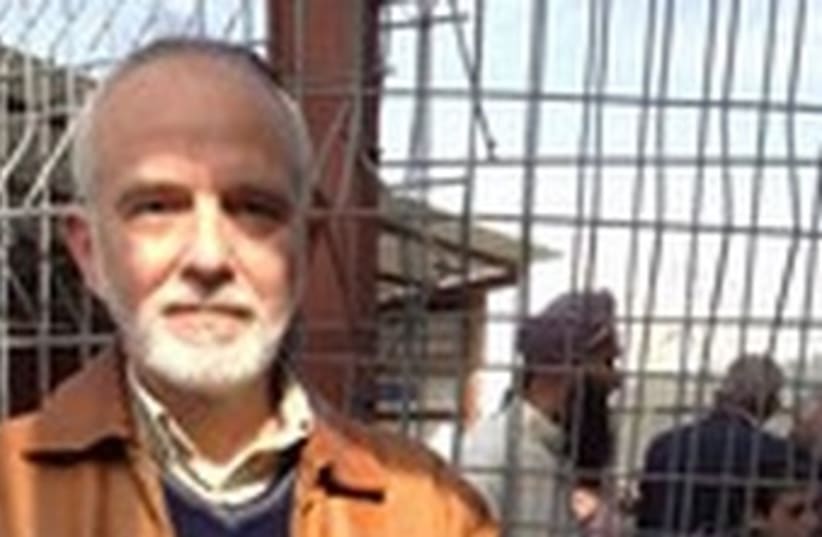
By JOSH HASTENMichael Palmer at the Ofer military court 370(photo credit: JOANNA PARASZCZUK)
Wednesday, April 18 marked the resumption of the unprecedented military trial of a five-member Palestinian terror cell accused of murdering an Israeli father and his infant son using a rock as their weapon of choice.On September 23, 2011, 25- year-old Asher Palmer and his son Yonatan, strapped in his car seat, were murdered in a precisely plotted attack, on the road between Kiryat Arba and Jerusalem. Terrorists laying in wait in their car hurled a rock at Asher’s vehicle causing him to lose control and plummet off the road into a ditch killing him and his son.Asher, whose parents made aliya from New York in 1985, left behind a wife who was pregnant with the couple’s second child.Originally, the police dubbed the incident an accident or an apparent suicide. Several days later it was revealed to the Palmer family that there was unequivocal evidence proving that this wasn’t an accident or a suicide, but pre-mediated murder carried out by a Palestinian terror cell.According to security officials the gang had been practicing for a month – aiming and heaving heavy projectiles from car windows – in preparation for the eventual targeting of an unassuming Israeli motorist, whose passing car would be clearly marked with a yellow license plate.Many suggest that the authorities knew all along that this was a deliberate attack since they were monitoring the cell, but downplayed the incident to avoid widespread panic.A short while later, Israel arrested six Palestinians in connection with the attack. Five of the Arabs are currently being charged in an Israeli military court with planning the murder while the sixth is being held for his role in approaching the mangled car and stealing Asher’s gun as he his son were trapped and near death, or had already died.Despite the fact that the Palestinians being held for murder have lengthy nationalistically motivated police records for violence against Israelis, according to Michael Palmer, Asher’s father and Yonatan’s grandfather, the prosecution in the case is talking down expectations that the court will levy a just punishment against the perpetrators.The Palmers fear a lenient sentence will be handed down for several reasons. Firstly, as mentioned above, this case is unique since it’s the lone instance where a Palestinian is on trial for murder of an Israeli where the murder weapon is a rock.But more so, according to Palmer, he is pessimistic that justice will be served because in his words “according to the prosecution, the legal system’s primary audience is the Palestinians and NGOs who support them, and [the justice system] is tailored to satisfy their criticism and is thus tilted towards leniency.”Palmer also admits that he is “astonished” that as the case advances along all the necessary steps of the legal process, he has found that the court has gradually expressed greater sensitivities towards the needs of the defendants, while at the same time seems to be “lacking comfort” showing the same compassion towards the plaintiffs.Palmer admits that when the trial started back in December he did feel some compassion from the state, but once he expressed his desire for Jewish support in the courtroom, that’s when things started to change.As an example Palmer says that during the last court session held in March, only 10 of the nearly 100 Jewish supporters he brought to the courthouse for encouragement were allowed entry while the defendants were offered far greater representation, which included direct support and communication with those on trial [for terrorism] during the proceedings.Palmer adds that the Arabs in the courtroom were jeering and heckling the judge as well as the plaintiffs “as if they were the victims.”Palmer was puzzled that his supporters were forbidden access since he says the hearings are “public proceedings” and thus are supposed to be open to the community at large.He says that the “prosecution initially asked me for my list, which included nearly 100 names, but then there was silence, and on the day of the trial, only the 10 were allowed entry by the court, which claimed it had to place restrictions in order to preserve order and security.”In addition, Palmer was dumbfounded that he was forced to wait outside the court before the most recent session literally side by side with the defendants’ families for nearly 20 minutes, as if they were on the same moral playing field; a situation he found nearly unbearable.Despite last month’s hearing, things were not that much different this time around. During yesterday’s session only 13 family members and guests were admitted to the court among over 50 people who showed up for support, and that was only after much pleading with court officials.At one point toward the beginning of the ordeal, Palmer sat helplessly on the ground in protest, refusing to enter, as a court official claimed that he would have to attend the session alone, since a list of ID numbers of all guests was not provided in time. Palmer’s attorney argued that such a demand had no precedent. That image of a mourning Jewish father and grandfather sitting outside an Israeli court on the ground will be etched in my mind for many days to come.Even after all of yesterday’s drama, once inside, the presiding judge decided to postpone the session until June per a request from the defendants’ attorney.Another delay in the closure process for the Palmer family.Michael Palmer knows know that nothing will bring back his loved ones. He and his family are living through an unimaginable nightmare. Nevertheless he is adamant that awareness needs to be raised as to how the courts are run in Israel.“On behalf of my son who is gone and grandson who is gone, our families, and the families of all victims of terror in Israel, and actually everybody in Israel – since we are all [potential] targets of this kind of terrorism, there has to be a lot more sensitivity and a lot more cognizance of the fact that justice needs to be appreciated and felt amongst Israelis and [not only] Palestinians in this process.”
if(catID != 151){
var cont = `Take Israel home with the new Jerusalem Post Store