Khairat el Shater, Omar Suleiman seek presidency, conflict between Brotherhood, SCAF turns into open warfare.
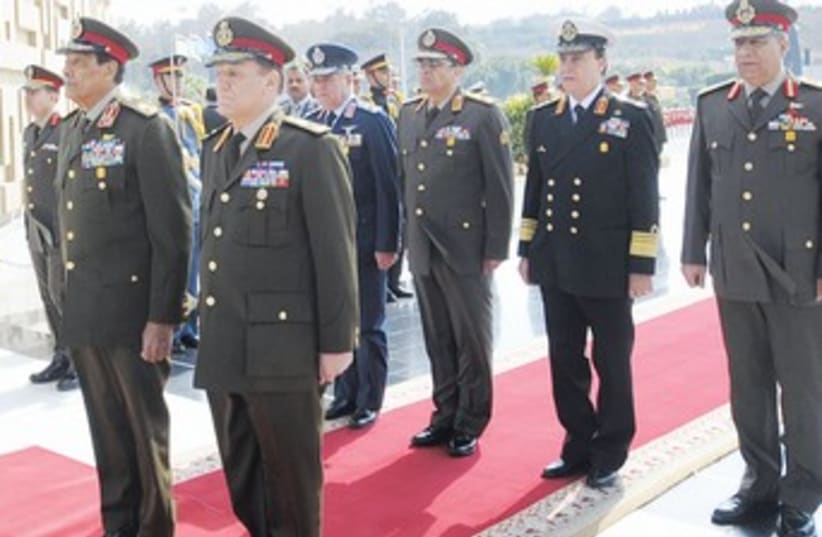
By ZVI MAZELEgypt's Supreme Council of the Armed Forces(photo credit: Reuters)
With Khairat el Shater and Omar Suleiman vying for the presidency, the long simmering conflict between the Brotherhood and the SCAF has turned into open warfare.Ever since Hosni Mubarak’s ouster conventional wisdom had it that there was some form of understanding between the army and the Brothers. The generals, accepting the fact that the Brotherhood was the main political force that would rule Egypt in the coming years, were keen to make a deal.The army would keep its special status and its immunity under the new regime – and in return would support the Brotherhood and let them draw up the new constitutional framework.Only thus, explained political pundits, could the army retain its economic empire and escape having to answer for what it had done during the Mubarak years. Many things appeared to confirm this theory. Drafting the transition constitution was left to a committee consisting largely of Islamists; when it was submitted to a referendum, the Brothers campaigned so vigorously in its favor that 77 percent approved of it, thus giving the army an important propaganda victory. The timetable for elections set down in that constitution was thought to favor the Brothers, and they refrained from taking part in many of the subsequent mass demonstrations in Tahrir square.However, all that is in the past. Suddenly the Brothers have 47% of the seats in the new parliament, and together with the Salafists can muster nearly three quarters. Now they are flexing their muscles.They want the Ganzouri government to resign; they threaten to pass a no-confidence motion. They have the votes for it.The parliament has already blamed the government for the sorry economic situation.A communiqué issued by the Brothers accuses the SCAF-appointed government of attempting, at its bidding, to tamper with the results of the referendum on the constitution and of the presidential election. These are very serious allegations which the army angrily refuted with a communiqué of its own.Hadn’t it made it possible to hold the free and fair elections that gave the Brotherhood its majority in the parliament? There was no cause to doubt the fairness and honesty of the army and the SCAF and to question the loyalty of the government or the independence of the supreme court which is in charge of supervising the elections.The fact is that according to the transition constitution – which the Brothers supported and voted for – the army holds executive and legislative powers until a president has been elected. The parliament has no real power. This is especially galling for the Islamists who stand on their right to criticize national institutions.The “supreme guide” of the Brotherhood, Muhammad Badi’e, proclaimed that the government had to be dismissed forthwith.“There is no honeymoon between us and the SCAF, since we never got married” he said bluntly, hinting that no deal had been struck with the army and that since he was the leader of the majority party in parliament he had every right to confront the army.While the issue is as yet unresolved, another crisis is looming regarding the composition of the special council tasked with drafting the constitution.The parliament decided that half of the 100 delegates would come from the lower and upper houses, and the other half would be chosen among leading figures by that self-same parliament – where the Brothers and the Salafists hold 73% of the seats in the lower house and 85% in the upper house.As a result, 75% of the delegates chosen were Islamists; with only six women and a handful of Copts (though Copts make up 10% to 12% of the population). This was clearly a blueprint for a thoroughly Islamic constitution.It was apparently too much.Twenty-five of the chosen delegates – the representative of Al Azhar included – did not attend the first session of the council; six resigned; a complaint was submitted to the supreme court, demanding that the committee be disbanded.The court postponed hearings to April 10, in the hope that a compromise might be found. The army is doing its best to encourage such a compromise, but it does not seem very likely at the moment. Secular and liberal forces are all too aware that this is their very last opportunity to stop the wave of radical Islam threatening to engulf the country and turn it into an Islamic dictatorship.IF THAT was not enough, the Brotherhood, which had always said it would not have a candidate of its own for the presidency so as as not to unsettle local and international public opinion, suddenly backtracked. It had previously stated it would only field parliamentary candidates in 30% of the districts – but then changed its mind and carried a large majority.Now that the prize seems within reach, it let itself be tempted and announced that Kheirat el-Shater, founder of the Brotherhood’s economic empire, would run for president.In other words, the Brotherhood wants all three key power points: the parliament, the constitution and now the presidency. A formidable threat for the army.As to the army, accused of maneuvering to remain in power, it tried an interesting ploy. General Mahmud Nasser, a highly respected member of SCAF, gave an informal briefing to a select number of media representatives and public figures. He had harsh words for the masses – why aren’t they working instead of protesting? Have they forgotten how to earn food? He also wondered how fair elections could be held when hungry people might start a new revolution. Economic growth for 2011-2012 had been a dismal 0.6%; foreign currency holdings had dropped from 35 to 15 billion dollars; a further 12b. dollar of private money had fled the country. Traditional allies were reluctant to help.Saudi Arabia and the Emirates, fuming at the treatment meted to their longtime ally Mubarak, were making their help conditional on political demands. Though the International Monetary Fund was about to grant a $3.2b. loan, this would not solve the problem as long as protests and strikes paralyzed the economy.In contrast, the general extolled the tireless efforts of the army to improve and develop the many companies it owns, which saw a profit of more than a billion dollars over the past 10 years. Thanks to these revenues, he said, the budget of the army was a mere 4.8% of the country’s budget, far less that would be the case otherwise. Moreover the army tried to help by lending nearly $2b. dollars to the government, and selling its food and clothing surpluses at reduced prices to the population, thereby easing its plight.This was the first time the usually close-mouthed army had made public the extent of its economic activities, and it made it clear that it would fight to keep what it had so carefully built over the years.Battle lines lines have been drawn. At stake, the fate of Egypt.The writer is a former ambassador to Egypt and a fellow at the Jerusalem Center for Public Affairs.
if(catID != 151){
var cont = `Take Israel home with the new Jerusalem Post Store