Israel must use a tough hand to deal with ultra-Orthodox extremists. If it doesn’t, the future looks bleak indeed.
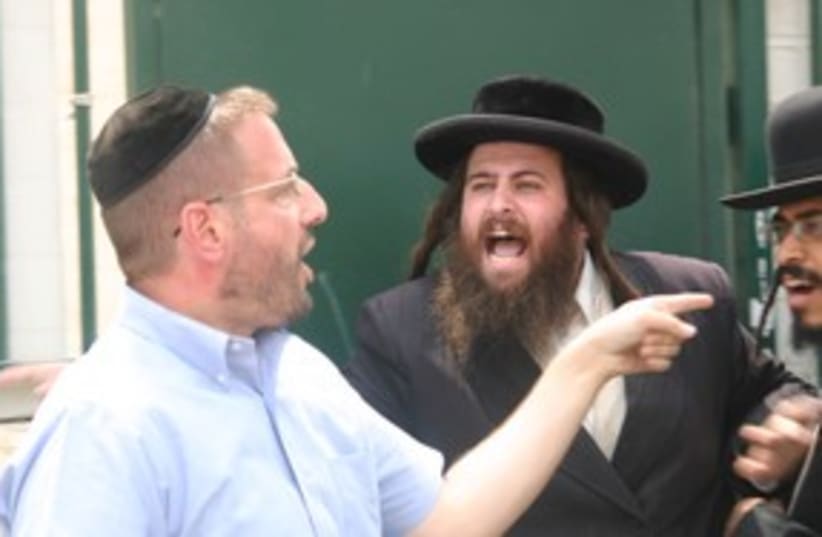
By RABBI DOV LIPMANHaredi yelling 311(photo credit: Michael Lipkin)
The ongoing struggle in Beit Shemesh is a microcosm of a wider fight for the character of the State of Israel.Last week, on the first day back at school after the holiday break, the religious extremists who had been demonstrating against the Orot Banot national-religious girls’ school returned and began screaming right outside the building. Police were summoned and, in contrast to the passive, soft treatment the extremists were given in previous protests, a young, new officer pulled out his taser gun and pulled the trigger, causing the demonstrators to vacate the area immediately. The demonstrators have not yet returned.The next day, a secular woman in her sixties from Hebrew University, dressed modestly in an ordinary shirt and with pants to her knees, was walking through the neighborhood to conduct a poll about terror-related trauma. When she approached a building which houses some religious extremists, she was physically blocked from entering and subjected to verbal assaults.Again, the police were summoned, but this time, instead of using force to escort the woman into the public apartment building, they checked her ID and discussed the situation with the extremists, whose numbers had grown substantially as more and more flocked to the site from around the neighborhood. One officer tried unsuccessfully to move one of the extremists. Eventually, the police ended up sending the woman to the local police station to file a complaint against the goons. The extremists walked away empowered and emboldened.This second story reflects the more usual experience in Beit Shemesh in recent months. Extremists have been allowed to verbally assault little girls on a regular basis because police prefer quiet to enforcing the law. They fear that coming down hard on the extremists will lead to rioting, burning trash bins and the blocking of main roads. They simply do not want to deal with that. Instead, they have opted for peace and quiet, at the expense of young girls’ trauma.
THE ISSUE is not limited to local police. Government officials have been made aware of the clashes, but no major attempts have been made to stop the goons from harassing these children.In Beit Shemesh, this development has started to affect other areas of our lives as well. There are plans for 20,000 new housing units to be built in the beautiful hills surrounding Beit Shemesh. The general population is fighting hard to make sure that some of these new neighborhoods be built to meet the needs of the general population and not just those of the ultra-Orthodox.Why is there a need to fight for this? Because the coalition agreement between Prime Minister Binyamin Netanyahu and Degel Hatorah promises that ultra-Orthodox communities will get preferential treatment with regard to future construction in Beit Shemesh.This agreement was made despite the fact that a huge percentage of the city’s general population supported Netanyahu and his party in the previous elections. But instead of allowing us to build a nice, balanced city for all sectors of our population to live, including the ultra-Orthodox, the leader we voted for has given in to political pressure. That will breed more extremism instead of doing the right thing and embracing a moderate approach.This is about more than Beit Shemesh: it is about extremists vs. moderates and what this country will look like in 20 years. The ultra- Orthodox population is reproducing at a far more rapid pace than the rest of the country. At some stage, the ultra-Orthodox will constitute a majority of Jews in Israel.Is that a problem? God forbid! The average ultra-Orthodox Jew on the street has no interest in forcing his values on any other Israeli, has no interest in making any city or the country ultra-Orthodox, and is busy simply making a living and raising a family. They have no interest in seeing the ultra-Orthodox world become more extreme and would gladly live a moderate lifestyle in peace and quiet with their neighbors.If the extremists were to be isolated by means of a strong and determined agenda to squelch their hatred, the moderates would encourage these efforts and would work together with the general population to continue building a beautiful and moderate country.In fact, as Beit Shemesh experienced with the extremists fleeing from one taser gun and the moderates applauding that police action, a strong response will silence the extremists, even if they initially react with riots and the like, while emboldening the moderates.IF WE use this approach, no Israeli need fear the spectre of an ultra- Orthodox majority in this country because aside from a few outcast extremists, no one would try to impose their lifestyle on others.However, when ultra-Orthodox political and rabbinic leaders are permitted and empowered to openly act in extremist ways without any resistance or repercussions, then the growth of this community does become a problem. The tendency is for even moderate ultra-Orthodox Jews to yield to the pressure of their peers, resulting in the entire community slowly become more extreme.Unfortunately, the recent trend has been to sit back and enable and embolden the extremists among the ultra-Orthodox movement. This is a development which polarizes populations and has the power to ultimately destroy our country.While there is absolutely no comparison between the motivations, emotions and goals in the tensions between the ultra-Orthodox and the general population to our struggles with the Palestinians, the same principles are at work. When Israel exhibited strength against Hamas and other militant groups, the extremists remained isolated and moderate voices were able to be heard. But that approach seems to be a thing of the past. The pacifistic, soft approach to dealing with our enemies which has emerged in recent decades has not only strengthened the fanatics but has silenced the moderates and pushed them toward the side of the extremists.We now sit at this critical crossroads.Will the State of Israel become an extremist, fanatic and unpleasant place to live on the religious side and an unsafe and uncertain country on the security side, or will we fight extremists on all fronts and enable the ultra-Orthodox moderates to call the shots on religious matters and the Palestinian moderates to represent their people on security matters? That decision is currently in the hands of our country’s leaders and, sadly, from police chiefs up to the government ministers, they seem to be steering us in the wrong direction on all fronts.If these leaders do not change course quickly and choose the right path, we must explore other options.Their inaction and unwillingness to change on this critical issue should lead all concerned citizens to consider not voting the same tired, pacifist and soft leaders into power over and over again (regardless of what they promise before the elections) while they lead us to a life of fanaticism, extremism and lack of security.We should vote for new and fresh alternatives who will act with absolute force against extremism in all its forms, and provide us all with both a safe country from without and a moderate and free country which captures all the beauty which Judaism has to offer from within.The writer is a rabbi, teacher, author and community activist in Beit Shemesh and director of Anglos for Am Shalem, a new political movement led by MK Rabbi Haim Amsalem.http://www.rabbilipman.com/
if(catID != 151){
var cont = `Take Israel home with the new Jerusalem Post Store