The Jerusalem Post
Jpost search icon google-icon iphone
  Set as Homepage
Wed, Jun 19, 2013   11 Tammuz, 5773
newspapers magazines
 
    • Breaking News
    • Diplomacy & Politics
    • Defense
    • National
    • Mideast
    • Syria
    • Iran
    • World
    • Business
    • Sports
    • Health & Science
    • Environment
  • Video
  • Opinion
    • Columnists
    • Editorials
    • Op-Eds
    • Letters
  • Jewish World
  • Lifestyle
    • Arts & Culture
    • Food & Wine
    • Travel
  • Features
    • Insights & Features
    • Week in review
    • On the Web
    • Shalva Superheroes
    • Obama in Israel
  • Blogs
    • In the news
    • Judaism
    • From the Middle East
    • Lifestyle
    • Aliya
    • Science and Technology
  • JPost Apps
    • iPhone app
    • iPad app
    • Android app
    • Twitter
    • Facebook
    • RSS feeds
    • JPost Toolbar
    • JPost Newsletter
    • JPost Alert
  • Premium Zone
    • The Jerusalem Report
    • Magazine
    • Metro
    • In Jerusalem
    • ePaper
    • Expert Opinion
    • Q&A
    • Dash
    • Christian Edition
    • Ivrit
  • French
    • Politique & Social
    • Affaires Palestiniennes
    • Diplomatie & Monde
    • Art & Culture
    • Israel
  • Green Israel
JPost Learn Hebrew  
Advertise with us  
Nefesh Guided Aliyah  
Eldan  
AFMDA  
YTA  
Isram Group  
JPost Twitter  
JPost Facebook  
Classifieds  


Breaking News
 
 
  • JPost.com
  • Opinion
  • Op- Ed Contributors
 

Can Bashar Assad survive the storm?

By JACQUES NERIAH
LAST UPDATED: 06/19/2011 22:33
Tweet

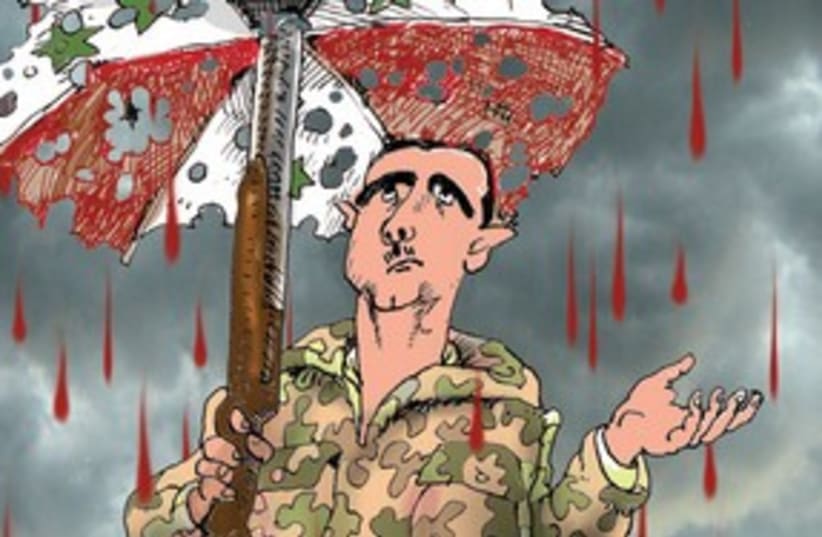
The Syrian president knows his time is limited; in fact, he has until Muammar Gaddafi falls.

Bashar Assad
Bashar Assad Photo: AVI KATZ
The world has got accustomed since mid March to reports of wide unrest sweeping Syria. Unlike Egypt, Tunisia and very much like in Libya, the Syrian regime has chosen to confront the “Arab Spring” with armed repression, including tanks, helicopter gunships and missile boats – thus provoking, like in the Tunisian case, a steady flow of refugees fleeing the battle ground to a safe haven, in Turkey, and who are revealing day after day the atrocities committed by the Alawite regime against its own people.

Even though the 2011 events remind one of the 1982 rebellion staged by the Muslim Brotherhood in Hama, and of the brutal repression that followed, the repression under Bashar has not reached the scope of the repression under Hafez Assad. In 1982, more than 20,000 were killed by forces loyal to the tyrant, compared to around 1,200 victims today. Yet the same methods applied in 1982 are being repeated; the regime has no answer other than brutal repression, with a small difference. Hafez Assad did not ask for the assistance of the Iranians and Hezbollah (which was practically non-existent at that time). Oddly enough, in 1982 it was Rifaat Assad – Hafez Assad’s brother – who led the repression. Today it is Maher Assad, Bashar’s younger brother.

However, unlike the 1982 events, unrest and demonstrations this time are widespread, from South to North and East to West, and not limited to two towns and a specific sector of the population. The opposition is not limited to Islamic fundamentalists (although the regime is trying to create a picture according to which Syria is under a combined attack by al-Qaida and its associates – with Israeli backing and involvement, of course).

Unlike the 1982 events, the protests began in the South and were meant to combat the corruption represented by the ruling family. In this context, the first targets attacked by the demonstrators (as in Egypt and Tunisia) were the offices of the ruling Ba’ath party and the headquarters of Syria’s leading cellular company Syriatel, owned by Bashar Assad’s first cousin, Rami Makhlouf.

Bashar Assad knows his time is limited. The western powers may be slow to react, but when they do, their intent is very clear: to limit his powers and end his repressive methods, with a regime change if needed.

The first sanctions by the Europeans and Americans have already landed on the Syrian elite, singled out for its involvement in the repression, and there will probably be others to come, until the rope gets tighter and tighter.

European regimes, as well as the US administration, are being criticized for their double standard in treating Syria and Libya. This criticism will inevitably bring the West and the US to apply the same kind of sanctions against the Syrian regime as they did in the Libyan case if the Syrian regime continues in his rage against the demonstrators.

Assad has an important ally in this field besides Iran and Hezbollah: Russia, whose delaying role in the UN Security Council has given the Syrian regime time to cope with its domestic problems in the hope that by the time the West organizes, Syria would again be disciplined, and revolts a part of history!

In the meantime, Assad plays “business as usual.” He played a leading role as catalyst in breaking the fivemonth political deadlock which had divided Lebanon, and forming the Hezbollah-backed, almost entirely pro- Syrian, Lebanese government. For Bashar this was sweet revenge, compensating him for his shameful withdrawal from Lebanon following the 2005 assassination of the then-Lebanese prime minister Rafik Hariri.

On the Israeli border, in close association with Hezbollah, Syria tried to put pressure on Israel by a diverting exposé of its ‘non-humanitarian’ response to unarmed demonstrators who tried to cross its borders and commemorate the “Nakba,” (the “catastrophe” of 1948).

Indeed, May 15 came as surprise to Israel, whose borders were crossed in the Golan, but its harsh reaction even before the “Naksa” demonstrations (commemorating the June 1967 Arab defeat ) reestablished the equilibrium between Israel, Hezbollah, Syria and Lebanon, and reinstated the status quo ante.

Nevertheless, time is of the essence. Bashar Assad has a very narrow window of time. This window is more or less equal to the time Muammar Gaddafi remains in power. The moment Gaddafi steps down, Syria will experience all the attention of the Western powers, especially if the turmoil and armed suppression persist.

This is a descending slope bordered by two vertiginous ravines. Assad’s chances of remaining in power depend very much on his ability to bypass his Pretorian Guard, which he cannot do at this moment.

The writer is a Mideast political analyst and a former diplomatic adviser to the late Yitzhak Rabin.
  • Send
  • Large
  • Small
  • Print
  • Share
Most Viewed in
1
Iran's new fanatic-in-chief
2
Gezi Park protests: The AKP's battle with Turkish society
3
The Iranian election: Have the people really won?
4
Chief rabbi battle
JPost Community
Tweet
Assad Bashar Assad Syria Naksa Gaddafi Middle East
Tweets by @Jerusalem_Post
Share this article
Tweet
Share
Send
Your comment must be approved by a moderator before being published on JPost.com. Disqus users can post comments automatically.

Comments must adhere to our Talkback policy. If you believe that a comment has breached the Talkback policy, please press the flag icon to bring it to the attention of our moderation team.
JPost Services
conferenceConference
newsletterNewsletter
iphoneMobile Apps
kotelcamKotel Cam
kolboJPost Alert
premiumPremium
JPost TV News  
Mobile Apps  
Bank Hapoalim  
Meir Panim  
Israel Law Center  
Inbal Hotel Jerusale  
Meier on Rothschild  
Weizmann Institute o  
JPost Premium Zone  
JPost kotel Camera  
         
 
Israel Focus
JPost TV News
Watch Now!  
Israel Law Center
The ultimate Mission to Israel, October 21 – 28, 2013 Register now!  
Nefesh B'Nefesh Guided Aliyah
Already living in Israel? Enjoy the Benefits of Aliyah!  
One year International MBA
in English, Bar-Ilan University, Israel – Open House July 9, 2013, 17:30  
Give "Freedom" this Passover
to needy Israeli families. Donate now  
YTA – A Yeshiva in Israel…
in English. Come Join Us  
War Threatens
Protect the People of Northern Israel  
Bank Hapoalim
Israeli's number one bank  
Jerusalem Post Lite
Lite Edition of the Jerusalem Post for English improvement  
Learn Hebrew with us
Get 10 minutes free personal coaching in Hebrew through phone or Skype  
JPost newspapers
Sign up for the JPost newspapers and receive one month free subscription  
Kosher English Magazine
English language weekly magazine - especially for religious people  
JReport Kindle Edition
Now you can get the Jerusalem Report directly to your Kindle  
JPost Premium Edition
The very best articles are available only in our Premium edition  
Lifestyle Magazine
 
 
Real Estate
Meier on Rothschild
Tel Aviv's Most Prestigious Address  
Don't Look For a House!
In Israel, our website will do it for you!  
 
Travel
Tourism Magazine
June 2013  
The Inbal Jerusalem Hotel
Hot summer deal, order now!  
Eldan Rent a Car
20% off all Car Rental Reservations in Israel  
Hertz Car Rental
Special Online Discounts!  
The King David Jerusalem Hotel
One of the world's truly iconic hotels, and a Jerusalem landmark  


Sites Of Interest:

Jerusalem Hotels
KKL-JNF
Poalim Online
BreitBart.com
Our Friends
Jerusalem Attractions
Jerusalem Tours
itraveljerusalem.com

JPost sites:

Learn Hebrew
The Jerusalem Report
Our Magazines
JPost Edition Francaise
Green Israel
Christian World
Jerusalem Post Lite

Services:

JPost Mobile Apps
JPost Premium
JPost Newsletter
JPost Toolbar
JPost News Ticker
JPost RSS feeds
JPost Archives
JPost Alert
JPost Kotel Cam

JPost Conferences:

NYC Conference
Diplomatic Conference

Information:

About Us
Feedback
Staff E-mails
Copyright
Sitemap
News Partners
Advertise with Us
Statistics
Ad Specs
Terms Of Service
Jpost.com, the online edition of the Jerusalem Post Newspaper - the most read and best-selling English-language newspaper in Israel. For analysis and opinion from Israel, the Jewish World and the Middle East. Jpost.com offers expert and in-depth reporting from Israel, the Jewish World and the Middle East, including diplomacy and defense, the Palestinian-Israeli conflict, the Arab Spring, the Mideast peace process, politics in Israel, life in Jerusalem, Israel's international affairs, Iran and its nuclear program, Syria and the Syrian civil war, Lebanon, the Palestinian Authority, the West Bank and Gaza Strip, Israel's world of business and finance, and Jewish life in Israel and the Diaspora.
 
About Us | Advertise with Us | Subscribe | Premium | Newsletter | RSS | Contact Us
 
All rights reserved © The Jerusalem Post 1995 - 2012