One should ask: Why invent the wheel rather than learn from the US primaries and from other countries in which buying votes is negligible or even nonexistent?
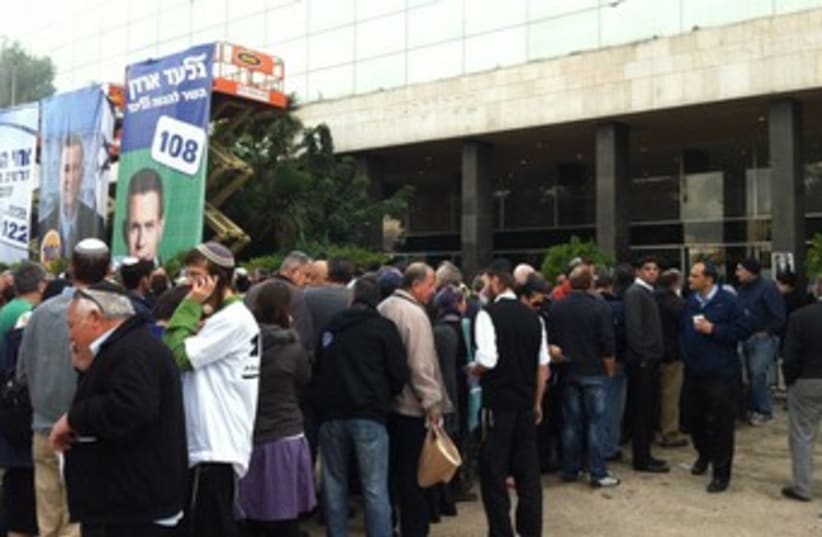
By REUVEN SHAPIRALong line at Likud primary 370(photo credit: Lahav Harkov)
According to an article in Haaretz on November 30, Israel’s political primaries are “ruled by party hacks,” while concomitantly Yediot Aharonot described how primary votes were bought by a fictional candidate in the Likud primary and found that votes could have been bought in Labor primary.A Haaretz editorial subsequently suggested that the remedy would be having an “arrangement committee,” that is, a party leaders’ committee, choosing some of its candidates, with a primary deciding some others. Unfortunately this is a another failed Israeli idea, much like the 1990s invention of the direct election of the prime minister.One should ask: Why invent the wheel rather than learn from the US primaries and from other countries in which buying votes is negligible or even nonexistent? The Israeli primaries suffer from two defects: 1. Primaries are held on a different day for each party, hence one can vote in more than one primary, provided s/he is a registered and duespaying member in these parties.So-called vote contractors enlist primary voters for Party A among supporters of Party B, because the latter can, after a few days, vote in the primary of Party B as well – as long as there is someone to register them and pay dues for them. The vote contractors do it with money paid by candidates.A clear sign that many voters are not authentic party members are the large mismatches in specific places between the number of party primary voters and the number of votes the party receives in the general elections; often the former is twice the latter, or more. Logically the number of party members should always be much smaller than the number of those who vote for the party in the general election. If open primaries were held as in the United States, by the government, on one day for all parties, every citizen could take part and choose only among the candidates of one party, without having to be a member and pay dues. Then no vote contractor could use the same people in the primaries of two parties.2. Since only registered members vote, their number is only a small fraction of the number of party supporters, which invites vote contractors to manipulate voting. At the Labor Party primary 35,000 people voted, while, according to the polls, over half a million people are expected to vote for that party in the general election.If there were state-sponsored open primaries, instead of a limited number of party members who sometimes travel many kilometers to vote, there would be polling stations on every corner, as in the general election, and far more supporters of each party would vote; closer to the number of voters in the general election.In the 2008 US primaries there were 57 million voters compared to 131 million voters in the general election, i.e. 43 percent. If 43% of the Labor supporters voted in the primary, the impact of contractor deals that include at most 10,000 votes would be negligible among the 200,000 votes. Hence, candidates would not have paid for votes and the phenomenon would disappear.State-sponsored primaries have other advantages. Such primaries would make it possible to supervise the funding of intraparty election campaigning, which would also greatly limit the possibility of buying votes. Even more important is the possibility that such primaries will combine national with regional election of candidates.Experts agree about this issue and many reformers such as the 1980s “constitution for Israel” movement have tried to introduce some kind of regional elections of party candidates, beside national candidates. Regional elections have many advantages, hence they are held in most democratic countries, not only for the US Congress and UK Parliament. However, they may suffer from one disadvantage: The possible manipulation of regional borders by power-holders aimed at achieving supremacy, often called “gerrymandering” in the US.Only state-sponsored primaries can cope with this problem by defining regional borders according to existing municipal borders and having all parties agree on them.This would largely neutralize specific interests. It will not eliminate all possibility of self-serving manipulations by power-holders, but can reduce them to minimum.HOWEVER, THERE is another major advantage of state-sponsored primaries: The possibility of introducing regional voting without entering the constitutional minefield which has bedeviled Israel for 64 years. Like other basic laws which were introduced in the 1990s (e.g., Human Dignity and Freedom), a basic law of primaries could introduce regional influences on Knesset membership and be adopted by a large Knesset majority without touching the sensitive issue of Knesset member regional elections.Small parties can agree to such a law despite their total opposition to the introduction of regional elections, since they believe such elections will reduce their power.Moreover, some Knesset members who are already largely supported by specific regions (e.g., ultra-Orthodox in Jerusalem) will support such a law since it will ensure their position within their party.There is another alternative to state-sponsored primaries, which is used in Norway: party committees deciding the candidates list but then having party voters choose who will enter the parliament from among these candidates by arranging their priority in the list at the polls.This system’s clear disadvantage is elimination of candidates unwanted by party leaders. In the recent Labor primary this system would have meant the elimination of some half of the chosen candidates. Thus, reforming the primaries is clearly preferable.US-educated Prime Minister Binyamin Netanyahu likes following many US policies, so why not follow it with our voting system?The author is a retired professor of sociology and anthropology.
if(catID != 151){
var cont = `Take Israel home with the new Jerusalem Post Store