Winston Churchill’s insight about challenge facing UN remains relevant – the organization can only be as effective as its member states.
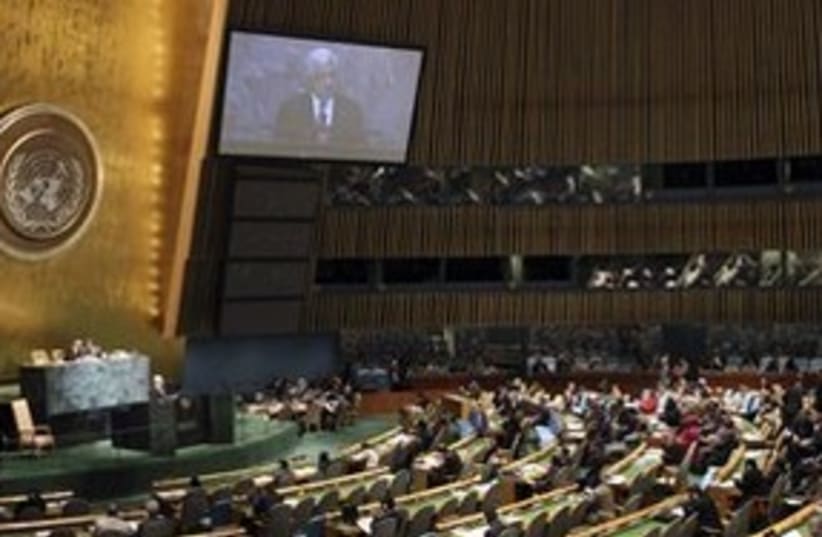
By MERON REUBENUN General Assembly 311(photo credit: ASSOCIATED PRESS)
Not long after helping found the United Nations, Winston Churchill cautioned an American audience to be vigilant in ensuring that the new world body served as “a true temple of peace... and not merely a cockpit in a Tower of Babel.” Sixty-four years later, Churchill’s insight about the fundamental challenge facing the UN remains just as relevant.After three months on the job as Israel’s ambassador to the UN, I have been able to see up close both the promise and plight of this important global institution. Every day the mission to the UN walks a fine line, voicing our concern when the world body strays from its founding vision, while at the same time looking for opportunities to meaningfully partner with the UN in ways that improve life around the world.Last month, we saw how UN politics can obstruct constructive dialogue as the General Assembly commemorated the “International Day of Solidarity with the Palestinian People” – a day that since its establishment in 1977 has done little to further its stated aim of helping Palestinians to realize peace, pursue prosperity and enjoy self-determination.Year after year, this observance ignores the reality of history and the facts on the ground to advance a distorted narrative about Israel that disregards the threat of terrorism facing our civilians, overlooks widespread anti-Israel incitement carried out by our Arab neighbors and perpetuates onesided notions of Palestinian victimhood, freeing them from responsibility to be a partner in peace.WHEN IT comes to Israel these are the unfortunate political dynamics of the UN General Assembly, which often seems to be held hostage to groups of states that join together to condemn Israel regardless of the circumstance.After 33 years, one would think that these nations might finally be able to see the bigger picture, recognizing that the best way to support Palestinian welfare is to play a constructive role in realizing a two-state solution.But instead of working to bring the parties together in negotiations and preparing the Palestinians to take the bold actions that will be required to reach a peace agreement, these countries prefer to seize the opportunity to score cheap political points.As Israel’s leaders have made clear since the rebirth of our ancestral homeland in 1947 – and proven through our historic agreements with Egypt and Jordan – we believe that it is both necessary and possible to live in peace with our neighbors.But it takes two to tango.While it has been very encouraging to see the emergence of Palestinian leaders committed to establishing security and promoting economic growth in the West Bank, these same leaders continue to refuse to sit with Israel in negotiating a peace agreement.At the same time, Hamas – an extremist Islamist organization committed to Israel’s destruction – continues to rule in the Gaza Strip, holding the Palestinian population hostage and exposing Israeli civilians to the daily threat of rocket and terror attacks.It is clear that there are major challenges, but also historic opportunities before us to achieve peace in our region. This should be a fitting moment for the UN to play a constructive role.Unfortunately, the UN can only be as effective as its member states, many of which continue to lack Churchill’s foresight – or share his beliefs – about the most productive way to use the institution.All too often, the cynical politicization of bodies like the General Assembly detracts from the UN’s credibility as an objective international forum to resolve conflict and distracts from the vitally important work that it carries out all over the globe, taking away valuable time needed to deal with pressing issues like global poverty and hunger, human trafficking, universal access to clean water and HIV/AIDS.Israel continues to show that it has much to share in these efforts, whether it is by deploying police officers and medical personnel as part of the UN mission in Haiti or offering our unique expertise in agriculture in pursuit of the organization’s Millennium Development Goals.Let’s hope that the international community will again take stock of Churchill’s prophetic words from more than six decades ago and work to build UN institutions that effectively advance the causes of global peace and stability.In the interest of our region, for the sake of our people and in respect of our nation’s fundamental values, Israel is prepared to play its part in this effort.The writer is ambassador to the United Nations.
if(catID != 151){
var cont = `Take Israel home with the new Jerusalem Post Store