Make the case. Go large. About a foreign policy in ruins. About an archaic, 20th-century welfare state model that guarantees 21st-century insolvency.
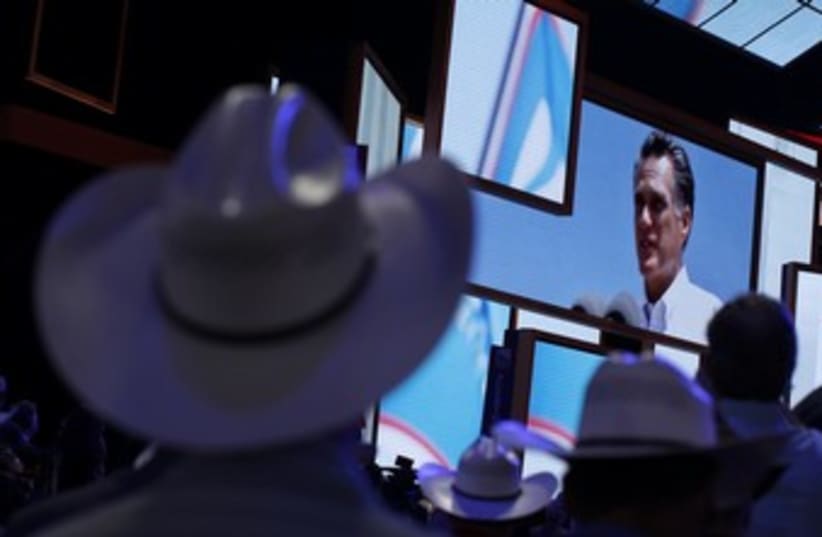
By CHARLES KRAUTHHAMMERMitt Romney on screen (R370)(photo credit: REUTERS/Shannon Stapleton)
WASHINGTON, DC – In mid-September 2008, Lehman Brothers collapsed and the bottom fell out of the financial system. US President Barack Obama handled it coolly.John McCain did not. Obama won the presidency. (Given the country’s condition, he would have won anyway.But this sealed it.) Four years later, mid-September 2012, the US mission in Benghazi went up in flames, as did Obama’s entire Middle East policy of apology and accommodation. Obama once again played it cool, effectively ignoring the attack and the region-wide American humiliation.“Bumps in the road,” he said.Nodding tamely were the mainstream media, who would have rained a week of vitriol on Mitt Romney had he so casually dismissed the murder of a US ambassador, the raising of the black Salafist flag over four US embassies and the epidemic of virulent anti-American demonstrations from Tunisia to Sri Lanka to Indonesia.Obama seems not even to understand what happened. He responded with a groveling address to the UN General Assembly that contained no less than six denunciations of a crackpot video, while offering cringe-worthy platitudes about the need for governments to live up to the ideals of the UN.The UN being an institution of surpassing cynicism and mendacity, the speech was so naive it would have made a fine middle school commencement address. Instead, it was a plaintive plea by the world’s alleged superpower to be treated nicely by a room full of the most corrupt, repressive, tin-pot regimes on earth.Yet Romney totally fumbled away the opportunity.Here was a chance to make the straightforward case about where Obama’s feckless approach to the region’s tyrants has brought us, connecting the dots of the disparate attacks as a natural response of the more virulent Islamist elements to a once-hegemonic power in retreat.Instead, Romney did two things.He issued a two-sentence critique of the initial statement issued by the US Embassy in Cairo on the day the mob attacked. The critique was not only correct but vindicated when the State Department disavowed the embassy statement. However, because the critique was not framed within a larger argument about the misdirection of US Middle East policy, it could be – and was – characterized as a partisan attack on the nation’s leader at a moment of national crisis.Two weeks later at the Clinton Global Initiative, Romney did make a foreign-policy address. Here was his opportunity. What did he highlight? Reforming foreign aid.Yes, reforming foreign aid! A worthy topic for a chin-pulling joint luncheon of the League of Women Voters and the Council on Foreign Relations.But as the core of a challenger’s major foreign-policy address amid a Lehman-like collapse of the Obama Doctrine? It makes you think how far ahead Romney would be if he were actually running a campaign. His unwillingness to go big, to go for the larger argument, is simply astonishing.For six months, he’s been matching Obama small ball for small ball. A hitand- run critique here, a slogan-of-the- week there. His only momentum came when he chose Paul Ryan and seemed ready to engage on the big stuff: Medicare, entitlements, tax reform, national solvency, a restructured welfare state. Yet he has since retreated to the small and safe.When you’re behind, however, safe is fatal. Even his counter-punching has gone miniature. Obama has successfully painted Romney as an out of touch, unfeeling plutocrat whose only interest is to cut taxes for the rich. Romney has complained in interviews that it’s not true. He has proposed cutting tax rates, while pledging that the share of the tax burden paid by the rich remains unchanged (by “broadening the base” as in the wildly successful, revenue- neutral Reagan-O’Neill tax reform of 1986).But how many people know this? Where is the speech that hammers home precisely that point, advocates a reformed tax code that accelerates growth without letting the rich off the hook, and gives lie to the Obama demagoguery about dismantling the social safety net in order to enrich the rich.Romney has accumulated tons of cash for 30-second ads. But unless they’re placed on the scaffolding of serious speeches making the larger argument, they will be treated as nothing more than tit for tat.Make the case. Go large. About a foreign policy in ruins. About an archaic, 20th-century welfare state model that guarantees 21st-century insolvency. And about an alternate vision of an unapologetically assertive America abroad unafraid of fundamental structural change at home.It might just work. And it’s not too late.Charles Krauthammer’s email address is letters@charleskrauthammer.com. (c) 2012, The Washington Post Writers Group
if(catID != 151){
var cont = `Take Israel home with the new Jerusalem Post Store