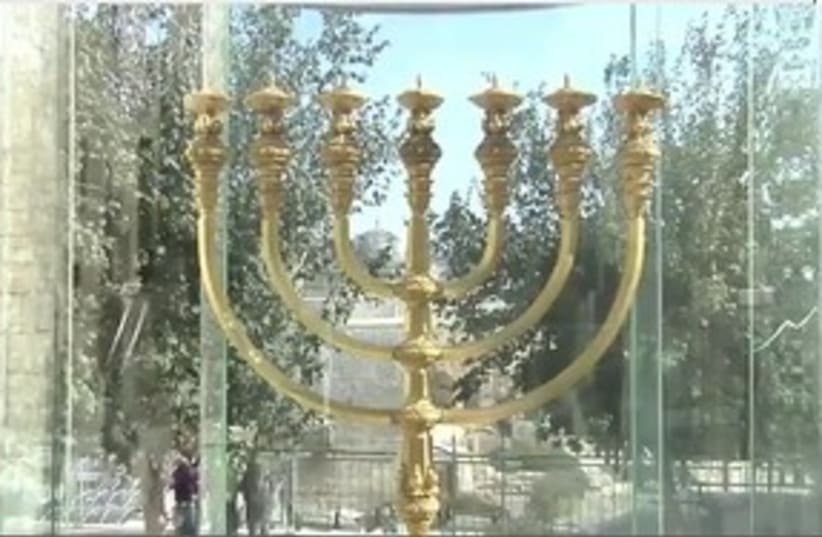
The Parker mission failed to find the golden Menora, but cleared Hezekiah’s Tunnel while looking for it.
By STEPHEN GABRIEL ROSENBERGGold Menorah 311(photo credit: courtesy/itraveljerusalem)
Just over a hundred years ago, in August 1909, a luxury yacht sailed into Jaffa harbor. It carried Captain Montague Parker and a group of his friends, with some rudimentary mining equipment and a stash of pounds sterling. Parker was on his way to Jerusalem to find the treasures of Solomon’s Temple that, he had been told, were hidden in a secret passage under the Temple Mount.Montague Parker had been an officer in the Grenadier Guards and distinguished himself in action during the Boer War in South Africa. He had risen to the rank of major but retained his substantive rank of captain, that being better known to the world at large. At the end of the war he was at a loose end and happened to meet a Finnish amateur Bible scholar called Valter Juvelius, who had researched arcane Hebrew and other documents and come to the conclusion that the Temple artifacts were to be found in a secret location in Jerusalem. All he needed was the money to mount an expedition to search for the ancient treasures.Parker was interested and agreed to raise the funds if he could lead the enterprise.Being the nephew of the Earl of Morley, Parker had aristocratic connections and was able to raise the necessary sum of £50,000 – equivalent to several million pounds today. The sponsors would receive their share of the rich findings; the Ark of the Covenant alone was considered to be worth 20 times the sum needed for the expedition.Once the money was in hand, Parker went to Constantinople to get the necessary “firman” or permit to start the dig near the Temple Mount, which he obtained by judicious bribery. He also persuaded two of the underpaid Ottoman officials to come to Jerusalem, for the princely sum of 200 Turkish pounds per month, plus a share of the booty, to supervise the work.All was now ready to go. From Jaffa the team rode to the recently completed Augusta Victoria Hospice on the Mount of Olives to set up their base. The grand building had recently been completed in honor of the consort of the German kaiser, who had ridden on horseback into the Old City, through the enlarged Jaffa Gate, in 1899.With the help of his two Turkish supervisors, Parker and his men claimed an area of ground near the entry to the Gihon water system, known at the time as the Virgin’s Spring, which was then fenced off and guarded by Turkish troops, who did not allow entry to any locals or other visitors. The Jerusalem Pasha Azmey Bey had been suitably bribed to turn a blind eye to the work.Parker’s activity naturally aroused the intense concern of the local archeological community. The Germans, French and British all had their missions in Jerusalem, but Parker would give out no communication and allow no inspection. His men proceeded with the digging, but they were amateurs and it went slowly and with little result.Back in London, the Finnish scholar Juvelius had hired an Irish medium, who studied the documents and sent directions to the team about suitable locations. He advised Parker to search the long water tunnel, so Parker sent to London to obtain the services of two mining engineers who had worked on the Metropolitan Railway, the first line of the London Underground. Then he made another excellent move.He persuaded Père Louis-Hughes Vincent of the Sainte-Etienne Ecole Biblique in Jerusalem to join the team and guide them through the water channel, known as Hezekiah’s Tunnel, where the Irish medium had reported they would find a secret passage to lead them to the treasure under the Temple Mount.Père Vincent was professor of archeology at the famous French school and was known locally as the pre-eminent expert on the archeology of Palestine. His presence on the dig gave it immediate respectability in the eyes of the local archeological missions.THE WATER tunnel had been discovered 70 years earlier, but the first genuine explorers crawled through it only 30 years later. They were Lt. Charles Warren and Sgt. Birtles of the Palestine Exploration Fund, who braved a tunnel full of silt, debris and rotting domestic waste. Parker decided to have it fully cleared to enable him to find the secret passage. Vincent agreed to join the expedition as he saw this as a once-and-for-all opportunity to examine the tunnel in detail, which would be a great contribution to the archeology of Jerusalem.When Warren and Birtles had gone through the tunnel in 1867, they had had to proceed on all fours, with compass, notebook, pencil and candles held in their firmly clenched teeth, as they crawled through on their bellies, all the time in danger of being overwhelmed by a rush of water and refuse.Nevertheless, Warren managed to make a reasonable survey of the tunnel and to discover several passages at the Gihon end, one of which is still known as Warren’s Shaft. Père Vincent was able to follow the same trail, but he did it in relative comfort after Parker’s men had cleared the full half-kilometer length of tunnel. Vincent was happy, but not so Parker, as no secret passage leading under the Haram es-Sharif had come to light.The survey that Vincent conducted was a fully accurate piece of work and he very shortly after published his plans and a detailed account of his findings in French, closely followed by an English version in 1911. That publication is still considered to be the standard work on the layout of the tunnel.The clearing of the tunnel was useful to Vincent and all students of ancient Jerusalem. But it was of little use to Parker, who now telegraphed London desperately for more guidance. The reply came that Parker was to start work on the Temple Mount itself, at the southeast corner in the area of the socalled Solomon’s Stables. This called for further bribery, but that did not deter Parker.He and his men worked for several clandestine nights on the Mount with little success, and the Irish medium now advised them to start digging in the Cave of the Spirits itself.This was the cave under the Even Shetiya, the Foundation Stone in the center of the Dome of the Rock from which, by tradition, Muhammad had ascended to Heaven on his steed El-Burak, and on which, two thousand years earlier, Abraham had prepared to sacrifice his son Isaac.There was an ancient tradition that within the cave there was a shaft, known as the Shaft of the Spirits, that led down to a secret hoard of fabulous treasure, and it was this that Parker now had to find. Luckily both the Jerusalem pasha and the guardian of the Dome of the Rock, Sheikh Khalil, had been well bribed (but not the humble keeper, who guarded the Dome during the day).Parker proceeded on this tricky task one night in April 1911. Unfortunately for him, the keeper, who usually went home at night, decided to sleep in the Dome that night, as his house was packed with visitors for the Muslim festival at Nebi Musa (on the road to Jericho, from where the tomb of Moses could be sighted), which coincided with the Jewish Passover and the Christian Easter. So that night the city was full of visitors and pilgrims.The noise made by Parker and his men hammering and digging in the cave woke the superstitious keeper who, imagining ghosts and spirits, rushed to the cave to find it full of strange-looking workmen. He ran off screaming and shouting to raise the alarm and call the police.The story soon spread among the faithful milling around the Temple Mount and a large crowd attacked the guardian of the Dome of the Rock, who had been alerted and had come to restore order. But order was impossible as rumors spread that a group of infidels had infiltrated the cave and made off with the Crown of Solomon, the Ark of the Covenant and the sword of Muhammad.Taking advantage of the public furore, Parker and his men had quietly slipped out of the city and back to Jaffa. But the game was up as the police had telegraphed to Jaffa, where Parker and his men were apprehended, and became the focus of another angry crowd.Parker was able to show that he did not (unfortunately!) hold any of the assumed treasures and invited the police to come to his yacht that afternoon to search for the treasures and discuss the matter in peace and quiet.The officers agreed, but of course when they sailed out to the yacht, it had slipped anchor and was well out to sea. So ended the archeological career of Montague Parker and his merry men, and a mission that was doomed to failure in spite of the efforts of Valter Juvelius and his anonymous Irish medium, and the expenditure of large sums of the money of the British aristocracy.Nothing further is known of Parker, and how he dealt with his disappointed sponsors, but he left two legacies, good and bad.The first was the excellent work done by Père Vincent, whose survey and findings are still used by today’s archeologists. The second, the bad result, was the animosity created by the adventurers, now extended to genuine archeologists, which is one factor that makes it impossible for research to be conducted on the Temple Mount.Stephen Gabriel Rosenberg is a Senior Fellow of the W.F. Albright Institute of Archaeological Research, Jerusalem.
if(catID != 151){
var cont = `Take Israel home with the new Jerusalem Post Store