How about some religious freedom for Orthodox soldiers?
It seems that the media’s priority is to be hostile to, and to create hostility towards, the national religious community.
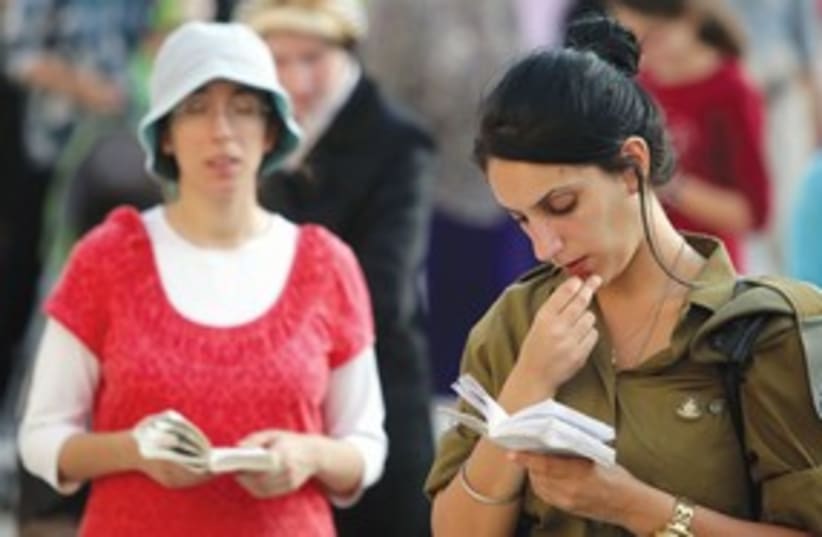
By AVICHAI RONSKY311_Army chick praying(photo credit: Marc Israel Sellem)
When I received the phone call, I couldn’t have imagined what was about to happen.On the line was a cadet in the IDF Officers’ Academy who told me he was facing disciplinary action for leaving an evening activity that included women singing. He and a number of other religious cadets had requested permission not to attend portions of the activity that offended their religious sensibilities, but the commanding officer refused to grant permission.The cadets disobeyed the order, left the hall when the female soldiers began singing and were now facing dismissal from the course and possible court martial.I was amazed. I served in the IDF for 40 years, both as a regular soldier and in the reserves. I’d never heard of a case like this.This event was neither a military activity nor an exercise.It was simply an evening of entertainment. What possible reason could there be to require religious soldiers to violate their understanding of halacha (Jewish law)? Where was the commander’s common sense? Former chief of staff Lt. Gen.(res.) Dan Halutz once told me that a soldier’s disobedience is his commander’s problem. In this case, his words were most profound.I told the cadet that I thought he and his friends were wrong in to have left the hall. Listening to women sing is not like desecrating Shabbat.There are practical ways to deal with such matters.However, I also told the commanding officer that by forcing the cadets to stay in the hall, he had made a serious mistake.THE MATTER should have stopped there and then. It should have been a strictly internal issue, but it did not end there. To my great astonishment, the media continues to discuss the subject of women in the IDF, as if female soldiers are allowed to serve coffee to their male superiors and little more.
Almost every day we hear that extremism is on the rise and that exclusion of women is no less than an existential threat to the State of Israel. In the Orthodox world, too, religious Zionists reminisce fondly about the “good old days” when boys and girls in the Bnei Akiva youth movement used to dance and sing together – as though the explicit law in the Shulhan Aruch forbidding men to listen to a woman singing did not exist.When the leaders of this well-organized incitement campaign realized that the headlines on religious extremism had run their course, they raised the issue of exclusion of women in the IDF. All of this stemmed from one unfortunate incident in the Officers’ Academy.Exclusion of women? In the IDF? Not the one I served in.Has anyone ever stopped our military bands or entertainment troupes from appearing? No. Has anyone ever suggested that women be excluded from these units? No. The only thing that did occur was that some religious soldiers requested that they not be forced to attend such evenings (in keeping with the military regulations pertaining to religious inclusion).But the truth be damned. It seems that the media’s priority is to be hostile to, and to create hostility towards, the national religious community.I am deeply distressed over what is now happening among certain strata of our society. The so-called “elite” – primarily non-religious Ashkenazim living in the Center of the country in what is known as Medinat Tel Aviv (the State of Tel Aviv) – feel their position in the State of Israel is threatened by the national religious community.It is especially threatened by the young people who are gradually taking their places as military commanders and as leaders in economics, politics and law.When a few dozen young people commit serious crimes against the IDF, these “elite” demonize the whole national religious camp and call on the community to engage in self-examination.There are no similar calls for left-wing soul-searching in light of the weekly attacks on soldiers in Bil’in and Ni’lin, attacks led by leftist anarchists.Clearly, if these issues of “religious extremism,” “exclusion of women” and “right-wing violence” were to be dropped from the national agenda, they would be replaced by new issues criticizing the national religious public and portraying them as fanatical, impractical and certainly not relevant to public discourse.SO WHAT should be done in the face of these repeated attacks on us, the religious community? First, we must understand that these attacks are the death throes of a small but extremely militant community, a community that has a strong grip on academia and the media. In facing its demise, it kicks out in all directions.Moreover, we must continue our activities in all areas of public life. We must not panic when hearing the cries of despair from those groups mentioned above.We must not forget that the majority of Jews are still strongly, spiritually connected to rebuilding Eretz Yisrael, even if they are not actively engaged in doing so. We must find ways to bring them closer to faith and to the Jewish People’s great mission on earth. As the late chief Rabbi Abraham Isaac Kook said, this generation will progress to the final redemption in four stages: respect, affinity, recognition and fulfillment.I pray that respect for our way of life and affinity for it will soon bring the desire to recognize it, and that the light and beauty of the Torah way of life will thus lead to the fulfillment, the mitzvot.The writer is head of the yeshiva in Itamar and the former IDF chief rabbi.
if(catID != 151){
var cont = `Take Israel home with the new Jerusalem Post Store