Syrian air defenses downed a Turkish F-4 which was completely unarmed and flying solo on a test mission for Turkish national radar system.
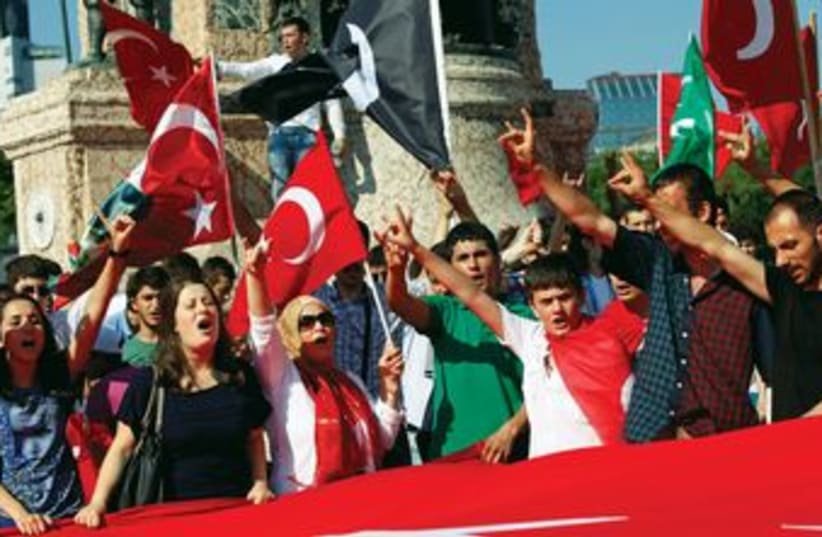
By CAN KASAPOGLUTurkish nationalists wave flags in Istanbul 370 (R)(photo credit: REUTERS)
On June 22, Syrian air defenses downed a Turkish F-4 which was completely unarmed and flying solo on a test mission for Turkish national radar system.Although Damascus declared the warplane had been flying over Syrian territorial waters, it was then revealed that the Turkish jet was shot down in international airspace. Turkey has now initiated a comprehensive diplomatic effort abroad, including a presentation before the North Atlantic Council on June 26, and Turkish Prime Minister Recep Tayyip Erdogan has informed the domestic opposition of the need for a national consolidation. Indeed, the ongoing crisis reflects a drastic shift in Turkish-Syrian relations, and the possible trajectory of the event will determine the relevance of Turkey’s regional leadership ambitions.DURING PROF. Ahmet Davutoglu’s era in the Turkish foreign ministry, Turkey shifted from its traditional “non–involvement in the Middle East” principle and isolationist stance. Davutoglu’s famous book Stratejik Derinlik largely dwells on the concept of redefining Turkey’s foreign policy priorities. Notably, under the subtitle of “an Unavoidable Hinterland: Middle East,” Davutoglu mentions that the Middle East region has been (and should be) defined well beyond the geopolitical unity but within the geocultural integrity which has been fostered by the Islamic civilization.Under the new paradigm, Ankara strived to improve political influence on Turkey’s Middle Eastern hinterland.Within the historical Ottoman territories, the new doctrine aimed to make territorial borders around Turkey “de facto meaningless.”In accordance with making borders de facto meaningless Ankara strived to boost its trade ties with the Middle Eastern nations, pursued economic integration through free trade zones, and cancelled visa requirements to provide mass cultural interaction and mobility.The Davutoglu doctrine seeks to transform the historical Ottoman territories in the Greater Middle East into a Turkey-centric free trade zone with high cultural interaction and free, unrestricted movement.Indeed, Syria was at the very center of the new Turkish foreign policy. Just three years ago, in 2009, Turkey and Syria established a high-level strategic cooperation council which even included joint cabinet meetings twice a year, and visa requirements between the two countries were canceled. Furthermore, Turkey’s socioeconomic integration policy and soft power charm offensives toward Syria were designed to achieve a level of postmodern integration which could have exceeded the classic nation state paradigm. However, things were about to change due to the turbulence in the Arab world.THE SYRIAN crisis is not Solely Syrian. In fact, when the “Arab Spring” was ignited in Tunisia and quickly brought about the demise of the Cold War remnant regimes of the Arab world, Ankara had high expectations about the relevance of the “Turkish model,” which is believed to successfully combine religious values and democracy.However, by the time the turbulence reached Bahrain and Syria, it was no longer either Arab or spring, but a sectarian struggle between the Shi’ite and Sunni sects of Islam.Iran, for that matter, characterized the Arab Spring as inspired by Khomeini and the Islamic Revolution from the very outset of the protests in Tunis, Egypt and Libya. However, when it came to Syria, Tehran reversed its stance radically, and has been backing its most important ally diligently. On the other hand, Turkey did not back the uprising in Bahrain in practice, but at present, Ankara is one of the most important protectors of the Syrian political and armed oppositions.Essentially, these sectarian divisions are not the result of a new wave of theological debate within Islam, but a military-political rivalry between the two blocs. In the Sunni bloc, now Turkey strives to lead the Gulf States due to its regional hegemony agenda and growing national capacity. On the other hand, the Shi’ite bloc’s natural leader is Iran. Briefly, the new status quo rendered abortive the Davutoglu doctrine’s imperial vision, which is not sectarian in nature, and dragged Turkey into being a Sunni actor of the Middle East.WITHOUT A doubt, the troublesome economy of Europe and the forthcoming elections in the United States are leaving Ankara alone in its struggle against the Syrian Baathist dictatorship’s bloody crackdown.Furthermore, the Gulf States’ economic capacity is able to finance the Syrian opposition but does not offer a robust military assistance.Therefore, by shooting down the Turkish fighter jet, it is argued, Damascus aimed to take advantage of the current situation in which Syrian tyranny in enjoying a stalemate between regional and global powers, to send a message to political and armed opposition by questioning Turkey’s capability. The move is a demonstration of defiance toward Turkish involvement in the Syrian turmoil, and in the larger context, Turkey’s regional leadership ambitions. Besides, it is obvious that Damascus would have not been that audacious if the target was an Israeli fighter jet.THEORETICALLY, THE clash between Turkey and Syria is tantamount to a clash between the normative idealism of Ankara’s ambitions and the pragmatic realism of the Baathist dictatorship’s survival strategy. However, in the Middle East, a state which responds to military aggression with rhetoric and condemnation cannot claim regional leadership.It is a tough environment with constant low-intensity conflicts, and conventional wars take place nearly in every decade. Put simply, if Assad now does not feel as worried as he would if his air defenses had downed a British or an Israeli warplane, or an American one, Turkey’s regional leadership ambitions are tantamount to empty talk.For instance, in 1998, during the expulsion of Abdullah Ocalan, the currently imprisoned leader of PKK terrorist organization, Hafez Assad stepped back by giving way to Turkish gunboat diplomacy. However, Iran’s mounting political-military profile and Russia’s rise under Putin now constitute a different security environment than the one that existed in the 1990s.Nevertheless, the recent escalation might be a game-changer regarding the possible trajectory of Turkish- Syrian tensions. The incident may dramatically shift Turkish public opinion, which currently opposes war with Syria. The pilots are still missing; if they were killed, the traditional religious-nationalistic martyrdom cult of the Turkish culture would garner support of masses demanding Assad be payed back.Although mainstream Turkish media favors muddle-through efforts, as it generally does, there is no middle course for Ankara in the final analysis. Therefore, in the following weeks we may either witness a military intervention against Damascus, which would be spearheaded by Turkey and may trigger a regional clash, or the downfall of Turkey’s neo-Ottomanist ambitions along with Ankara’s return to the classic isolationist policy. No one would bow before a sultan who tolerates such an insult.The writer, who served as a post-doctoral fellow for the Begin Sadat Center for Strategic Studies in Israel, holds a PhD from the Strategic Researches Institute at the Turkish War College, and a Master’s degree from the Turkish Military Academy.
if(catID != 151){
var cont = `Take Israel home with the new Jerusalem Post Store