The Jerusalem Post
Jpost search icon google-icon iphone
  Set as Homepage
Wed, Jun 19, 2013   11 Tammuz, 5773
newspapers magazines
 
    • Breaking News
    • Diplomacy & Politics
    • Defense
    • National
    • Mideast
    • Syria
    • Iran
    • World
    • Business
    • Sports
    • Health & Science
    • Environment
  • Video
  • Opinion
    • Columnists
    • Editorials
    • Op-Eds
    • Letters
  • Jewish World
  • Lifestyle
    • Arts & Culture
    • Food & Wine
    • Travel
  • Features
    • Insights & Features
    • Week in review
    • On the Web
    • Shalva Superheroes
    • Obama in Israel
  • Blogs
    • In the news
    • Judaism
    • From the Middle East
    • Lifestyle
    • Aliya
    • Science and Technology
  • JPost Apps
    • iPhone app
    • iPad app
    • Android app
    • Twitter
    • Facebook
    • RSS feeds
    • JPost Toolbar
    • JPost Newsletter
    • JPost Alert
  • Premium Zone
    • The Jerusalem Report
    • Magazine
    • Metro
    • In Jerusalem
    • ePaper
    • Expert Opinion
    • Q&A
    • Dash
    • Christian Edition
    • Ivrit
  • French
    • Politique & Social
    • Affaires Palestiniennes
    • Diplomatie & Monde
    • Art & Culture
    • Israel
  • Green Israel
JPost Learn Hebrew  
Advertise with us  
Nefesh Guided Aliyah  
Eldan  
AFMDA  
YTA  
Isram Group  
JPost Twitter  
JPost Facebook  
Classifieds  


Breaking News
 
 
  • JPost.com
  • Opinion
  • Op- Ed Contributors
 

Israel should retake Philadelphi

By DANIEL MANDEL
08/12/2012 22:09
Tweet

Egyptian forces will be brutal on terrorists that attack them, but will not interfere with Hamas and other forces bringing weaponry into Gaza.

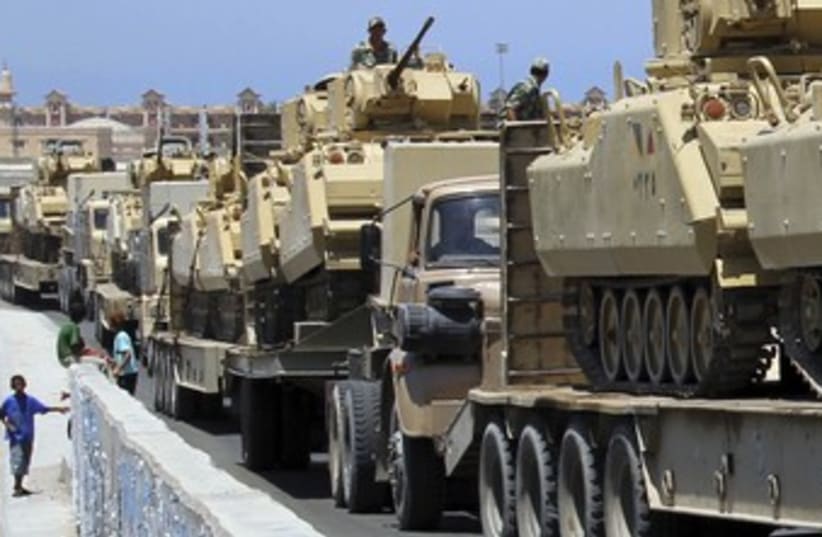
Egyptian tanks arriving in Sinai city of Rafah
Egyptian tanks arriving in Sinai city of Rafah Photo: Mohamed Abd El Ghany / Reuters
Last week’s failed attack from the Sinai peninsula, in which terrorists killed Egyptian soldiers, was extraordinary. Terrorists operating out of Gaza do not usually attack Egyptians. They can obtain arms and materiel by sea, but the Israeli navy stops this most of the time.

That leaves the tunnels beneath the Philadelphi Corridor, the narrow strip of southern Gaza that borders Egypt. Israel left the Philadelphi Corridor in 2005 when it unilaterally evacuated Gaza. In the wider interest, as well as its own, it should retake the Philadelphi Corridor with dispatch.

The evidence that it should do so is abundant.

First, there was never a sound reason to leave the corridor. It occurred purely as an unintended byproduct of a flawed Israeli decision to leave Gaza. This unilateral withdrawal was widely criticized by the most senior military and security figures, including the former and then-serving heads of the Shin Bet (Israel Security Service), the former IDF chief of staff, deputy chief of staff and chief of IDF Intelligence, and two former heads of the Mossad.

Even so, leaving Philadelphi was not part of the original plan. That outcome was due to unexpectedly strong pressure from the George W. Bush administration, secretary of state Condoleezza Rice in particular. In short, even those who supported the unilateral withdrawal did not reckon on relinquishing control of the Gaza/Egypt border.

Second, following the withdrawal, the evidence rapidly accumulated that the system of Egyptian troops, Israeli intelligence and international monitors instituted to replace direct Israeli supervision of the border was no substitute. Instead, there was an exponential increase in the quantity of offensive weaponry entering Gaza from Egypt.

Already in 2006, the former OC Southern Command, Maj.-Gen. Doron Almog, said that “there is a need for a permanent IDF presence in the area,” while the late doyen of military analysts, Zeev Schiff, observed that “even though Israel’s security and intelligence services have given the Egyptians a list of the names of those involved in the gun running... in practice nearly nothing is being done to prevent large-scale smuggling through the Philadelphi Route.”

Third, alterations last year to the security annex of the Egyptian/Israeli peace treaty to enable Egypt to deploy a further 2,500 troops in Sinai, in addition to the 700 already on the border, have achieved nothing. The reason is not hard to find and indeed is even more obvious now than when the annex was altered: the Egyptian forces are too much in sympathy with the terrorists and too loath to clash with Hamas to engage in a thorough- going campaign of terrorist suppression.

Egyptian forces will be brutal on terrorists that attack them, but will not interfere with Hamas and other forces bringing weaponry into Gaza.

It is therefore not a matter of troop numbers but of will. Where the efforts to stamp out the traffic in men and arms are tepid, grudging and spasmodic, large battalions will not avail. And nothing – least of all the change of regime in Cairo – suggests that the willpower that was once lacking has been found.

Fourth, the recent murderous attack on Egyptian soldiers underscores all of the foregoing, while providing Israel with an opportune moment to act. The security threats from Gaza to Israel have multiplied. Terrorism emanating from Sinai has also reared its head. Last August, it claimed Israeli lives; this August, Egyptian lives. Border clashes between Israel and Egypt, once a rare occurrence, look like becoming routine. All such incidents carry the risk of putting the nail in the coffin of Egyptian/Israeli peace treaty and even producing a war.

Accordingly, the case is strong: without having to clash with an internationally recognized regime holding authority in Gaza by treaty, without resuming control of Palestinian civilians, and to the mutual benefit of Israel and Egypt – admittedly a benefit Mohamed Morsy and the Brotherhood would rather forfeit – Israel can reoccupy the Philadelphi Corridor. It would then be able, as it once was, to reduce drastically the traffic of men and arms into Gaza.

Egypt will find the means to protest this development, but it is hard to see how it can make much hay of it. In any case, a more tightly sealed Hamas is a weaker Hamas, one for which there are fewer reasons for Egypt to stick out its neck to help. And a Gaza that is deprived of weaponry in time becomes a far more containable and reducible threat to Israel. International criticism of any such Israeli move will be hamstrung for lack of any serviceable rationale justifying its stance. There is little scope to protest cutting off the traffic in terror that helped produce last week’s attack.

The writer is a Fellow in History at Melbourne University and director of the Zionist Organization of America’s Center for Middle East Policy.
  • Send
  • Large
  • Small
  • Print
  • Share
Most Viewed in
1
Iran's new fanatic-in-chief
2
Gezi Park protests: The AKP's battle with Turkish society
3
The Iranian election: Have the people really won?
4
Chief rabbi battle
JPost Community
Tweet
Sinai Gaza IDF Philadelphi Egyptian Morsy
Tweets about "#jpost"
Share this article
Tweet
Share
Send
Your comment must be approved by a moderator before being published on JPost.com. Disqus users can post comments automatically.

Comments must adhere to our Talkback policy. If you believe that a comment has breached the Talkback policy, please press the flag icon to bring it to the attention of our moderation team.
JPost Services
conferenceConference
newsletterNewsletter
iphoneMobile Apps
kotelcamKotel Cam
kolboJPost Alert
premiumPremium
JPost TV News  
Mobile Apps  
Bank Hapoalim  
Meir Panim  
Israel Law Center  
Inbal Hotel Jerusale  
Meier on Rothschild  
Weizmann Institute o  
JPost Premium Zone  
JPost kotel Camera  
         
 
Israel Focus
JPost TV News
Watch Now!  
Donate to Save Lives in Israel
 
Israel Law Center
The ultimate Mission to Israel, October 21 – 28, 2013 Register now!  
Nefesh B'Nefesh Guided Aliyah
Already living in Israel? Enjoy the Benefits of Aliyah!  
One year International MBA
in English, Bar-Ilan University, Israel – Open House July 9, 2013, 17:30  
Give "Freedom" this Passover
to needy Israeli families. Donate now  
YTA – A Yeshiva in Israel…
in English. Come Join Us  
War Threatens
Protect the People of Northern Israel  
Bank Hapoalim
Israeli's number one bank  
Jerusalem Post Lite
Lite Edition of the Jerusalem Post for English improvement  
Learn Hebrew with us
Get 10 minutes free personal coaching in Hebrew through phone or Skype  
JPost newspapers
Sign up for the JPost newspapers and receive one month free subscription  
Kosher English Magazine
English language weekly magazine - especially for religious people  
JReport Kindle Edition
Now you can get the Jerusalem Report directly to your Kindle  
JPost Premium Edition
The very best articles are available only in our Premium edition  
Lifestyle Magazine
 
 
Real Estate
Meier on Rothschild
Tel Aviv's Most Prestigious Address  
Don't Look For a House!
In Israel, our website will do it for you!  
 
Travel
Tourism Magazine
June 2013  
The Inbal Jerusalem Hotel
Hot summer deal, order now!  
Eldan Rent a Car
20% off all Car Rental Reservations in Israel  
Hertz Car Rental
Special Online Discounts!  
The King David Jerusalem Hotel
One of the world's truly iconic hotels, and a Jerusalem landmark  


Sites Of Interest:

Jerusalem Hotels
KKL-JNF
Poalim Online
BreitBart.com
Our Friends
Jerusalem Attractions
Jerusalem Tours
itraveljerusalem.com

JPost sites:

Learn Hebrew
The Jerusalem Report
Our Magazines
JPost Edition Francaise
Green Israel
Christian World
Jerusalem Post Lite

Services:

JPost Mobile Apps
JPost Premium
JPost Newsletter
JPost Toolbar
JPost News Ticker
JPost RSS feeds
JPost Archives
JPost Alert
JPost Kotel Cam

JPost Conferences:

NYC Conference
Diplomatic Conference

Information:

About Us
Feedback
Staff E-mails
Copyright
Sitemap
News Partners
Advertise with Us
Statistics
Ad Specs
Terms Of Service
Jpost.com, the online edition of the Jerusalem Post Newspaper - the most read and best-selling English-language newspaper in Israel. For analysis and opinion from Israel, the Jewish World and the Middle East. Jpost.com offers expert and in-depth reporting from Israel, the Jewish World and the Middle East, including diplomacy and defense, the Palestinian-Israeli conflict, the Arab Spring, the Mideast peace process, politics in Israel, life in Jerusalem, Israel's international affairs, Iran and its nuclear program, Syria and the Syrian civil war, Lebanon, the Palestinian Authority, the West Bank and Gaza Strip, Israel's world of business and finance, and Jewish life in Israel and the Diaspora.
 
About Us | Advertise with Us | Subscribe | Premium | Newsletter | RSS | Contact Us
 
All rights reserved © The Jerusalem Post 1995 - 2012