Jewish leader to FDR: Don’t send New Year greetings
Rabbi Silver critical of President Roosevelt's Jewish refugee policy in 1930s Palestine, says many more should have been rescued.
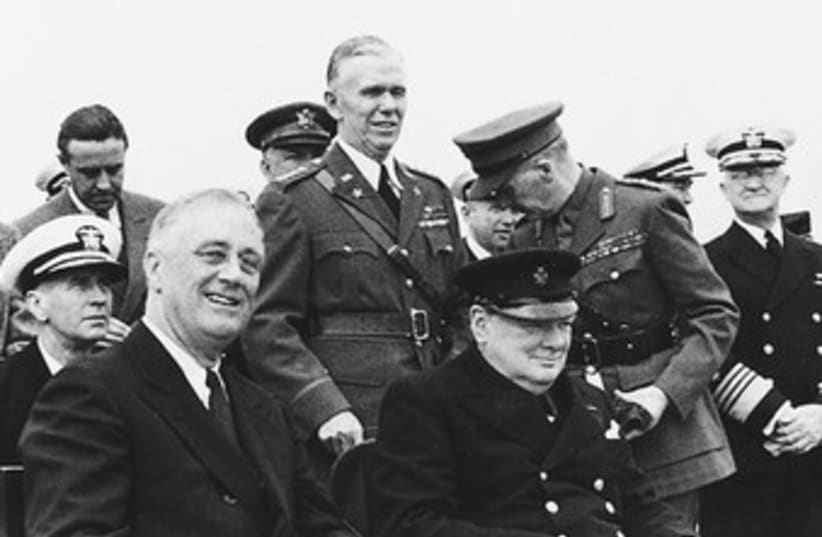
By RAFAEL MEDOFFRoosevelt and Churchill(photo credit: Reuters)
Every year, on the eve of Rosh Hashana, American political leaders, candidates for office and other VIPs send the Jewish community their wishes for a happy new year.Although these boilerplate messages consist of general platitudes, without reference to any of the actual issues or problems troubling American Jewry, Jewish leaders respond with fulsome expressions of gratitude. But in 1943, one Jewish leader decided that sympathetic words without accompanying action would no longer do. A Holocaust was raging. Enough was enough.Rabbi Stephen S. Wise, leader of the American Jewish Congress, World Jewish Congress and American Zionist movement, was the most prominent and influential of Jewish leaders of the 1930s and 1940s. He was also deeply attached to President Franklin D. Roosevelt, the New Deal, and the Democratic Party. Wise sometimes privately referred to FDR as “the All Highest,” “the Great Man,” or other terms of reverence.“I still repeat the new American Hosanna, ‘Thank God for Franklin D. Roosevelt,’” Wise declared after reading the president’s Rosh Hashana greeting to American Jewry in 1938.But by 1943, there was a growing sense of disappointment in the Jewish community over the Roosevelt administration’s insistence that nothing could be done to rescue Jews from Hitler.FDR’s aides claimed, for example, that no ships were available to transport refugees – but a Baltimore Jewish Times editorial pointed out that empty troop-supply ships were “frequently going out of their way to find ballast” to weigh them down on their return trips, and that the Allies had managed to find ships to bring tens of thousands of Polish refugees to Iran, Uganda and Mexico.The administration asserted that refugees would take jobs away from Americans – but Congressman Samuel Dickstein revealed in a radio address that the Department of Agriculture was spending $30 million “to import into this country Mexican and other residents of this hemisphere to help to relieve our labor shortage.”US officials said that the immigration quota system prevented admitting more refugees – but immigration “has for years been held far below the legal quotas” by the administration as a matter of policy, the World Jewish Congress charged. “[T]he admission of immigrants has been obstructed by the piling up of formalities, questionnaires [and] inquiries... The whole thing could be summarily dropped, fully or in part, by a simple order of the chief executive.”On May 1, 1943, American and British officials were concluding the proceedings of their conference in Bermuda on the refugee problem. It was clear that no concrete rescue plans would emerge.That evening, at a Zionist conference in Philadelphia, Rabbi Abba Hillel Silver of Cleveland delivered the sharpest public challenge yet to President Roosevelt’s Jewish refugee policy.A rising star in the American Zionist leadership and an advocate of greater activism, Silver was critical of Rabbi Wise and other FDR supporters for accepting the White House’s excuses on rescue. In his keynote address at the United Palestine Appeal’s national conference, Silver pulled no punches.“Our former friends in government circles” – note Silver’s use of the term “former” – “content themselves with sending us prolific expressions of sympathies on Jewish persecution,” Silver complained.“When pressed to do something about it, they regretfully remind us how difficult it is to do anything for these unfortunate people under present war conditions.”“The whole subject of a Jewish homeland in Palestine has suddenly become taboo in Washington,” Silver charged. The president’s most recent holiday message to the Jewish community “quite pointedly, and not by accident, omit[ted] any mention whatsoever of Palestine.”“We’ve had enough Rosh Hashana greetings from the president of the United States,” Silver declared. We’d like to see some action on the matters which mean the most to us.”Sadly, Rabbi Silver’s appeal fell on deaf ears. When Rosh Hashana rolled around in September 1943, President Roosevelt sent another vague greeting to American Jewry.Five days later, 400 rabbis marched to the White to House to plead for rescue; FDR refused to meet with their leaders. Three weeks after that, Allied leaders meeting in Moscow issued a statement deploring Nazi atrocities against a long list of occupied nations – but omitting the Jews.To get the action that Silver wanted, Jews would have to take matters into their own hands. At the end of 1943, a campaign of newspaper ads, rallies and Capitol Hill lobbying by the activist Bergson Group brought the rescue issue to the front pages. The Bergson pressure, combined with behind-the-scenes efforts by Treasury Department staffers, eventually forced President Roosevelt to establish the War Refugee Board, a government agency to rescue Jews from the Nazis.Although understaffed and under-financed, the War Refugee Board helped save an estimated 200,000 Jews during the final 15 months of the war. Had FDR created it sooner, instead of contenting himself with sending the Jewish community pleasant Rosh Hashana greetings, many more would have been rescued.The writer is director of The David S. Wyman Institute for Holocaust Studies, and coauthor, with Prof. Sonja Schoepf Wentling, of the new book Herbert Hoover and the Jews: The Origins of the “Jewish Vote” and Bipartisan Support for Israel.
if(catID != 151){
var cont = `Take Israel home with the new Jerusalem Post Store